

What happens when a local congregation wants to disaffiliate from its denomination but keep the church land, buildings and bank accounts?
That question is being pursued in West Virginia’s judicial and legislative branches.
At the core is a dispute between the West Virginia Conference of the United Methodist Church and 33 local congregations seeking to disaffiliate while retaining their property. The local churches are being supported by an organization called the National Center for Life and Liberty.
The local churches have sought to leave the United Methodist Church because of “issues of conscience” following shifts in the denomination’s policies on human sexuality, particularly over the issues of same-sex marriage and allowing openly gay people to act as ordained clergy.
The United Methodist Church had a disaffiliation process allowing churches to leave and keep property after fulfilling specific financial obligations, such as pension liabilities. that expired Dec. 31, 2023. While the process was open over four years, about 25% of UMC congregations, more than 7,600 churches, moved to split from the denomination.
Some congregations that disagree with the UMC’s direction but did not disaffiliate before the deadline are still trying to find ways to exit with their church property, leading to ongoing denomination-versus-local-church litigation.
The United Methodist Church maintains that all local church property is held in an irrevocable trust for the benefit of the entire denomination, a principle known as “connectionalism.”
The local churches counter that they paid for, maintained and insured the property, and that the Conference’s attempt to seize it constitutes unjust enrichment and a deprivation of their contractual rights.
A major part of the legal battle is over whether a secular court has the authority to hear the case.
In the court system
The state Supreme Court last month granted oral arguments in an ongoing dispute between the church entities. The oral arguments, which would likely be this fall, have not yet been scheduled for a particular date.
Justices will be examining what has already happened in the lower court.
In Mercer County, the first circuit judge assigned to the case, Ryan Flanigan, originally dismissed the local churches’ claims late last October, citing the First Amendment and the ecclesiastical abstention doctrine that prohibits civil courts from interfering in the internal governance, discipline,or religious law of a hierarchical church.
Judge Flanigan ruled that the church’s high judicial council has final authority over property trusts and separation protocols.
However, early this year, Judge Flanigan recused himself by saying he had a “conflict in presiding over this matter” that was not publicly specified.
The matter was transferred to Judge Mark Wills, who reinstated the case on March 13.
“As there are, indeed, allegations of fraud and collusion, the Court believes that those are questions of fact for a jury,” Wills wrote in his order.
The West Virginia Conference of the United Methodist Church responded by filing a petition with the state Supreme to try to block the circuit judge from proceeding with the case, arguing he lacked the constitutional authority to review these church decisions.
The question being asked of the justices is:
Whether the First Amendment of the U.S. Constitution and Article III, Section 15 of the West Virginia Constitution deprive the Circuit Court of Mercer County of subject matter jurisdiction to review decisions of a religious nature made by the United Methodist Church and its highest judicial tribunal, the UMC Judicial Council.
Attorneys for the local churches filed a response that asked a different question about the matter:
Whether the ecclesiastical abstention doctrine prohibits the circuit court from presiding over a case of fraud and collusion committed by a statewide conference of a claimed hierarchical church against local churches
The fraud claim has to do with whether the United Methodist Church schemed to prevent the local churches from disaffiliating before the deadline to do so passed.
In the Legislature
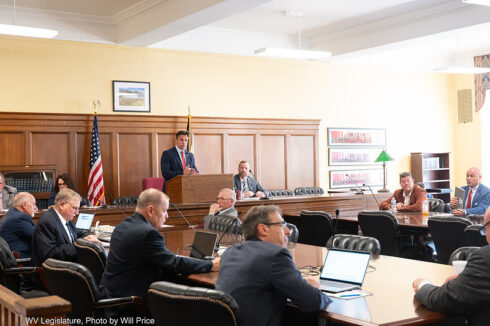
These questions have also come up in West Virginia’s Legislature, and might yet again.
House Bill 4515 as introduced in the regular legislative session earlier this year focused on resolving disputes over church assets when a local congregation chooses to leave a denomination.
Supporters contended it would shift focus from religious doctrine to civil property ownership, specifically land, buildings, bank accounts and furniture paid for by local members. The legislation would have required a two-thirds congregational vote for a local church to disaffiliate with its property.
The legislation would have required a parent denomination to provide a full accounting and carry the burden of proof to establish its interest in local property.
Meetings between the House Judiciary Committee and representatives from local congregations and hierarchical denominations didn’t manage to produce a consensus on to resolve the complicated legal and First Amendment implications.
The bill was assigned to the House Judiciary Committee but did not advance.

After the regular session was over, delegates gathered in May to explore policies that could lay the groundwork for future legislation. The House Judiciary Committee and a subcommittee discussed policies surrounding church splits for nearly two hours.
“You’re going to see that this is a legally complex matter, has First Amendment implications, obviously. and the question of how the state should be involved in resolving this matter is again very interesting but complicated,” House Judiciary Chairman J.B. Akers, R-Kanawha, said while setting up the discussion.
One of the speakers representing the local churches was David Gibbs, president of the National Center for Life and Liberty.
“This bill is necessary because local churches in West Virginia should not be forced to choose between conscience and confiscation,” Gibbs told delegates.
He said the local churches “should not be told they are local enough to be sued, local enough to bear their own liabilities, but not local enough to have their property rights protected under West Virginia law.”
Representing the denomination, attorney Tom Starnes said the proposed West Virginia law would be unconstitutional, establishing a state rule for what should be a church rule under the First Amendment.
“It violates the Free Exercise Clause and the Establishment Clause because it purports to tell a religious denomination how to organize itself, what its rules for membership are, what its rules for disaffiliation are, and what happens to church property,” Starnes told delegates.
“Those have always been decisions from the founding of this country reserved for the churches themselves, and the state can’t impose its own rules.”