

Listen to “Does Chatrie Put Flock Cameras on Constitutional Thin Ice?” on Spreaker.
Yes.
The Supreme Court’s recent decision in Chatrie v. United States wasn’t about Flock Safety cameras. It was about Google.
But if you read what the Court actually wrote — not just the headlines or what is thrown out in soundbites — it raises serious constitutional questions about government-operated Flock camera systems.
The Court held that when police obtained Google Location History data through a geofence warrant, they conducted a Fourth Amendment search. Why? Because Americans have a reasonable expectation of privacy in the record of their physical movements.
That should sound familiar.
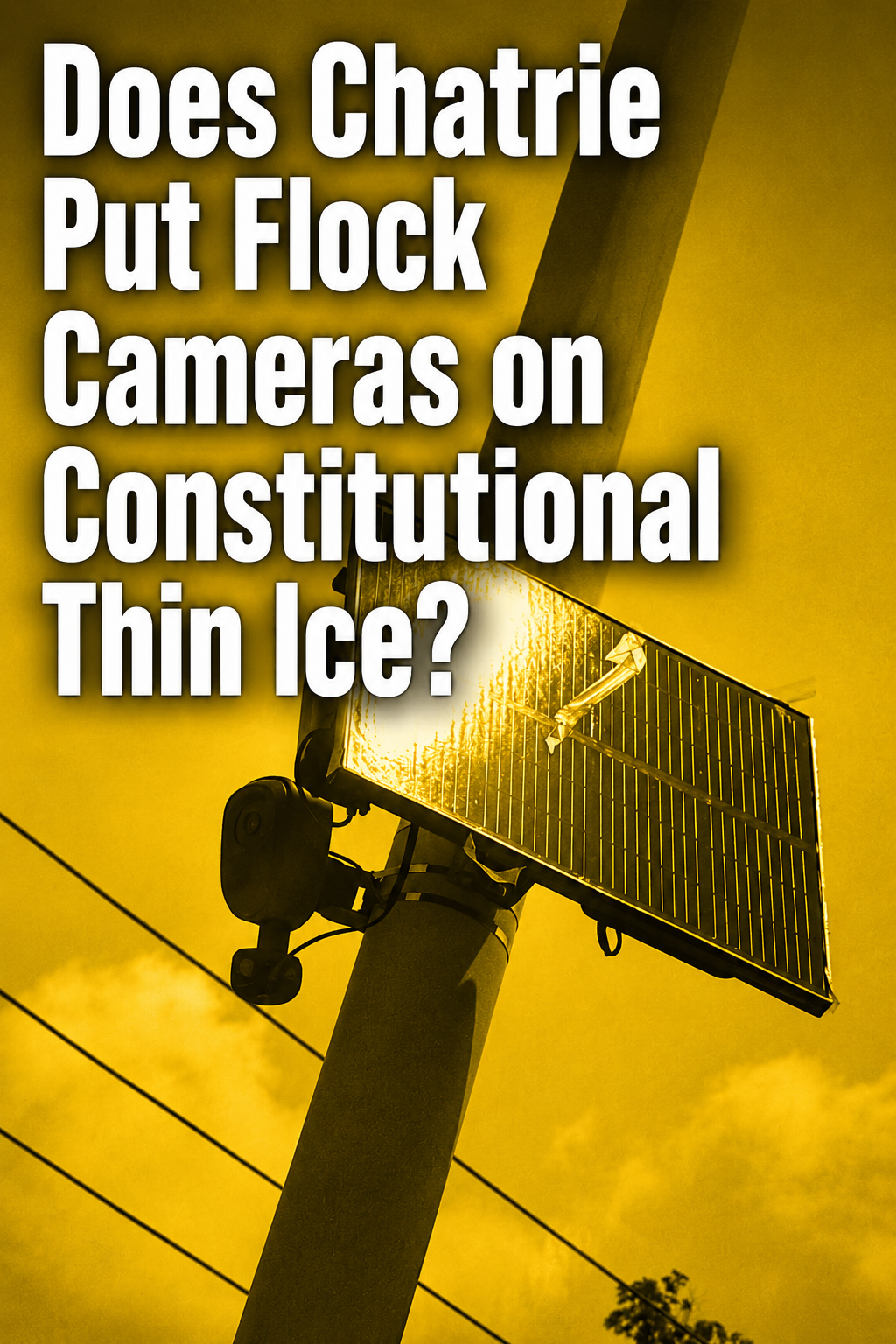
Flock cameras are designed to create records of physical movements.
The technology is different. Google tracks cell phones. Flock tracks vehicles. But the constitutional concern identified by the Court isn’t really about the technology. It’s about government surveillance.
Justice Kagan writing for the majority said that the Fourth Amendment exists to protect citizens from “a too permeating police surveillance.” She emphasized that new technologies dramatically expand the government’s ability to monitor innocent people and that constitutional protections must keep pace.
That’s exactly the conversation we’re having in West Virginia — and across the country.
Supporters of Flock argue the cameras capture only license plates and vehicle descriptions — not people. They point out that officers receive alerts only when a vehicle matches a hot list (in Mon County’s case) and that the data is retained for only a limited period. Those are important safeguards.
But Chatrie suggests the constitutional inquiry doesn’t end there.
The Court rejected the argument that collecting only a short period of location information somehow avoids Fourth Amendment scrutiny. Even brief monitoring, the Court said, can reveal intimate details about a person’s associations, beliefs, and movements. And once the Fourth Amendment applies, it applies. The government doesn’t receive a constitutional grace period simply because it collected less information.
There’s another passage that deserves attention — perhaps the most important to the Flock debate.
The Court observed that digital surveillance now allows police to reconstruct people’s movements retrospectively “at the click of a button.” That capability, the Court warned, affects everyone — not merely criminal suspects.
Isn’t that, at least in part, what an expanding statewide network of license plate readers does?
Every vehicle that passes a camera is recorded, regardless of whether the driver is suspected of a crime. Those records become searchable after the fact.
That sounds remarkably similar to the concern the Court identified in Chatrie.
Now, there are important legal distinctions. A vehicle’s license plate is plainly visible in public. Courts have long held that there is generally no reasonable expectation of privacy in what anyone can observe from a public roadway. That principle remains well established.
But Chatrie reminds us that the Fourth Amendment isn’t simply about individual observations.
It’s about what happens when technology allows the government to aggregate countless observations into a searchable database capable of reconstructing a person’s movements over time.
The opinion repeatedly emphasizes that constitutional protections must account for the realities of modern surveillance technology — not merely whether each individual observation occurred in public.
That doesn’t necessarily mean Flock cameras are unconstitutional. Far from it. No appellate court has yet reached that conclusion.
But it does mean the constitutional analysis has become far more complicated than simply saying, “You were driving on a public road and don’t have an expectation to privacy,” as we’re hearing from government proponents of this technology.
The Supreme Court has signaled that digital surveillance capable of tracking people’s movements — even over relatively short periods — deserves serious Fourth Amendment scrutiny.
Because Chatrie was decided after the district court ruled in Schmidt v. City of Norfolk — a case now on appeal before the Fourth Circuit — the appellate court will now have the benefit of intervening Supreme Court guidance that the district court did not.
Whether the Fourth Circuit, or ultimately the Supreme Court, concludes that Flock systems cross the constitutional line remains to be seen.
Cities and county governments in West Virginia would be wise to slow down and heed Kagan’s warnings – waiting for a definitive outcome in the courts – before moving forward. At minimum, they should first obtain a warrant before placing any cars or individuals on “hot lists,” seek a warrant to retain any images from day-to-day, and before reviewing images as part of an investigation.
Will they?