

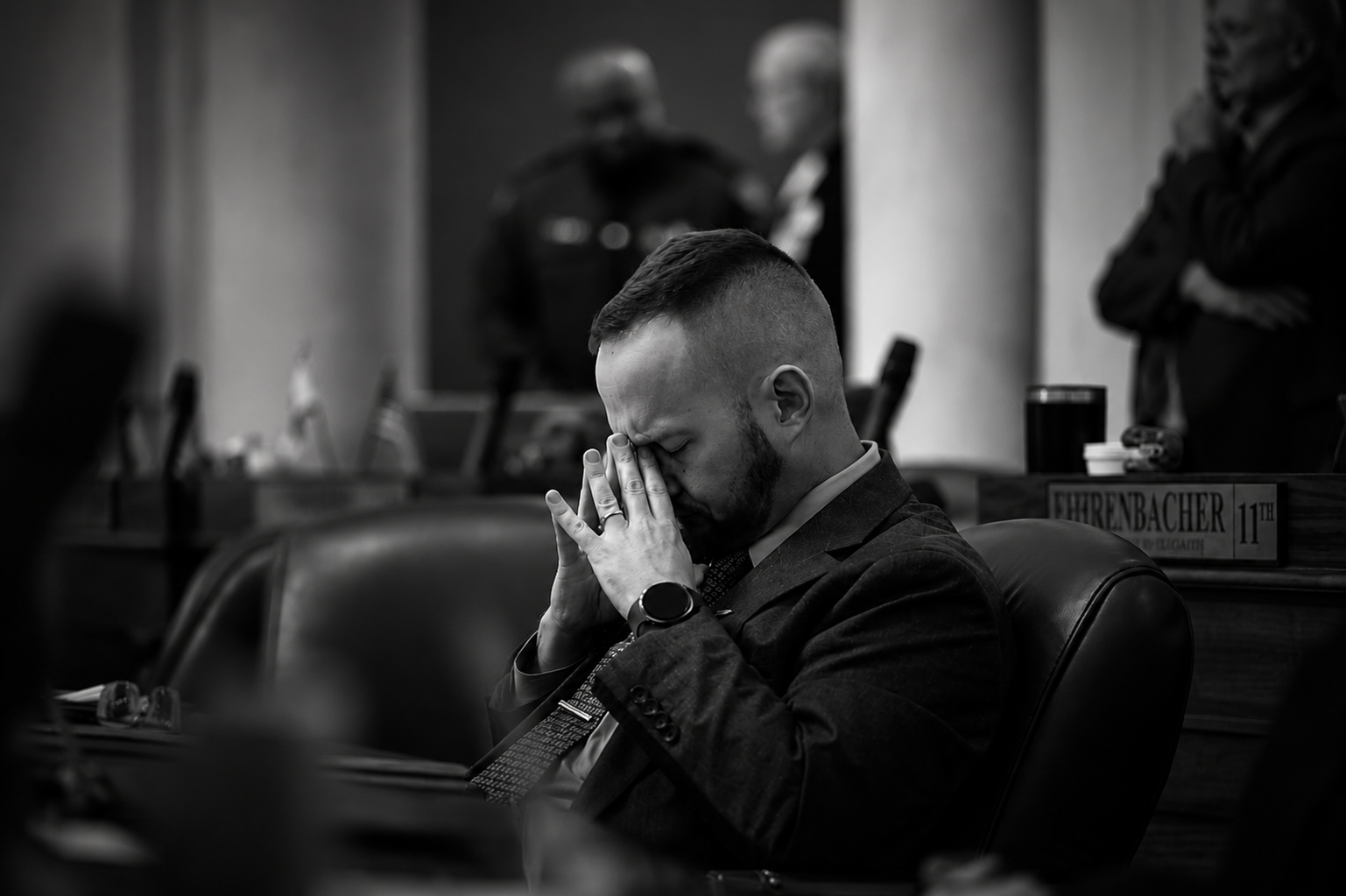
Certainly, by now you’ve heard of Delegate Elliott Pritt, even if you’d never heard of him before Wednesday.
Has he ever appeared on Talkline — at least since Hoppy Kercheval retired? I honestly don’t remember. I’m not sure I’ve ever exchanged a word with him. But legislators become known over time. It’s not difficult to know someone who knows someone, and word travels about people’s reputations, especially during session.
Frankly, if all 134 legislators were lined up, Pritt probably wouldn’t have been the one most people would have picked as the person now facing these allegations. Yes, he is innocent until proven guilty, but the allegations and evidence made public are deeply troubling, disgusting and downright damning.
The lesson is obvious: we never really know most people. At best, we have acquaintances. Friends are different.
Psychological research suggests humans can maintain roughly 150 social relationships at any given time. “Relationships” is a broad term — people you recognize, greet in passing, or interact with from time to time.
The inner circle is much smaller. About five people. Those are the close confidants — the people you call in a crisis, the people you truly call friends. That number is remarkably limited.
So, as shocking as this case may seem, it’s not surprising that many people didn’t really know Elliott Pritt. It’s a sobering reminder that appearances can be deceiving. While most people appear good — and hopefully are — it is impossible to know with certainty what lies beneath the surface.
Pritt remains incarcerated in a Kentucky jail, his teaching certificate now suspended pending the outcome of trial, while calls continue for his resignation from the House of Delegates. Whether he even knows those calls are being made is unknown.
Having watched similar situations unfold over the years, there is sometimes a strategic calculation. An elected official delays resigning in hopes of gaining leverage during plea negotiations. There is no indication Pritt is doing that here. But if he is, it would be a mistake. He should resign the moment he learns of those calls and someone is willing to hand him a pencil and a piece of paper, plus postage.
If he had any remaining sense of responsibility to the people he represented, he would have already done so — without anyone asking.
Pritt fooled a lot of people, me included.
I watched him stand passionately on the House floor during the closing night of the last legislative session, exhausting every parliamentary maneuver available to pass Raylee’s Law — a worthwhile bill designed to protect children from abuse.
If the allegations are true, he did so while allegedly having committed crimes against a child himself. If proven, that would represent an extraordinary act of deception and hypocrisy – an act perpetrated with tears and his head in his hands appearing stunned at the bill’s failure to move.
My heart breaks for the young woman Pritt is accused of victimizing. One can only imagine the pain she and her family endure each day. We can only hope she is surrounded by people who love her and will help her heal.
There is also sorrow for Pritt’s wife and children. Whatever the outcome of the criminal case, they are enduring consequences they did not choose. They, too, are victims in their own way, seemingly now a widow and orphans — they deserve compassion as they attempt to build a new normal.
As for Pritt, he deserves a harsh and hard sentence if his peers find him guilty.
Finally, for those who would use this case to argue that Raylee’s Law is somehow flawed or inappropriate — and that sentiment is already appearing across social media — I’d caution against that conclusion.
Raylee’s Law should stand or fall on its own merits. The allegations against one of its advocates, and any deception or hypocrisy that may ultimately be proven, should not be used to discredit the legislation itself. That just isn’t fair or worthy of debate.
Audio version available here