

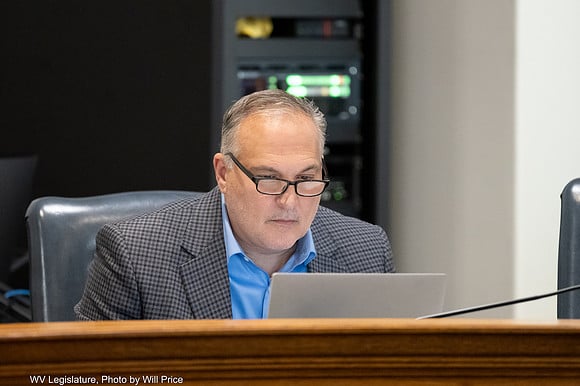
Lawmakers gave a key approval to regulations that set reporting, generation-dispatch, maintenance and fuel-planning requirements for utilities under Public Service Commission jurisdiction.
Over about an hour, lawmakers on the Rule-Making Review Committee discussed and then approved the framework adopting only a clarification to the utility reporting deadlines. The regulation now moves on to the full Legislature, where it will eventually be considered with other rules.
Discussion in committee focused on ratepayer protections, including a 69% capacity-factor capability standard, the costs and benefits of generating versus buying power through the grid and safeguards for confidential information.

Providing his own view of what the rules are aimed at accomplishing, Delegate Bob Fehrenbacher said, “It benefits our employees, our generation units, to run well, to run hard, and frankly, not only to supply West Virginia electricity consumers, but those electricity consumers in the PJM grid outside of our state, correct?”
This all happened because the Legislature passed a law and the regulations are necessary to fill it out.
Last year, the Legislature passed a sweeping policy called the Power Generation and Consumption Act with most of the focus on data centers and their power sources.
Also, the bill required the Public Service Commission to evaluate capacity auctions conducted by PJM Interconnection, and review each generating unit’s current economic dispatch to ensure they could meet future needs. PJM is this area’s regional energy grid, which oversees the allocation of electric-power in a 13-state area.
Furthermore, the policy passed by the Legislature required utilities to maintain their generating units and fuel inventories to allow them to achieve at least a 69% capacity factor.
Electric utilities must submit detailed monthly generation dispatch reports and extensive fuel inventory data to ensure energy is produced at the lowest possible cost.
The Public Service Commission was assigned to propose rules for legislative approval to reflect its new duties and responsibilities under the law.
Commissioners produced an initial draft and then went through a process to receive comment from the public and businesses on the proposals.
Much of the public debate has been over how specific requirements could push utilities to run coal plants more or whether the policies would result in higher electricity prices for consumers.
A 51-page PSC order entered in October reflected specific changes from a public comment period.
One change incorporates the exact statutory language of state code, clarifying that requiring utilities to maintain units to achieve a 69% net capacity factor is a maintenance and operational-readiness standard.
And the revised rule explicitly states that utilities are not required to operate a unit at 69% net capacity factor if doing so would increase electric charges for ratepayers.
The PSC specified that capacity factors will be accumulated and evaluated over rolling 12-month periods rather than enforced as an immediate or hourly operational requirement.

“We had a big public hearing, and this is a product of that public hearing and the many, many comments that we had. So, we feel like they’re pretty good rules,” said Public Service Commission member Bill Raney, former president of the West Virginia Coal Association.
During the legislative committee discussion, one of the most active participants was Senator Brian Helton, R-Fayette. Among those Helton questioned was Raney, starting with potential effects on ratepayers.
“The ratepayer is always to be protected in this,” Raney said, adding that the “ratepayer is the keystone of all of these things, Senator.”
“Does this rule give you guys more ability to enforce the provisions of House Bill 2014?” Helton followed up by asking.
“I think we feel it does, yes, sir,” Raney responded.
In what way? Helton asked.
“Well, I think it specifies the rules. We get the information. We get the data, and it sets some standards,” Raney said. “And you know, people spend a lot of time talking about 69 percent.
“And of course, as the bill indicated, 69 percent is a standard to be achieved by the plants. It’s not mandatory. And just as the discussion was — that, you know, the plants are going to be maintained as we understand to achieve as much capacity as they possibly can, so we we think with all the data and all the attention to this that it will certainly improve things.”
“Yeah,” Helton said, “I agree with that.”
The senator then asked if the objective is for power plants to generate at a greater capacity. Raney agreed that’s so.
“Why do we want them to generate at a higher capacity factor?” Helton asked.
Raney responded, “I think they use more West Virginia fuel, use more West Virginia workers, and make more electricity that they can export to the people that need it.”