

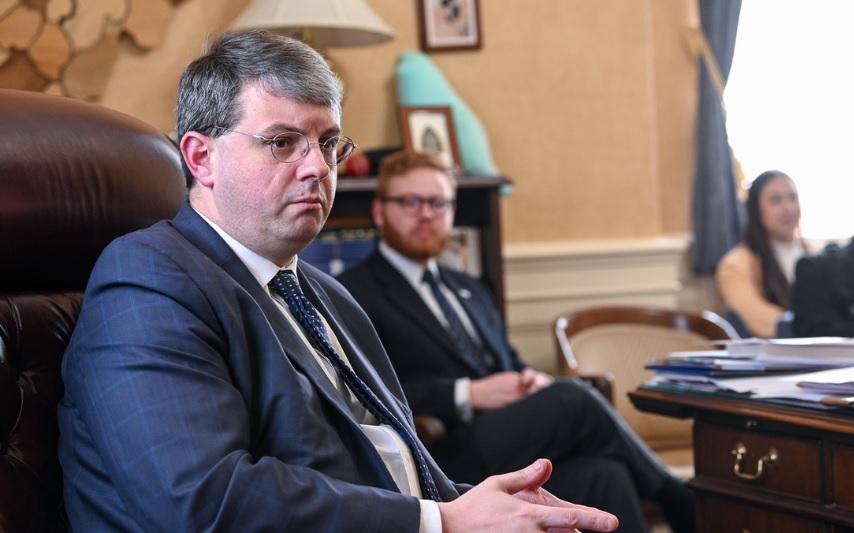
MORGANTOWN, W.Va. — House of Delegates Speaker Roger Hanshaw says this legislative session produced policies that will have a positive impact on the state for decades to come.
Hanshaw, during an appearance Monday on WAJR’s “Talk of the Town” pointed to dividing the DHHR into three entities, tax cuts for individuals and businesses, pay raises for state workers and comprehensive changes in classrooms as the session’s top accomplishments.
“Not even to mention the fact that we now have enacted into law a program that will put assistant teachers and teacher’s assistants in every 1st, 2nd, and 3rd grade classroom in West Virginia over the next three years,” Hanshaw said. “There’s a lot to be proud of here. It was a big 60 days.”
Hanshaw said negotiations for changes in the classroom were easy because all sides had a very similar vision for the legislation. Once plans from Gov. Jim Justice, the Senate and House were debated, a compromise wasn’t difficult to find.
“That money comes with a bit of flexibility in the first two years because we wanted to be sure counties that were already using their federal funds or other sources of funding to provide assistant teachers.”
According to Hanshaw, pay raises, tax cuts, and PEIA reforms really equal pay raises and gains for all West Virginians.
“That’s why we did them all literally on the same day,” Hanshaw said. “So, you tie the pay raises in with the immediate cut to personal income taxes of 21.25 percent, and when you take it all in together, everyone is getting a pay raise.”
Hanshaw expressed disappointment that important issues have become polarized. He said the politics of change can be difficult, and criticism will likely continue until people see the policies in action.
“Controversy is an industry, and creating controversy where none should exist is the livelihood of a lot of folks,” Hanshaw said. “That’s a depressing situation, but it’s the reality of the life we live.”
Hanshaw said what gets done during the legislative session has little to do with a Republican supermajority. He said 60% of the state’s population lives near the border of another state, making the issues more related to regional impact than political philosophy.
“We end up taking issues that have regional differences of opinion more seriously than political differences of opinion so the numbers of any particular political party are almost immaterial.”