

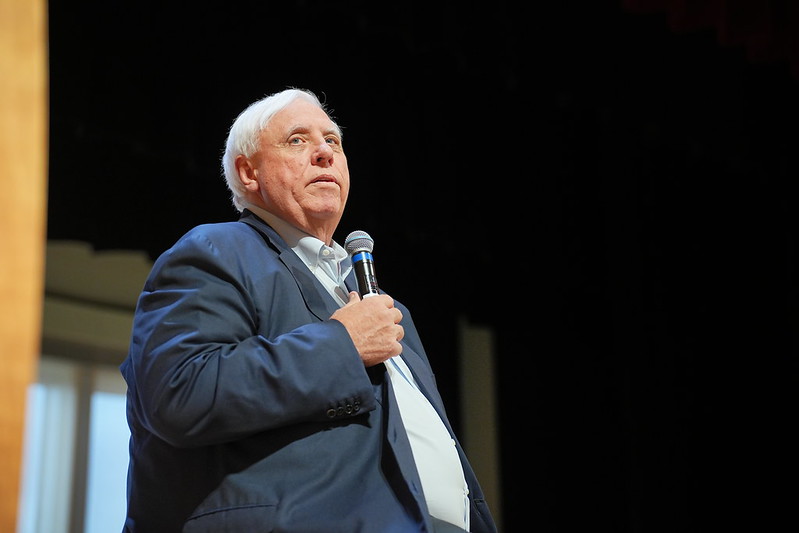
A roundup of Gov. Jim Justice’s financial conflicts is rarely short of material.
In one court case, a local judge in Virginia has set a hearing for next month on whether Justice’s family businesses have to pony up $300 million in assets to their longtime lender. In a federal case, a judge has set a hearing to try to straighten out ownership of a Justice corporate helicopter that has multiple parties laying claim.
And in yet another longstanding federal case, a judge’s order to pay thousands of dollars in attorneys fees has been met with a claim that Justice’s companies just can’t: “Defendants have no operations, revenues, or unencumbered assets.”
Such perils have been regular during Justice’s time in office.
For many years, Justice was described as West Virginia’s only billionaire, but Forbes downgraded him after 2021 debt disputes. Justice’s political persona has been as a businessman who can buzz the numbers. Now he’s a leading candidate in a high-profile race for U.S. Senate, and the stability of his financial network is being questioned not only in court filings but also in political competition.
Justice has dozens of business holdings listed on his annual state ethics disclosures, although a recent U.S. Senate financial disclosure indicated that most earn little, if any, profit. The governor has not placed most of his family’s holdings in a blind trust but has repeatedly said the responsibility of running the businesses has been passed on to son Jay Justice and daughter Jill Justice.
In a briefing early this month, Justice broadly acknowledged financial challenges but contended his family always makes good.

“You’ll see a family that has worked really, really, really hard — a family that, at one time, if you’re really fair and you’ll step back from it, you’ll say ‘Well, when things were really tough, why didn’t they take bankruptcy like every coal company almost in the land that was in trouble that wrote off hundreds and hundreds of millions, if not billions, of dollars.’ And we didn’t do it,” he said.
“There’s no big pots of gold sitting around. Absolutely, at the end of the day, you can see that. And from that you can see a family that sometimes are a little late on a bill and everything, but we pay them, don’t we?”
Right now, though, teeth are bared for Justice’s finances in multiple courtrooms.
Carter Bank: $300 million
In one month, Justice and his family companies are headed for a clash over $300 million in secured debt to their longtime lender, Carter Bank & Trust.
Carter Bank earlier this year filed confessions of judgment, written and signed agreements accepting liability in instances of default. In such circumstances, the note may be presented to the court without even notifying the debtor or having a hearing. By signing, borrowers may sacrifice their right to be heard in court.
The confessed judgments added up to $302 million, plus interest and attorneys fees. The claims cited personal guarantees by Governor Justice, his wife Cathy and their adult son Jay, who is the named executive of the family’s coal operations.
The confessed judgments filed by Carter Bank apply to loans on James C. Justice Companies, Justice Family Group, Greenbrier Hotel Corp., Greenbrier Golf and Tennis Club, Greenbrier Sporting Club, Players Club LLC, Oakhurst Club, Greenbrier Medical Institute, Justice Low Seam Mining, Twin Fir Estates and Wilcox Industries.
Those loans had come due April 15.
Lawyers for Justice’s companies responded by filing motions to set aside the confessed judgments in the 11 cases in Martinsville, Virginia. The filings contend that enforcing the judged confessions is a radical step and that the Justice companies deserve a chance to offer a more detailed defense.
That tension has drifted along until now.
At 3 p.m. Nov. 15, in Martinsville Circuit Court, attorneys for Carter Bank will present oral arguments about why the court should deny motions by the Justice businesses to set aside the confessed judgment.
Helicopter up in the air
A day after the Carter courtroom drama, at 2:30 p.m. Nov. 16, the Justice companies will be in a federal courtroom tangle over a 2009 Bell helicopter with multiple claimants.
Senior Judge James P. Jones of the Western District of Virginia’s Abingdon division ordered a hearing to sort out all the twists on helicopter claims.
Caroleng Investments Limited, parent company to the Russian mining company Mechel that bought and sold properties with Justice, is seeking the helicopter’s seizure over a debt now piling as high as $13 million that was already recognized and awarded in the federal court system.
Caroleng hasn’t been able to collect on its judgment through other means. Liquidating the helicopter, conceivably, could satisfy a portion of the debt.
U.S. marshals were directed earlier this month to seize the helicopter, acting on judgments already rendered several years ago in the court system.
The Justice family’s Bluestone Resources has objected to the helicopter seizure by a company “controlled by a Russian oligarch.” Bluestone’s lawyers say that if the helicopter is seized and liquidated then the money should instead go to different lenders higher up the food chain.
One of those lenders, 1st Source Bank of Indiana, jumped in last week to identify itself as a lender with a perfected, first-priority security interest on the helicopter.
Lawyers for 1st Source cited a 2018 loan for $1.55 million. The loan identified the helicopter as collateral. There were additional loans for more equipment after that, too, including for another helicopter, a 2012 Bell model, and a couple of helicopter engines. An agreement to restructure all of that resulted in a principal loan amount of $10.4 million.
Through the middle of this month, 1st Source was still owed $5 million, “which is far in excess of the value of the helicopter,” according to the court filing.
‘No Ability to Pay’
In a longstanding dispute with Justice holdings over mineral rights leasing, Fivemile Energy Company of Kentucky is currently trying to collect on $194,258.25 in attorneys fees and expenses, awarded as a sanction for running afoul of an earlier court order. The money was due Oct. 10.
The Justice businesses responded by saying they’re broke.
Lawyers for James C. Justice Companies filed a motion in U.S. District Court for the Eastern District of Kentucky, asking to be off the hook indefinitely.
“The fundamental fact of this case remains the same: Plaintiffs have obtained a judgment against Defendants who have no ability to pay. Defendants can neither satisfy the judgment nor comply with orders to pay money,” wrote the lawyers for Justice companies. “Defendants have no operations, revenues or unencumbered assets.”
That filing made reference to earlier testimony that “established that those things have been true for many years. Defendants have submitted bank statements that reflect their lack of funds, as well as a court filing from Carter Bank & Trust that shows Defendants’ assets are subject to liens.”
Lawyers for Fivemile responded that reflects a Justice legal strategy to “delay, object, and no-comply.” Those lawyers also moved for a show cause order, where the businesses and corporate officers Jay Justice, Steve Ball and Jill Justice would have to demonstrate why they should not be held in contempt. Following that, Fivemile has asked for an order that Jay Justice, Steve Ball and Jill Justice should personally pay the $$194,258.25.