

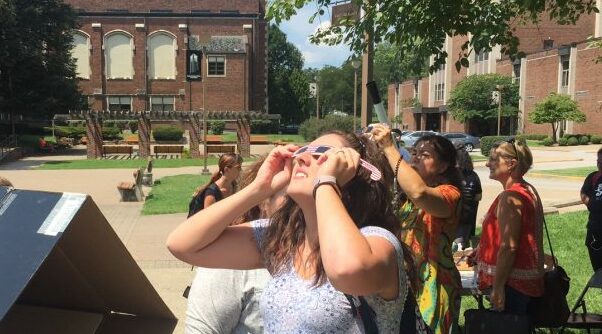
CHARLESTON, W.Va. — West Virginians will be able to witness the solar eclipse Monday with certain areas of the state seeing more sun coverage than others.
Beckley native Ed Evans, a former member in the West Virginia House of Delegates, is projecting parts of southern West Virginia may witness the eclipse the best. The Beckley area can expect to see the eclipse at around 1:56 p.m. Monday.
“We’re going to get a lot of a partial eclipse,” Evans said. “We’re expecting over 90% of the sun to be covered.”
A solar eclipse is when the moon is positioned between the sun and the Earth during it’s orbit. The shadow that is cast by the moon falls on the Earth, creating either a partial or a total eclipse.
Some West Virginia schools are taking this rare phenomena and using it as a learning opportunity for their students, especially in their science classes. A handful of schools have purchased solar glasses.
“The students should be right there with their science teachers, out in the grass, enjoying this with their solar glasses,” Evans said.
Evans is planning to travel to Batesville, Indiana which is about 45 miles west of Cincinnati, to experience the rare occurrence. He said a solar eclipse is so rare, it’s worth traveling to the best areas in the country to see it, even if the eclipse doesn’t last for very long.
“This is the most incredible feat of mother nature,” he said.
Eclipse glasses are the best way to view the solar eclipse. Evans said people should look at the ISO rating on the glasses and use ones that have a rating of 123.
Evans said the moon is going to closer to the Earth in this year’s eclipse. That means there will be more totality compared to previous eclipses.
“The maximum totality will be about four minutes and 26 seconds,” said Evans.
The last solar eclipse was in the summer of 2017. The maximum totality of the eclipse that year was around two minutes and 40 seconds.
The West Virginia University Planetarium is hosting a viewing event Monday at Mountainlair Lawn. The event will go on from 1:30-4:00 p.m. Everyone is invited to attend.
Over 1,500 solar eclipse glasses will be handed out at Marshall University for their viewing event. Folks can come to Buskirk Field and use their glasses to view the eclipse.
The Star Lab Planetarium will also be free & open to the public. The Marshall University Astronomy Club & Society of Physics Students will have a telescope projecting an image on to a large display from 1-4:30 pm.
West Virginia State University is also planning to hold a public solar eclipse viewing event Monday. The WVSU S.P.A.C.E. Club and the WVSU College of Natural Sciences and Mathematics are organizing the event which is free to students, staff and the general public. It takes place from 1:30 p.m. to 4:30 p.m.
People can view the eclipse at stations setup outside Hamblin Hall next to the WVSU Clock Tower. There will also be a classroom inside Hamblin Hall where folks can watch NASA’s live broadcast of the event.
The next solar eclipse won’t be for another 20 years. It’s projected to be Aug. 23, 2044.