

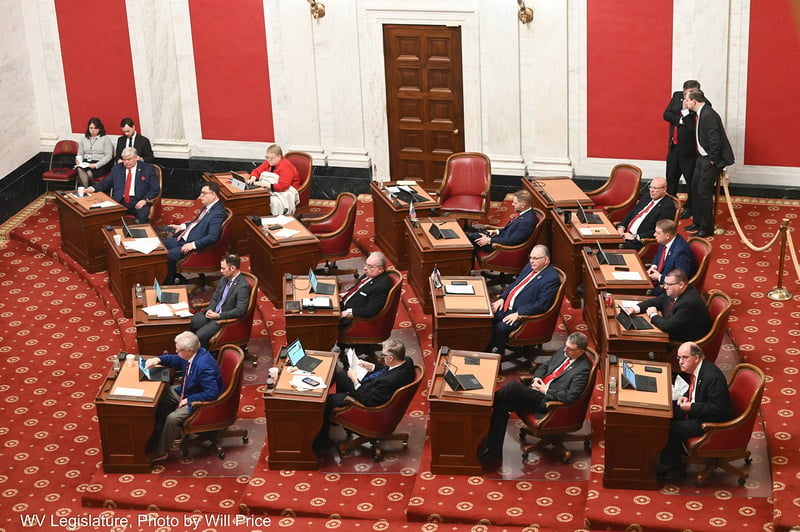
West Virginia senators passed two bills dealing with transgender issues.
The House of Delegates moved yet another piece of legislation dealing with transgender issues to the edge of passage.
In the Senate, lawmakers overwhelmingly passed a bill that would require teachers and school systems to tell parents if students confide that they are questioning their gender identity. S. B. 154 also would prohibit instruction on sexual orientation and gender identity in schools.
A short while later, senators passed a bill to further restrict treatment options for minors experiencing gender dysphoria.

“So it’s biological sex week here at the West Virginia state Senate,” said Senator Joey Garcia, D-Marion, who spoke against each of the bills.
At the same time, the House of Delegates advanced a bill “defining ‘men’ and ‘women,'” SB456, legislation requested by the governor that could pass as soon as Friday.
Senate Bill 154 prohibits public school employees from providing false information about a student’s gender identity and requires reporting of gender-affirming accommodations to parents. It includes sanctions for violations ranging from written reprimands to termination.
The bill also prohibits instruction on sexual orientation and gender identity in schools, whether it is offered as part of a health education class or program or as part of any other class or program.
Garcia it would break down trust between vulnerable students and teachers.
“There’s a just amount of fear that this bill just puts into place right now,” he said.
He concluded, “I see this as just another attack on really vulnerable people in our state, and students who might want to trust in a teacher with something that’s very hard or talk something through — again, if I was a lawyer, I would have a teacher at the very beginning of the year basically say, ‘Don’t tell me anything,’ because that’s how bad this bill is.”
Senate Education Chairwoman Amy Nichole Grady, a fourth grade teacher, sponsored the bill and disagreed.
“This bill states that an employee has to make a conscious decision to socially transition a child without the parent’s consent,” said Grady, R-Mason.

“If we make a conscious decision to do that, that is referring to them by another name, another sex, that’s referring to them in many ways, that’s recording information in our classroom — it’s a conscious decision, not just hearsay or talking here and there.
Grady continued, “It’s a shame that we have to have a bill like this. It really is. This is happening in our schools.
“As a mom of three kids, I want to make the decisions that are mental health decisions and medical decisions for my kids. As a teacher in our public schools, I don’t want to make these kind of decisions for other parents. It’s not my decision to make.”
Senate Bill 299 eliminates exceptions for prescribing gender-altering medication to minors with severe gender dysphoria.
This marks the third time in three years that West Virginia lawmakers have focused on the issue, including passage of a 2023 bill that banned gender surgery for minors but continued to allow treatment with medication under narrowly-tailored circumstances.
Now senators have passed an even more restrictive bill.

“Adults can do what they want. Children cannot. I urge passage,” said Senate Health Chairwoman Laura Wakim Chapman, R-Ohio.
Garcia again spoke against the bill, saying it would undermine medical decisions and could increase the risk of suicide.
He said the exceptions being eliminated are actually very narrow.
“There have to be two medical doctors or mental health professionals that make this diagnosis and that basically state that there is a risk of death by suicide or self harm,” he said.
“Not only that, it’s not a matter of just pushing this on a child and saying hey or an adolescent and saying Hey, make this decision. This is a family decision, which is really how things should be between a family and a doctor or medical professional.”
Senator Chris Rose, the bill’s main sponsor, spoke in support of it.

“We don’t trust children to drive a car till they’re 16. We don’t trust people to vote till they’re 18, or buy a firearm or serve in the military. And the human brain, through trust of science data, does not fully develop to age 25,” said Rose, R-Monongalia.
“So why are we allowing permanent harm be done to children at age three, age five, age eight, age 10? They’re not mature enough to know that decision.”
Senator Tom Willis, R-Berkeley, addressed whether the two bills conflict: one saying parents should be looped in if a student takes steps to reflect a different gender identity in school and another saying a minor could not take puberty blocking medication even if their parents agree.

“And so the bill that we talked about earlier really dealt with the sacred authority given by God to parents to raise their children right, and that that’s the general rule,” Willis said.
“There are some exceptions to that rule, as we all know, in cases of extreme abuse or neglect, but this bill that we’re talking about now is dealing with the fundamental right of a minor, it’s the protection of their personage.”
Willis continued, “And so I understand how it may seem like the two conflict, but they don’t, and this bill is essentially fulfilling the basic role of government, which is to disincentivize evil. It’s evil to fail to protect the personages of our minors in West Virginia. And so I think they’re they’re logically consistent”