

Legislation focusing on how to handle the most disruptive students in classrooms passed the state Senate unanimously.
The bill now goes to the House of Delegates, which earlier in the regular session passed its own bill on student discipline. There are some subtle but significant differences between the two bills.
This was day 27 of the 60-day legislative session, so there is plenty of time to work out any of those differences. On the other hand, similar legislation made it to the legislative finish line last year but did not cross before time ran out.
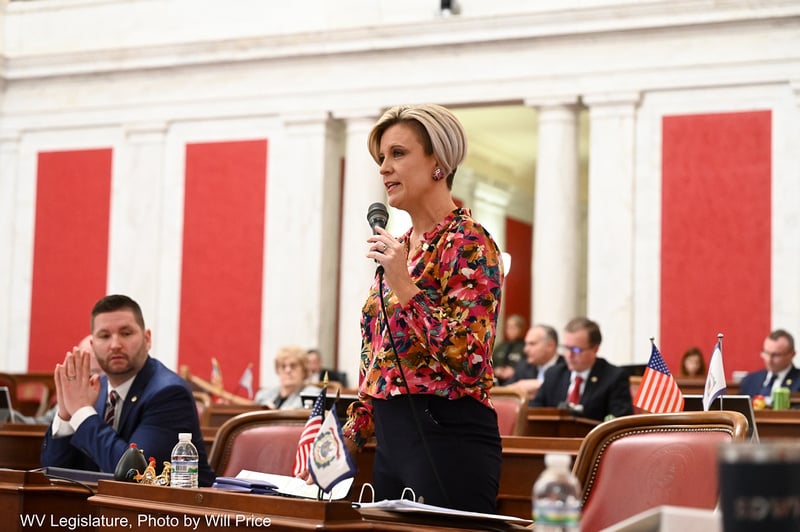
Senate Education Chairwoman Amy Nichole Grady, speaking to reporters on the chamber floor, said she feels good about this year’s passage.

“I’m very hopeful that it will be fine,” she said, “because we’ve still got plenty of time. And so I think that it will be OK. I’m knockin’ on wood here, but I’m hopeful.”
S.B. 199 passed the Senate on Monday on a 33-0 vote with one absence.
“I feel really great about it. I love that they were all green lights up there on the board, which we did not have last year,” Grady said, referring to the green color on the voting board to indicate a yes.
“I’ve talked with the vice chair and the chair of House (education), and both were excited about the changes that we made over here as well as over there. I think this is a really good bill that everyone worked together on. It’s much better than the one we had last year, and I worked really hard on that bill.”
The bill outlines specific actions for teachers of grades K-6 when a student exhibits violent, threatening, or disruptive behavior: immediate removal of the student, parental notification, potential suspension, evaluation and a possible alternative learning environment.
First, the student would be subject to a behavior plan. If adequate progress is being made after two weeks then that plan would continue.
If the student is not making progress, then the behavioral plan could be changed and followed for another two weeks.
If another two weeks pass without adequate progress, then the student would be placed in a behavioral intervention program or with a licensed behavioral health agency where the county has access.
If the county has no behavioral intervention program, the student would be immediately removed from the classroom, parents would be notified to pick up the child, and the student would be suspended for one to three days while alternative accommodations are made.
The student would not return to school until a risk assessment is done. After the risk assessment, the student could return to school provisionally for five to 10 days. If another incident occurs, the student would be placed in an alternative learning environment for the rest of the semester or school year.
That alternative learning environment could, in some cases, be virtual school.
“It gives a little more clarification on what we need to do with students in particular situations, and it also is not a cookie cutter approach,” Grady said. “You have kids that will be in different situations and it kind of individualizes what they need before we move forward.
“So I think it’s really great, and from what I hear from them (delegates), it won’t have any trouble passing.”