

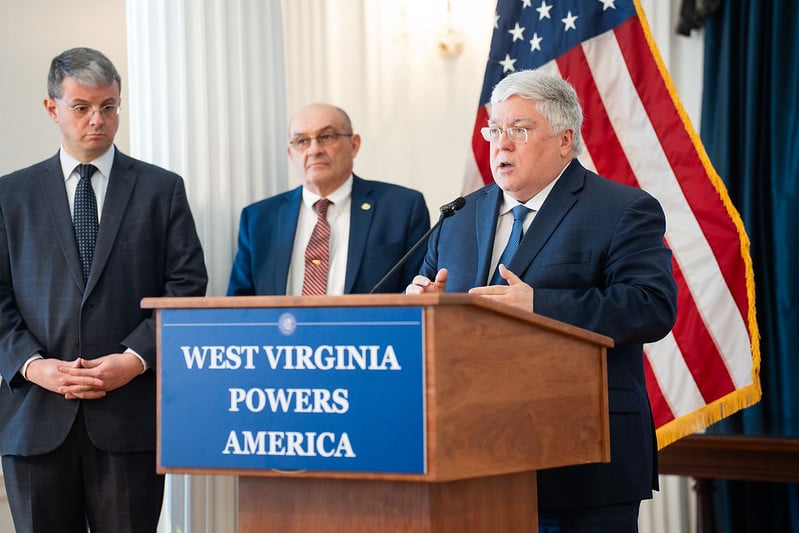
In the final week of the regular session, Gov. Patrick Morrisey is calling on legislators to complete action on a bill intended to allow developers, particularly data centers, to harness localized, self-sufficient energy systems.
The bill, HB 2014, passed the House of Delegates by a wide margin a week ago. It has not yet been taken up by the Senate, which generally needs to move bills out of committee by Wednesday.
The Senate Economic Development Committee had the bill on its Friday afternoon agenda but wound up not meeting that day. Now, the bill is on that committee’s agenda for Tuesday.

“We’re so close to the finish line, I’m urging every West Virginian to weigh in. Thank the House for their good work, and to urge the Senate to pick up this great bill,” Morrisey said during a press conference today.
HB 2014 introduces a Certified Microgrid Program and a High Impact Data Center Program for West Virginia, aiming to attract and support these industries.
Much of the legislation is focused on data centers, the physical facilities that house computer structures like servers and storage.
“Data centers represent a significant and growing sector of the economy, generating substantial economic activity, including jobs, infrastructure investments, and technological innovation,” the bill states.
Data centers are enormous energy users, and that is only expected to grow as artificial intelligence and other computing innovations gain traction.
They are prolific in states like neighboring Virginia, but they are also controversial among residents because of their aesthetics and noise. They are not major employers but can contribute significantly to local property taxes.
“And I would argue this bill could be one of the single biggest economic development bills for our state that we’ve seen in a very long time,” Morrisey said.
“I think it’s going to allow West Virginia to get on the map in a very significant way, to be a hub for these data centers and for technology to come to West Virginia in a way that we haven’t seen before.”
The bill offers a possibility for data center developers who might want their own energy framework, the microgrids in the bill’s name.
In the microgrid piece of the legislation, the secretary of the Department of Commerce can identify and certify the districts following conclusions that there would be a significant and positive economic impact for the state.
An industrial plant or facility choosing to locate and operate within a certified district must represent a new electric generating load to take advantage of the program’s provisions.

Senator Rupie Phillips, R-Logan, spoke against the bill during remarks in a Senate floor session on Friday.
Phillips said the ability to use their own power framework means the data center developers would not reduce the strain on rising energy prices for everybody else.
“Mamaw can’t afford this. I think everybody knows what I’m talking about. I’ll say it: HB, 2014, we can’t afford it,” Phillips said.
Speaking on MetroNews’ “Talkline” today, Phillips said “everyone is complaining on their power bill” and that the only way to lower prices “is to get more people on the grid or businesses on the grid.”