

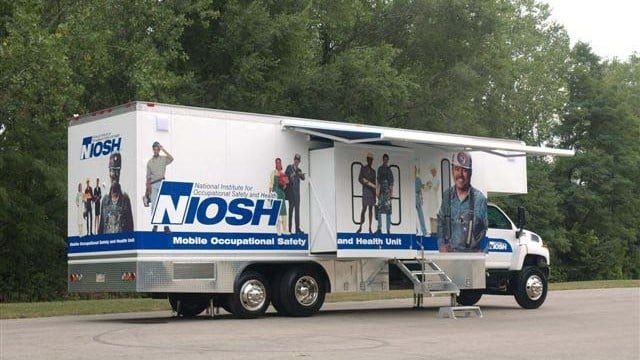
Attorneys for the federal government say a lawsuit over the anticipated dismantling of black lung screening through the National Institute for Occupational Safety and Health in Morgantown should not go forward because it is not yet clear whether the closure will actually take place.
The federal lawyers also contend the plaintiff in the case lacks standing and that the United States government has immunity from these kinds of lawsuits over the staffing and mission of its agencies.
“If these sorts of speculative claims regarding an executive agency’s ability to execute its duties and responsibilities gave rise to standing, virtually any American could sue over administrative cuts at any federal agency,” wrote the lawyers for the United States government.
U.S. District Judge Irene Berger is overseeing the case and scheduled a hearing for 10 a.m. Wednesday in Charleston on a preliminary injunction.
The legal conflict is occurring as hundreds of workers at the NIOSH in Morgantown have been told they will lose their jobs in a matter of weeks. About a week ago, some NIOSH functions for coal miner and firefighter safety were restored, although that seems to be temporary.
The National Institute for Occupational Safety and Health runs the Coal Workers’ Health Surveillance Program required under federal law. The black lung screening program is sometimes referred to as CWHSP.
NIOSH is an agency under the U.S. Department of Health and Human Services and Secretary Robert F. Kennedy Jr., both named in the federal lawsuit.
Kennedy and HHS announced on March 27 a restructuring in line with the administration’s Department of Government Efficiency initiatives.
“Over time, bureaucracies like HHS become wasteful and inefficient even when most of their staff are dedicated and competent civil servants,” Kennedy said at the time.
Despite the layoff notices, federal officials are making an argument in court that a legal challenge is premature because it is still uncertain whether the job losses will become final or if the functions might be reorganized.
“As consumers of statewide news media are aware, decisions regarding staffing at the Morgantown NIOSH facility are still in flux and subject to revision, evidencing their interlocutory nature,” wrote attorneys representing HHS and Secretary Kennedy.
“And HHS has never indicated that despite the RIF sent to employees in Morgantown, it does not intend to carry out its statutory duties under the Mine Act by, for instance, transferring duties under the CWHSP to other offices.”
Lawsuit filed on behalf of coal miners
A Kanawha County coal miner named Harry Wiley filed federal suit on April 7 on behalf of himself and others potentially affected by the loss of the Coal Workers Health Surveillance Program. Wiley is represented by attorneys from organizations like Mountain State Justice and Appalachian Mountain Advocates.
Wiley learned he developed black lung in 2024, according to the lawsuit filed in U.S. District Court for the Southern District of West Virginia.
The lawsuit notes that on April 1, the U.S. human services agency fired top employees including the chief medical officer overseeing the coal mine dust lung disease screening program “thus jeopardizing miners — like the Plaintiff, Mr. Wiley — who seek to utilize these critical and time-sensitive protections from continued dust exposure and debilitating disease.”
The suit contends that Wiley took an initial step last fall to apply for transfer under federal law to a non-dusty job, mailed a form and radiographic image of his chest last Nov. 8 to the lab in Morgantown — yet has received no response. So he remains actively employed in underground mines.
“The fact that Mr. Wiley must continue to work in unsafe conditions — facing the certainty of further dust exposure and worsening his existing lung disease — is purely the result of the decisions of Robert F. Kennedy Jr. and the Department of Health and Human Services,” his lawyers wrote.
The response by the federal government, filed on Tuesday, contends Wiley already received a denial of a black lung claim this past December.
The filing by the federal government seeks to have Wiley’s lawsuit dismissed. The attorneys again said it’s anyone’s guess what will happen to the employees and the black lung screening program.
“He argues that he has a property interest in his continued participation in the CWHSP, which is threatened following the RIF notices sent to employees at the Morgantown NIOSH facility,” wrote the attorneys representing HHS and Kennedy.
“Even if Plaintiff has the claimed property interest, he cannot show that he has suffered any injury. At this point, he is wholly speculating about his future ability to participate in the program.”
‘Deaths of miners’
The NIOSH Division of Safety Research in Morgantown focuses on preventing occupational injuries through preventing falls, encouraging motor vehicle safety and preventing violence in the workplace.
The Respiratory Health Division focuses on preventing work-related respiratory diseases and improving worker health. The Coal Workers Health Surveillance Program studies respiratory disease in miners and provides health screenings and information, particularly about black lung.
Anita Wolfe, who retired in 2020 as program coordinator for the Coal Workers Health Surveillance Program, said the reduction in force needs to be reversed.
“If this program, especially, is cut — this is the only program in the nation that does anything like this for coal miners and is free to them — it will result, I’m 100% sure it will result in deaths of coal miners,” Wolfe said on MetroNews Midday.
Josh Roberts, the director of health and safety for the United Mine Workers of America, agreed that it is important to retain the black lung screening program.
“I mean, we all you would have to do is look at how coal miners were dying and getting sick prior to these agencies,” Roberts said on MetroNews Midday. “You know, NIOSH has been one of the central agencies for research and certification of miners’ health and safety since 1969 so you’re looking at, you know, over 50 years of work that NIOSH has done.
“If you look at prior to NIOSH’s existence, history will tell you that it’s not going to be favorable for the health and
safety of miners.”