

Judges on a federal appeals court upheld West Virginia’s near-total abortion ban in a case that focused on access to the medication abortion drug mifepristone.
The 4th Circuit Court of Appeals, which covers the region that includes West Virginia, issued the ruling today in an opinion delivered by Judge J. Harvey Wilkinson III.
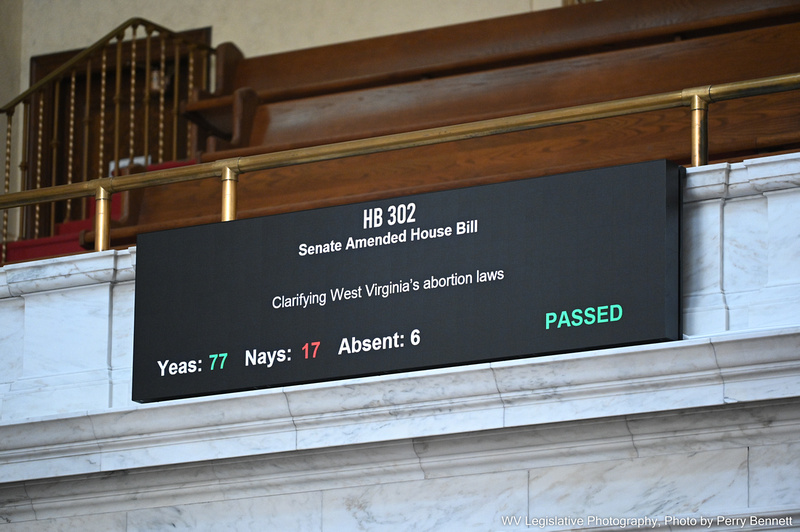
The case challenged West Virginia’s “Unborn Child Protection Act” that came after the U.S. Supreme Court’s Dobbs ruling that turned questions surrounding abortion back to the states.
“For us to once again federalize the issue of abortion without a clear directive from Congress, right on the heels of Dobbs, would leave us one small step short of defiance,” Wilkinson wrote in the majority opinion.
Wilkinson, a Reagan appointee, later concluded, “We take no position on the wisdom or folly of West Virginia’s abortion law. As Dobbs makes clear, that judgment belongs with the people and their elected representatives.
“One can of course agree or disagree with the Dobbs decision. But that is not the point. At a time when the rule of law is under blunt assault, disregarding the Supreme Court is not an option.”
The core issue revolved around whether federal regulations, specifically Food and Drug Administration policies surrounding the abortion drug mifepristone preempt West Virginia’s state law that almost entirely bans abortion.
The majority on the appeals court upheld an earlier district court ruling. Wilkinson wrote that there’s latitude within the Food and Drug Administration Amendments Act for states to set their own standards on abortion.
“In our view, the Act leaves the states free to adopt or diverge from West Virginia’s path. Because the Act falls well short of expressing a clear intention to displace the states’ historic and sovereign right to protect the health and safety of their citizens, we affirm.”

Gov. Patrick Morrisey, who helped shape West Virginia law surrounding abortion when he was attorney general, praised the appeals court opinion.
“Big win out of the 4th Circuit today,” Morrisey said. “I defended this law as Attorney General and am proud to see a victory in this case. West Virginia can continue to enforce our pro-life laws and lead the nation in our efforts to protect life. We will always be a pro-life state!”
The federal lawsuit filed in 2023 received national focus, including a New York Times story headlined “New lawsuit challenges state bans on abortion pills.”
The lawsuit was filed on behalf of GenBioPro Inc., developer of a generic version of mifepristone “to give patients a safe, effective, non-invasive medication option for terminating a pregnancy.
The company contended that the abortion ban passed in West Virginia interferes with its ability to market the drug even though it is subject to extensive federal regulation.
“Federal law preempts West Virginia’s ban and restrictions. These laws impermissibly restrict patients’ access to mifepristone and GenBioPro’s opportunity and ability to market, promote, and sell the medication in the state,” according to the lawsuit.
The original lawsuit named then-West Virginia Attorney General Patrick Morrisey as well as then-Putnam County Prosecutor Mark Sorsaia.
The Food and Drug Administration has approved mifepristone and misoprostol to be used in the first 10 weeks of pregnancy. Both drugs have received federal approval for doctors to prescribe online to be sent to patients by mail.
Mifeprestone and misoprostol are used together to induce a physical reaction like an early miscarriage. Mifepristone interrupts early pregnancy by blocking the effect of progesterone, a hormone necessary to maintain a pregnancy, and misoprostol causes uterine contractions, leading to the contents of the uterus being expelled.
Medication abortion accounts for more than half of all abortions in the United States, according to the Guttmacher Institute, research organization focused on advancing reproductive health policy.
In West Virginia, medication has been a common method for abortion.
In 2021, the Women’s Health Clinic of West Virginia performed 1,304 abortions, according to supporting documentation in an earlier state-level lawsuit challenging West Virginia’s abortion statutes.
Of those, 693 were medication abortions and 611 were procedural abortions.
U.S. Appeals Judge DeAndrea Gist Benjamin, a Biden appointee, issued a separate opinion in the case — concurring in part and dissenting in part.
“Put plainly, this law erects barriers to life-saving healthcare for countless West Virginians in ways not envisioned by Congress,” Benjamin wrote.
Despite the law’s overbreadth and potentially fatal consequences—to say nothing of its dangerous spillover effects on healthcare systems serving vulnerable communities in neighboring states—the majority would allow West Virginia’s Unborn Child Protection Act to stand.”