

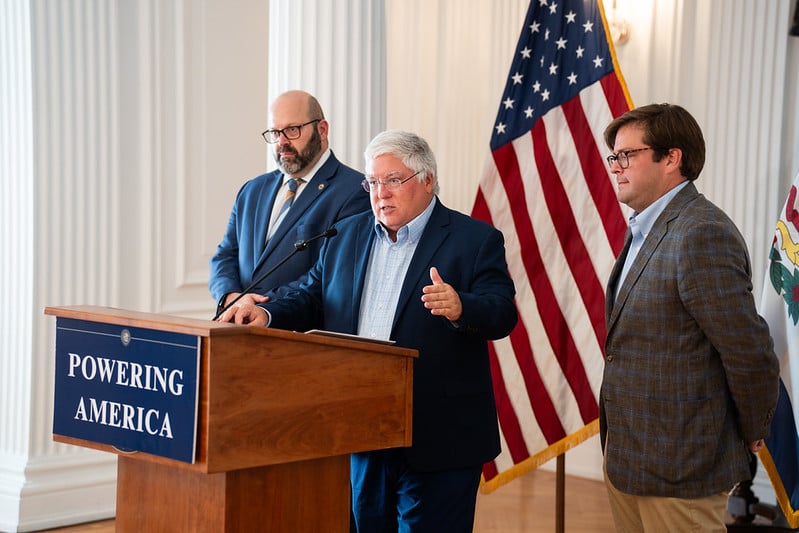
Gov. Patrick Morrisey says his administration wants to pursue a federal program for nuclear energy hubs, but he also has said this week that “West Virginia will not be a dumping ground for nuclear waste. Period.”

He continued, “I have directed my Office of Energy to ensure that every site identified in our final Nuclear Campus application is considered only for nuclear generation or manufacturing — not as a dump.”
The complication is that the U.S. Department of Energy’s call-out explicitly asks candidate states to detail how they will handle nuclear waste, used nuclear material and secondary waste streams. The DOE framed waste management as a core function.
West Virginia has been one of six states being considered as finalists for the federal government’s Nuclear Lifecycle Innovation Campuses program, a designation for a range of nuclear energy activities from beginning to end.
The integrated hubs are designed to support the entire nuclear cycle, including fuel enrichment, advanced reactor deployment and used material reprocessing.
West Virginia got in the door with a 48-page presentation to the U.S. Department of Energy that laid out ideas for how the state might handle all of that, including the nuclear waste part. The state proposed a phased approach that begins with spent fuel recycling and interim storage before expanding into advanced reactor deployment and manufacturing.
This week, the governor’s spokesman called that a “bureaucrat letter” and said the governor’s vow of no nuclear waste supersedes it: “Governor’s clear directive trumps bureaucrat letter. No nuclear waste. Once again, it couldn’t be more clear.”
Yet the federal government’s preference will supersede the governor’s. The project can go elsewhere.
COMMENTARY BY T.J. MEADOWS: Why Would DOE Want to Go Forward?
Straight ahead, West Virginia is up against a deadline in the application process for a legally binding Host Agreement to be executed by Sept. 30. If a Host Agreement is not signed by that date, either party has the right to terminate the partnership.
It’s possible that — in line with the governor’s directive expressed on social media — West Virginia could exclude the handling of spent nuclear material from any language in the Host Agreement.
Rejecting the handling of spent nuclear fuel entirely, though, isn’t in line with what the federal government has been asking.
“They’re trying to find a way to solve a decades-long problem that has never been solved. That’s the waste problem, but also how to jumpstart the nuclear industry to provide the power that we desperately need,” U.S. Senator Shelley Moore Capito said today on MetroNews Talkline.
“So, will they go to another state if we can’t satisfy the parameters of all the applications? I would say yes.”
Capito describes need to be up front about nuclear waste
Capito, chairwoman of the Senate Environment and Public Works Committee, led a hearing last week about America’s nuclear waste management policies.
In her opening statement, Capito observed that the country has grappled more than half a century with what to do with spent nuclear fuel and the Trump administration proposes to create Nuclear Lifecycle Innovation Campuses.

“In return for the economic benefits associated with these facilities, the host state would agree to be the permanent disposal site for a portion of our nation’s nuclear waste inventory,” said Capito, R-W.Va.
Noting in the hearing that West Virginia has been under consideration to a nuclear hub, Capito said state residents would need assurances and a full understanding of what the program entails.
“Second, it is imperative that each potential host state has confidence that nuclear waste will be safely managed — managed alongside the numerous nuclear facilities that could compose their innovation campus,” Capito said in her opening statement.
In a statewide radio interview today, Capito again said her understanding is that West Virginia would need to address nuclear waste to receive the broader benefits of a campus.
But she emphasized that this still needs clarification, including whether the state would be responsible for waste from other facilities. The senator said those terms and the public’s willingness to accept them remained open questions.
“I think West Virginia needs to be honest with what this is — the life cycle of nuclear that includes waste and other things — and how we’re going to deal with it and how we’re going to innovate,” Capito said on Talkline.
Asked to clarify whether West Virginia would have to commit to disposing of the nuclear waste to participate in the nuclear hub program, Capito said yes.
“My understanding, the answer to that is yes, but that’s a question that needs to be asked,” she said. “And is that something that the people of West Virginia want, or is this a commitment that we want to make? And I think other states are willing to make this commitment, that can maybe have nuclear facilities.
“We don’t have any right now, and so I want nuclear facilities in our stat. But you know you have to find out: There is an end product here. And even though it can be safer and less toxic and everything else than it has been in the past, it needs to be fully developed — and all those questions need to be asked.”
Lawmakers: Pursue nuclear possibilities, but be up front
In an announcement on Sept. 8 about West Virginia’s pursuit of the nuclear hubs program, Governor Morrisey focused his remarks on the possibility of nuclear power generation and side benefits like manufacturing and employment opportunities. A potential role for West Virginia in handling spent nuclear fuel was not an emphasis.
Federal officials have advised throughout their written guidance that public communication must be early, transparent, continuous and focused on education to build durable trust.
However, the governor has said very little aside from this week’s social media post that promised “More energy jobs and manufacturing jobs are on the table. Nuclear waste dumps are not.”

State Senator Eric Tarr, R-Putnam, in an appearance on Talkline described “an incredible opportunity for future major economic development. But he said state officials, particularly the governor, have fallen short on sharing that vision with other state leaders and citizens.
“We were not into the discussion. This was not a team effort across the legislature and the governor’s office. This was very unilateral,” Tarr said.
Tarr leveled criticism at a Charleston Gazette-Mail story that explored how West Virginia might handle nuclear waste as detailed in the state’s written response to the federal government.
He said the article set off a wave of negative public response that could have been eased through better communication with the public up front.
“Problem I have is how it’s been handled — is that the the communications out to the general public should have been discussions ahead of time, saying, ‘Hey, this a discussion we’re having. This is what’s going to look like.'”
A team approach would have made a difference, he said.
“And so you go through and can say, ‘OK, we know all the good, bad, and ugly, and that we’re going to go out and make decisions. We’re going to go through and bring our advisors in to have these discussions as well. We’re going to come back and we’re going to do this together for the people of West Virginia.
“And what I hope is that we don’t lose an incredible opportunity for having mishandled that up front.”
 Delegate Jordan Maynor, in an appearance on Radio Roundtable on WJLS AM in the Beckley area, said he supports responsible nuclear development.
“I think it helps us capture again a new form of energy. We’re known as the energy state, and and push the ball forward. It’s jobs. It’s economic development. It’s it’s taxes,” Maynor said.
Maynor, R-Raleigh, said West Virginia should explore the opportunity with strong safeguards, regulation, public education and transparency.
“I don’t want to I don’t want to skirt around this,” Maynor said. “Yes, any recycling facility would recycle used nuclear waste, but that is a far different proposition than a nuclear dumping ground, as some people might might frame this.”
He continued, “It’s to OK to be concerned. Yeah, it’s OK to ask those questions. It’s OK to push your government. I mean, we’re big boys and girls. You should be pushing us, but we also should provide adequate answers and alleviate those concerns with information, with education, and to be very transparent about how we’re going about doing business.”