

The federal nuclear program that West Virginia is aiming for, Nuclear Lifecycle Innovation Campuses, comes with some catches including the acceptance and management of spent nuclear fuel.
The integrated hubs are designed to support the entire nuclear cycle, including fuel enrichment, advanced reactor deployment and used material reprocessing.
While the federal government envisions providing some limited financial support, the initiative prioritizes private sector leadership and significant state-level capital investment.
Successful sites will likely co-locate energy-intensive industries, such as AI data centers, a booming sector that also draws intense public reaction.
And one of the central components involves the management of long-term nuclear waste, designed to safely isolate radioactive material.
Federal officials who outlined the initiative emphasized the need to talk frankly with communities about the risks and responsibilities.
The U.S. Department of Energy envisions the campuses to be deployed quickly, with initial facilities online in the 2027 timeframe.
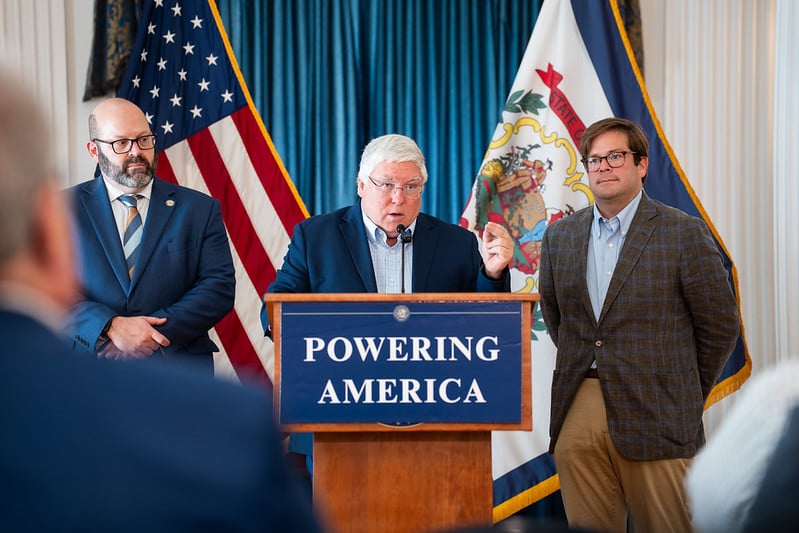
Gov. Patrick Morrisey announced Thursday that West Virginia has signed a memorandum of understanding to become one of six states under final consideration for the initiative aimed at investing in nuclear energy, although the memorandum has not been publicly released so far. So it’s not yet clear what specifics West Virginia pitched.
The memorandum of understanding establishes a framework for West Virginia and DOE to evaluate potential locations, infrastructure and workforce advantages, as well as engage communities and industry partners about a potential agreement. It does not guarantee that any developments will come to the state.
But a framework of what’s expected of states that are eventually chosen for Nuclear Lifecycle Innovation Campuses is available in a 25-page request for information by the U.S. Department of Energy.
Applying states were supposed to answer a series of questions like, “What specific sites within your state would you propose for hosting a Nuclear Lifecycle Innovation Campus, and why are they viable and suitable for the necessary functions?”
Another question for applicants was, “Which private sector partners does your state anticipate working with to develop these Nuclear Lifecycle Innovation Campuses? What roles will those partners play?”

West Virginia Senate Energy Chairman Chris Rose said he supports the governor’s effort to put West Virginia in a position to compete for additional nuclear and manufacturing investment.
“Coal and natural gas remain central to my vision for West Virginia’s energy future. I welcome opportunities to build on our industrial strengths, expand American manufacturing and create lasting jobs here at home. This agreement opens a process to explore what a nuclear campus could offer our state,” said Rose, R-Monongalia.
“I appreciate the governor pursuing this opportunity. I support moving the discussions forward and evaluating any eventual agreement on its merits. West Virginia should have a leading role in strengthening American energy security, with clear benefits for the people who live and work here.”
More details are crucial, Rose said.
“Specific proposals will need to demonstrate their economic benefits and address financing, safety, community concerns, and responsibility for nuclear materials. Protecting taxpayers and electric customers will be essential.”
West Virginia’s bid
West Virginia has not yet been chosen for the nuclear program, but it has a strong shot.
Twenty-six states applied for the U.S. Department of Energy’s Nuclear Lifecycle Innovation Campuses, submitting a total of 28 applications.
On July 28, the U.S. Department of Energy narrowed the field down to five finalist states: Idaho, Louisiana, Oklahoma, Tennessee and Utah. Each of those states has provided an outline of what it intends to do, often connecting the federal initiative with existing nuclear structures or programs within the state.
West Virginia, which just passed a law in 2022 to reverse its ban on the construction of nuclear power plants, was not initially named one of the finalists. But the governor, in a Tuesday press conference, said state officials “started working the phones” enough to rally to become the sixth state under consideration.
By the end of 2026, the Department of Energy plans to narrow the finalists down to select the final campus host sites.

“It means we are at the table with respect to attracting nuclear here to West Virginia, and we’re now well positioned to work with the DOE and the private sector toward a potential hosting agreement,” Morrisey said.
“We’re at the table. We’re going to compete, and you’re seeing in the energy space we’re not only competing; we’re doing very, very well.”
Information put out by the Department of Energy gives some clues what this particular initiative could be like.
Used nuclear fuel
The first specific area of discussion in the request for information is nuclear fuel reprocessing or recycling. States are supposed to define responsibilities for managing used nuclear fuel and waste along with secondary waste streams.
Reprocessing and advanced separation technologies are envisioned to recover reusable uranium and plutonium from used nuclear fuel. The process separates radioactive waste into distinct streams and reduces both the total volume and radiotoxicity of high-level waste needing long-term management.
Sites hosting long-term waste disposition facilities require geologically stable land, specialized drilling or excavation equipment and robust physical and cybersecurity systems.
Nuclear generation
The initiative envisions deploying a broad spectrum of nuclear generation technologies, ranging from small localized units to large commercial power reactors, serving as both commercial power producers and technology testbeds.
The primary uses envisioned include AI data centers, fuel-cycle facilities, plus supplying clean baseload power to state electrical grids and powering defense or national security installations.
Data centers
The request for information also outlines the likelihood that Innovation Campuses might host nuclear-powered data centers, classified as critical defense infrastructure.
The clustering of data centers, the request for information notes, could drive demand for additional small modular reactors and large nuclear reactors, requiring multiple reactors per data center to meet power needs and further integrating nuclear and digital infrastructure.
Cost structure
The Department of Energy says private investment should serve as the cornerstone of funding for the Innovation Campuses.
Facility‑specific infrastructure and associated capital investments would be funded primarily by private partners and, where appropriate, state and local entities, with limited Department of Energy support through some cost-sharing, loan guarantees and other mechanisms.
For example, back to data centers, the federal framework indicates leading technology companies could fund data center construction and operations, leveraging the Innovation Campuses’ reliable energy supply. Each Innovation Campus could host multiple data centers, according to the federal vision.
Similarly, each Innovation Campus could host multiple advanced reactors that would generate revenue through electricity sales to grids or AI data centers.
Rather than relying on federal development, the framework leverages private capital and industry expertise to achieve rapid scale across the entire nuclear value chain.
Federal officials suggest that private equity firms, venture capital and infrastructure funds could provide capital for Innovation Campus facilities, attracted by stable returns from power generation, isotope sales and exports.
Host states are expected to actively share financial responsibility and leverage state resources rather than relying on federal grants.
Benefits and communication
The U.S. Department of Energy highlights that Innovation Campuses could provide long-term societal benefits to local communities, including significant employment opportunities, educational and training programs and infrastructure improvements.
Federal officials say those benefits should be outlined alongside robust community engagement and clear communication of risks and responsibilities associated with long‑term waste management or site remediation.
More questions for West Virginia
Delegate Kayla Young, who has worked consistently on nuclear issues on the state House Energy Committee, said the initiative has potential and she is excited that West Virginia is exploring it.

But, she said, “We don’t know what West Virginia’s plan is — which I would love to know what West Virginia’s plan is. The other five states, we know what four of their plans are, but we have no idea what West Virginia potentially signed us up for, so we’ll see.”
She acknowledged that West Virginia is competing against other states, but noted that several have already publicly outlined their proposals.
“I think the government’s going to do different things based on their different needs. So I think we should have more information about what West Virginia’s plan is,” said Young, D-Kanawha, on MetroNews Talkline.
“We know what Utah’s, Idaho’s, Tennessee’s, Louisiana — Oklahoma has not released their plan — but we have no idea what West Virginia’s plan is. So those are the real questions that I have, and I hope that we’ll get from the administration. I think that’s what we need to be asking is, What did we agree to do?”