


BUFFALO, W.Va. — One of West Virginia’s biggest obstacles in the area of game and non-game management is poor habitat. During a recent seminar in Putnam County a representative of a leading advocacy group for habitat improvement said it’s not an easy fix.
“The three big requirements for quail are nesting cover, brood cover, and escape cover,” said Brad Blaine who is a Farm Bill Biologist for Quail Forever and Pheasants Forever working out of Point Pleasant, W.Va.
Blaine and his organizations work closely with the U.S. Department of Agriculture to help identify best practices for restoration of wildlife habitat. For Blaine, it focuses on quail and pheasant habitat, but as he explained to the group gathered for the workshop, pollinator fields and early successional habitat provide a level of diversity which benefits a lot of species beyond quail or pheasants.
“When any person in the business is done putting in a pollinator plot, we never put up a sign that says, ‘reserved for species A or Species B’ they all come to it. It may be built as a pollinator for Monarch butterflies which is a species of concern, but Bobwhite quail use it, Meadow Larks and deer love to bed down in native grasses, especially in the mid-west where there isn’t as much forest. That overlap is going to happen whether we plan for it or not,” he explained.
Pollinator fields feature a lot of flowering species to allow for diversity for all kinds of activity from honey bees to whitetails. They’re designed to attract a variety of insects which become a forage for a lot of wildlife. But, one of the biggest difficulties for restoring habitat is the foothold so many invasive, non-native flora have established in West Virginia. A botanist with Cornerstone Habitat and Land Management didn’t take two steps in Toyota’s recently created nature area before he had identified at least ten non-native plans during his presentation.
“That’s right, invasive species management is a critical component to any type of wildlife habitat. The big thing we’re trying to tell people with that challenge, if you can manage the habitat and keep an eye on it, you can stay ahead of it. A lot of these invasive are eating up the space that would otherwise be good habitat for all wildlife,” said Blaine.
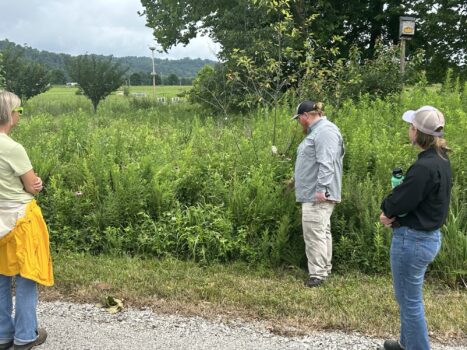
Most of those invasive species which are now choking out native grasses or bushes were put here with good intentions. Some were introduced to try and improve habitat with better food sources. Things like autumn olive were brought in deliberately as a way to help reduce soil erosion and provide a potential food source for a variety of birds. The problem is they grow faster than native plants or shrubs and will quickly take over the landscape and choke out other material which can be critical in the life cycle of many wildlife species.
David Galusha is the Cornerstone owner. His Ohio based company does habitat management work specifically for game species. He also explained during his part of the presentation habitat management for one species is probably going to benefit all species.
“Quail management is a catch all for everything. If you do something good for quail, turkeys are going to love it and deer are going to love it. It’s early successional habitat and edge habitat. Everybody who hunts deer know you hunt them on the edge of a forest or on the edge of a field or the edge of a food plot or cornfield. This is great stuff to install on farms or in odd areas,” he explained.
David said he sees a lot of people pay big money for food plots which aren’t really the best way to create habitat for wildlife. They are also expensive. If your property is a working farm you may seek a different conversation, but he explained if you’re managing for deer or other wildlife, going with native grasses and pollinators is a better play.
“A typical consult is, ‘How do I grow a giant buck to shoot in the fall?’ They tend to think that’s going to be a switchgrass screen and a food plot. But I like to survey the whole property and tell you instead of doing that, for a lot less money, we could take marginal hayfields and convert it over to natives,” he said.
You can find out more about Galusha’s company Cornerstone Habitat and Land Management here. Learn more about Quail Forever here.