


MORGANTOWN, W.Va. — Through Utah’s first three games this season, quarterback Devon Dampier was firing on all cylinders.
The New Mexico transfer completed 65-of-89 passes for 628 yards with seven touchdowns and no interceptions. He’d also rushed for 198 yards and one score on 33 carries.
Last Saturday, the dual-threat signal-caller had a rough go of it for the first time at Utah when his 38 passing attempts managed 162 yards and Dampier was intercepted twice while being held to 27 yards on 11 rushing attempts in a 34-10 loss to Texas Tech.
During his weekly media session Monday, veteran Utah head coach Kyle Wittingham noted Dampier was limited in practice while battling injury throughout the week — a revelation that came as a surprise to many.
“He was doing the best he could. He wasn’t able to practice Tuesday or Wednesday. Went a little bit Thursday,” Wittingham said. “It definitely impacted Devon, but if you’re out there, you have to get it done. We never use that as an excuse.”
Dampier was never listed on Utah’s official injury report, something Big 12 teams are required to provide for conference games for the first time this season. Dampier claimed his availability was never in question, but Wittingham issued a statement through social media to explain why the quarterback was not on the injury report.
It read:
“Quarterback Devon Dampier did not appear on last week’s player availability report because while he was limited in practice early in the week, his status of playing in last Saturday’s game vs. Texas Tech was never in question. We have spoken to the conference and have clarified the guidelines moving forward.”
The Salt Lake Tribune reported Dampier was seen with a brace on his right ankle in a since-deleted post on Utah’s social media account.
The Utes had four turnovers and failed to reach the end zone until the fourth quarter against the Red Raiders. After they scored their only touchdown, Texas Tech countered with 21 unanswered points and its defense continued to dominate, allowing 263 total yards and 3.8 yards per play for the day.
“We never discuss injuries here other than the injury report,’ Wittingham said. “We’ll just have to see how it goes. I know he’s in a better place on Monday than he was last Monday, so that bodes well.”
Dampier figures to be healthier when the Utes travel to Morgantown for Saturday’s 3:30 p.m. matchup with West Virginia that marks the first regular season meeting between the programs.
Dampier’s strong start at Utah came as little surprise. A year ago, in his second season with the Lobos, Dampier passed for 2,768 yards and 12 touchdowns and rushed for 1,166 yards and 19 scores. He played under the guidance of offensive coordinator Jason Beck in 2024 and is still doing so after Beck joined the Utah staff.
“Offensively, they’ve changed with the new coordinator and quarterback,” WVU head coach Rich Rodriguez said. “They’re a lot more spread, doing a lot of different quarterback run stuff. Really creative. Everybody was looking at him, because he was a dynamic player last year at New Mexico and he’s helped transform their offense this year.”
The Utes (3-1, 0-1) are averaging a shade under 37 points to rank 39th nationally in scoring offense, and a rushing offense producing nearly 243 yards on average is good for 17th among FBS teams.
Before last week’s loss, Utah had scored at least 31 points in each of its first three games and a total of 137 in convincing wins over UCLA, Cal Poly and Wyoming.
Dampier has a team-high 225 rushing yards, while running backs Wayshawn Parker and Naquari Rodgers have combined for 403 yards and seven touchdowns on the ground. Dampier, Parker and Rodgers each have more rushing yards than any Mountaineer to this point.
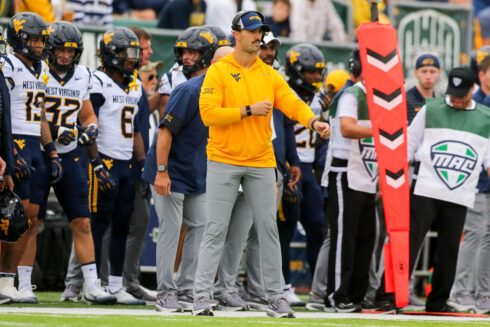
West Virginia defensive coordinator Zac Alley offered high praise to Utah left tackle Caleb Lomu and right tackle Spencer Fano.
“Their left and right tackle look like first-round draft picks. They have some dudes up there and they’re big and physical,” Alley said. “The quarterback is a good player. He can run. They use as a primary runner sometimes and get the plus-one run game going. They run behind the offensive line that way. They’ll give you normal sets where they take two extra offensive linemen, put them at tight end and run behind those guys. We have a big, physical group coming in and we have to play well.”
Alley feels the identity of the Utes’ offense isn’t all that different than what it’s been in recent seasons under Wittingham, but how Utah chooses to get there has been modified some.
“They’re still trying to be a power run team. They just get to it different ways,” Alley said. “They’ll show you more spread out formations, but they’re going to run power, counter and downhill at you consistently. That’s who they want to be.”