

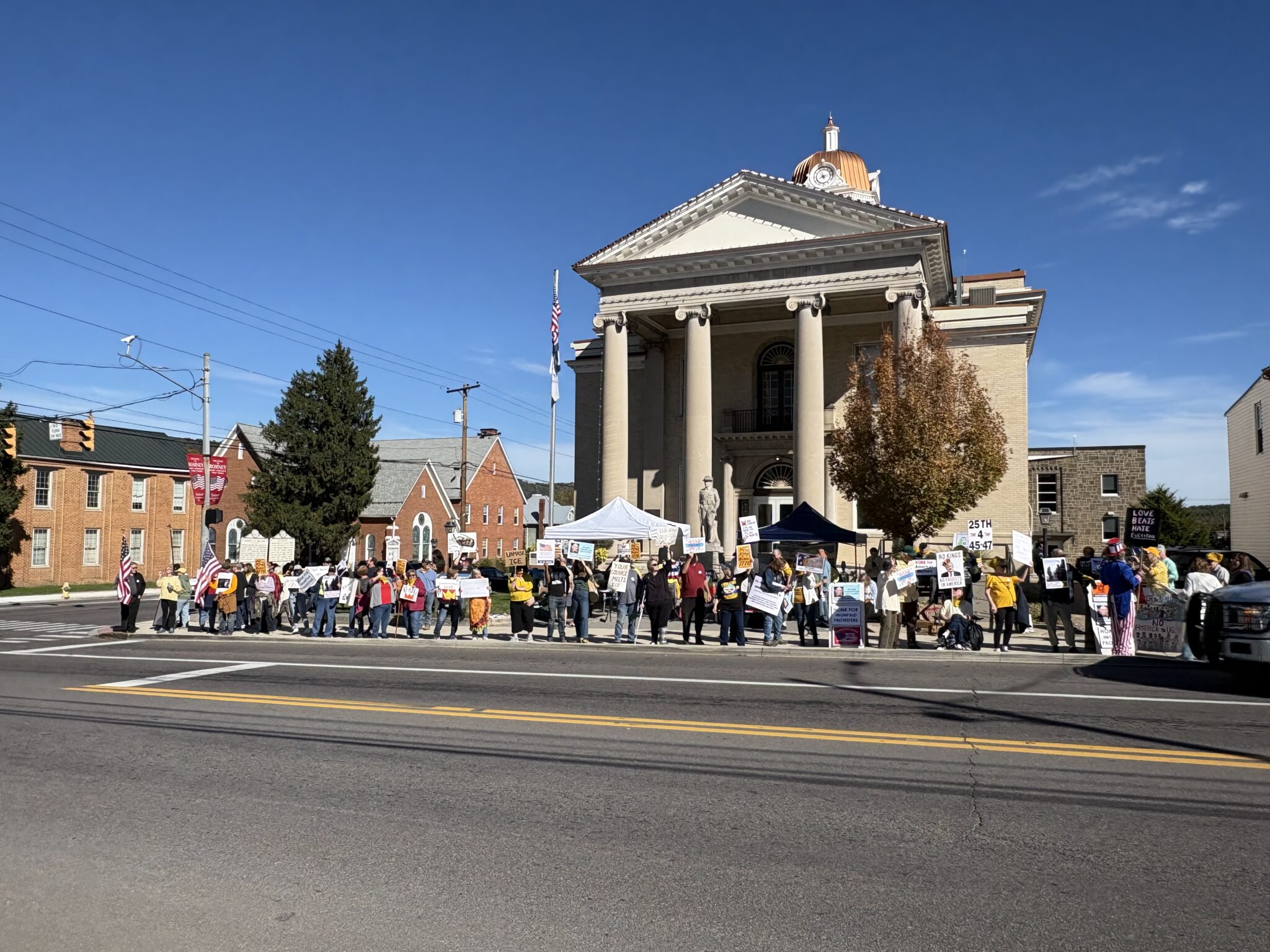
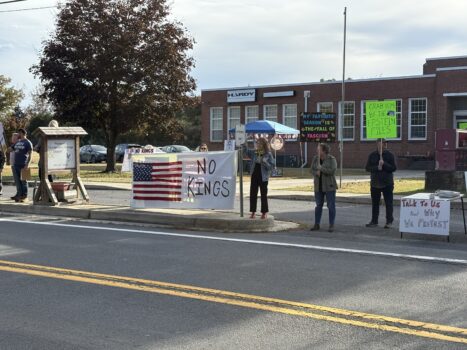
On a crisp fall morning along Main Street in Wardensville, Hardy County, a sign displayed by Annabel Park invited a question.
“Talk To Us About Why We Protest,” the sign said.
Park, a resident of nearby unincorporated Lost City, was one of many participants in the nationwide No Kings rallies to protest policies of the Trump administration.
“Right now, everyone all of us, we’re unhappy with what’s happening with this government. We need courage to go through this struggle and to defend our democracy,” she said.
“And I think by showing up and being counted and seeing one another it will inspire people to be more courageous — not just here but all over the country. Courage is a very specific thing because you can either submit to the fear or you can decide to stand up to the fear.”
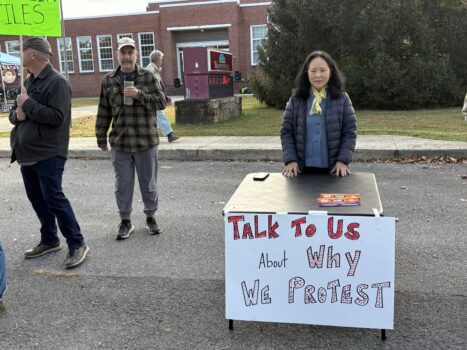
In West Virginia, rallies took place in communities all across the state on Saturday, including the state capital in Charleston, university cities Morgantown and Huntington and smaller places like Keyser, Fayetteville, Romney and Wardensville.
Participants said they were motivated by what they see as overreach by the Trump administration: on raids conducted by unmasked ICE agents, on mobilization of the National Guard in America’s cities, on extrajudicial explosions of boats said to be carrying drug dealers in international waters and on tariffs affecting markets without congressional approval.
HOPPY KERCHEVAL: Are we a free or fear society?
“I think we hate feeling like feeling like our freedom is being taken away from us. We hate feeling like our voices are not being heard. But we’re not hating anybody. We’re certainly not hating America. We’re trying to stand up for the America that we believe in, which is the First Amendment and right to have due process,” Park said.
“Most importantly, I think what we need is for people to know that there’s a community. It’s so important for us to know that we’re not alone and be a community, and that will also give us more courage.”
By vote margin, West Virginia has been the second-most Trump supporting state in the nation.
In the general elections of 2016, 2020 and 2024, Donald Trump won West Virginia by margins of about 42%, 39% and 42% respectively.
Trump’s overall favorability rating in West Virginia remains strong. Fifty-seven percent of respondents from last month’s MetroNews West Virginia Poll regarded Trump favorably compared to 38% who regard him unfavorably and just 6% who said they don’t know.
In the days leading up to this weekend’s No Kings events, U.S. House Speaker Mike Johnson was among the national Republican leaders who called the gatherings “hate America” rallies of “antifa types,” which refers to loosely-knit antifascist movements, and “Hamas supporters.”
Congressman Riley Moore, R-W.Va., echoed remarks like those during an interview on MetroNews Talkline this past week. Moore, the grandson of a West Virginia governor and nephew of a U.S. senator, said it’s self-evident there are no kings in America.
“You’ll have the antifa crowd and the pro-Hamas crowd of the Democrat party showing up and protesting, saying there’s no kings, which, yeah, got that — that’s pretty clear; any idiot knows that,” Moore said.
“But that tells you who’s kind of leading the Democrat party right now.”
A decade ago, conservatives supported a movement called The Tea Party.
In Romney, Hampshire County, rally-goer Emily McClellan blew bubbles to demonstrate that she is not inclined toward violence nor consumed by hate.
“There have been a lot of stories told about who we are, but as you look around here, you can see a number of elderly people, a number of middle aged people,” said McClellan, who lives on her family farm in Capon Bridge.
“And all we’re hoping for is to communicate a message that we are not happy with the way the government is going, and we’re taking advantage of the rights that are given to us under the Constitution to speak freely. We don’t have any ill will toward anyone.”
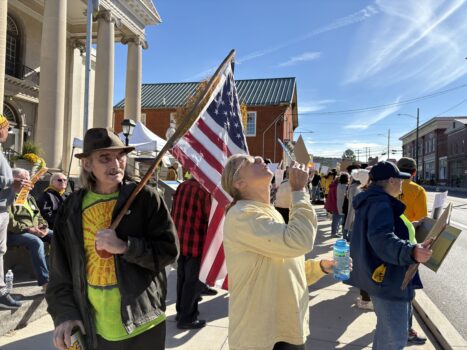
The crowd gathered at the Hampshire County Courthouse around a World War veterans memorial. Some drivers passing by honked in support and others rolled down their windows to express criticism. Music selections included “America (My Country, ‘Tis of Thee)” and “Country Roads.”
Several rallygoers carried American flags. “It’s patriotic, and we are here to support the Constitution,” said Robin Mills, a Navy veteran from Delray.
Dorothy Kengla of Augusta wore a badge that said “Honk for Unpaid Protesters,” a response to people who suggest the rallies are populated by people who are paid and bused in. Kengla also served as a marshal, meant to intervene and cool down conflict if any arose.
“To make sure nothing gets out of hand, that people don’t stand in the street, that we keep the sidewalk open, that type of thing,” she said.
“A couple of times we’ve had counter protesters here before, and they tend to get in arguments, so part of our job is just to diffuse any kind of argument. We’re here peacefully. We’re here protesting peacefully, we don’t want an uprising; we’re not here for an uprising.”
She concluded, “We’re not here to make trouble. Maybe good trouble, like John Lewis talked about. This is good trouble. We’re not hurting anybody. We’re not here to even argue with anybody.”
The biggest rallies in West Virginia were in the biggest towns. In Charleston, rally goers marched through the streets and then gathered on the steps outside the state Capitol, surrounding a statue of Abraham Lincoln that is associated with the state’s Civil War-era creation.
“I’m very worried that we’re heading to be not a democracy any more but to be an autocratic government,” said Lynette Shaw, who attended the rally in Charleston.
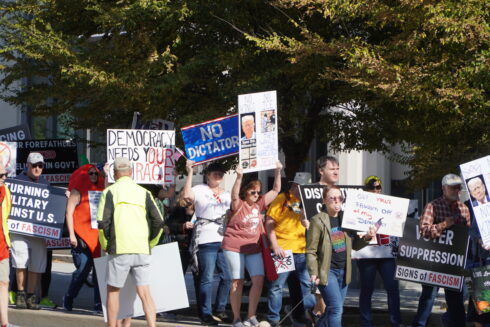
Another rallygoer in Charleston, Terry Messinger, described a range of growing concerns.
“I’m appalled at the condition of the country now. This is unprecedented. The loss of freedom. The loss of rights. Attacks on innocent people, hardworking people. And, particularly, rolling back the CDC,” he said, referring to hundreds of layoffs at at the Centers for Disease Control and Prevention.
At the rally in Wardensville, just a hop from the community library, the crowd gathered while “Tiny Dancer” by Elton John and “Islands in the Stream,” the duet by Dolly Parton and Kenny Rogers, rang out from a loudspeaker. It was the kind of playlist that might be featured at a Trump rally, actually, but the sentiment here was very different.
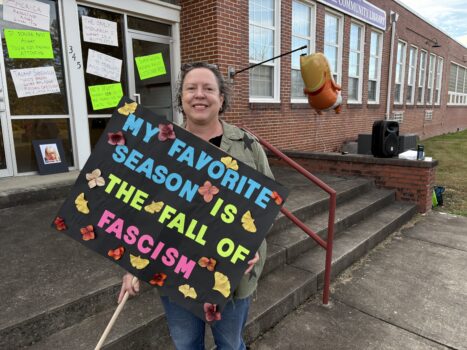
Sheryll Poe of Baker said a label of anti-fascist, or antifa, would fairly and accurately describe her view. Poe said she read “Project 2025,” all 900 pages. She displayed a sign that said “My favorite season is the fall of fascism.”
“It’s scary times for all Americans, and we can’t afford to be silent,” she said. “If you’re not anti-fascist, I don’t know why you would proclaim that you’re for fascism.”
Yet she was not certain that such events will change the minds of people with differing views.
“I come here for my community and my own gratification and to know that I said something and was on the right side of history,” Poe said. “I don’t do it because I think it’s going to influence or change any of my neighbors’ opinions.”
People at the rally in Wardensville observed that the community is close enough to the D.C. metro area that some people have second homes or getaways. And those people are affected by the federal shutdown or layoffs. Yet this is also a poultry farming area, where people might be affected by tariffs or the crackdowns on migrant workers.
“There is nothing more American than people showing up today. These are normal people who are scared. They’re angered by what’s going on, and the other side has really coopted the idea of patriotism and the U.S. flag in a way that I believe is un-American,” said Derek Howard of Lost River.
“This, to me, it doesn’t get any more American than this. So absolutely, we’re proud to fly the flag. I’m a proud American. Just because I’m here today, protesting, does not make me anti-American. I care deeply about our country, about our institutions.”
Aaron Parker of West Virginia MetroNews reported on this story from Charleston.