It had been almost a decade since Tanya Drummond needed help from her local food pantry. But at the end of last week, Drummond sat on a bench in the intake room alongside her young granddaughter.
“Just trying to get a little bit to make it,” said Drummond, a Charles Town resident.
The ongoing disruption in the Supplemental Nutrition Assistance Program meant monthly funds had not flowed to the card that usually helps her buy groceries. Drummond’s own refrigerator and shelves had emptied. So she came here for help to feed her family.
These stressful situations are arising across the state as federal food assistance remains in flux. Drummond had gone to Jefferson County Community Ministries, where need had increased last month, even before the SNAP problem hit.
“They’ve gotten extra tough. Usually I have food,” Drummond said. “They took the food stamps away, so family of three only living on SSI income made money really tight. Struggling.”
About 275,000 West Virginians hit by SNAP disruption
The food assistance program has origins in West Virginia. In fulfillment of a campaign promise made in West Virginia, President John F. Kennedy’s first executive order called for expanded food distribution and, on Feb. 2, 1961, he announced the initiation of Food Stamp pilot programs.
Alderson Muncy, an unemployed miner, and his wife Chloe were the first food stamp recipients on May 29, 1961. They bought a can of pork and beans along with other groceries from Henderson’s Supermarket for their household of 15 children in Paynesville, McDowell County.
This month, for the first time, the food assistance program has come to a halt. About 275,000 West Virginians — 16% of the state’s population — are supported by SNAP benefits. The total amount necessary to fund SNAP benefits in West Virginia for a month is about $47 million.

Gov. Patrick Morrisey has called for a donation drive while directing $11.1 million so far for distribution to pantries and feeding programs across the state. The governor has also directed the National Guard to assist.
Neighboring Maryland and Virginia have moved to use state funds to fill the funding gap on the cards people use for SNAP benefits, but Morrisey has not yet done the same.
““West Virginians take care of our neighbors. It’s times like these that we need to come together as Team West Virginia to help those in need,” Morrisey said.
Higher demands on the food pantry
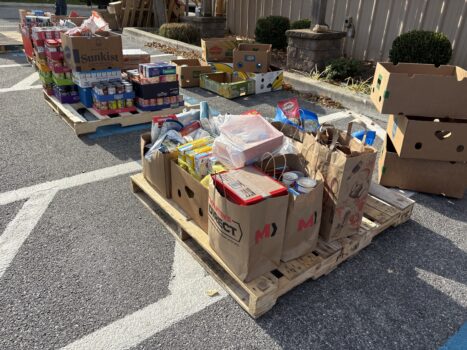
People have been turning for help to places like Jefferson County Community Ministries. A steady flow of people headed to the organization along West Washington Street in Charles Town late last week to fill needs like groceries or baby formula. A few blocks away at the Ranson Civic Center, cars pulled through to donate goods for a food drive.
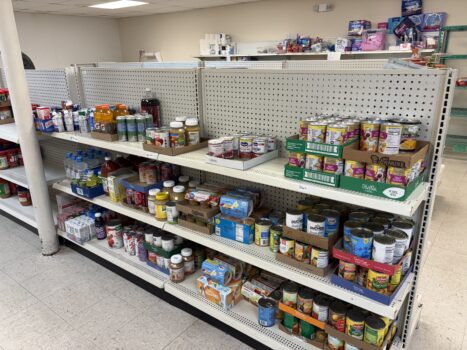
A storage area in the basement of Jefferson County Community Ministries is the most barren that Kari Dean, operations manager, can remember in her six years on the job.

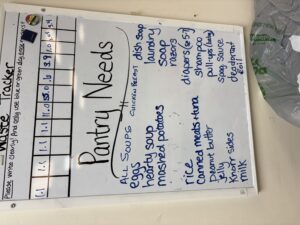
“We typically have our abundance of staples like green beans and corn — but the fruits and the other vegetables and the canned meat and that kind of stuff we do not have like we’ve had in the past,” Dean said.
“We had our busiest October in five years last month, and just in the first three days of business this month we gave out over 4,000 pounds of food. Typically, in the first three days of a month, it’s around 1,300 to 1,500 pounds — so it’s more than tripled already for this month.”
That kind of pressure was already growing.
Dean crunched some numbers at the end of another tough week.
Last year, during the first week November, community ministries served 83 families.
The same week this year — last week — the organization served 162 families.
In 2024, in the first week of November, the organization distributed 1,997 pounds of food.
The first week of November this year, people needed and received 6,959 pounds of food.
“It’s a combination of things,” Dean said. “You’re seeing more and more increase in food costs. This time of year is always busier, so you always see an increase and each year we see an increase from the year before. So compared to last year it’s higher, but it’s even higher because of energy prices and food prices.
“So for a lot of families in this area, it’s a matter of choosing between paying the mortgage and paying bills and putting food on the table.”
In the first three days of November, 20 new clients came in for help.
“It’s one thing to admit it to yourself. It’s another to walk into a building like this and say ‘Here I am, completely vulnerable, help me.’ It’s difficult,” Dean said.
“I’ve had people sit at the desk and cry because they need help and they’ve never needed help before. I’ve had grown men sit and sob because they aren’t able to support their families the way they feel like they should or they feel like they’re letting their kids down because they’re not doing their part in supporting them. It’s hard for people.”
Shutdown affects people in several ways
Jefferson County, like many communities in West Virginia’s Eastern Panhandle, has a significant number of federal workers, many of whom have not received paychecks while the shutdown has stretched more than a month.
On top of that, federal officials announced that benefits under SNAP would not be available starting Nov. 1, affecting 42 million Americans as the federal shutdown drags on.

“Households are having to make really difficult decisions who maybe have never faced something like this before,” said Brooke Grossman, executive director of Jefferson County Community Ministries.
Through all of this, families have watched a back and forth at the federal level.
Federal courts directed the Trump administration to use emergency contingency funds for SNAP. At first, the Trump administration said that it would have enough funding to cover about half of each eligible household’s benefits this month.
Then, a federal judge followed up with an order to fully fund SNAP for the month of November. The administration has said it would appeal and then asked for the judge’s order to be stayed.
“It’s an absurd ruling because you have a federal judge effectively telling us what we have to do in the midst of a Democrat government shutdown,” Vice President J.D. Vance said, adding “in the midst of a shutdown we can’t have a federal court telling the president how he has to triage the situation.”
On Friday evening, the Trump administration made an emergency appeal to the U.S. Supreme Court, which granted a temporary halt to the full funding of SNAP benefits until the matter is more thoroughly reviewed.
Watching what happens, or what doesn’t happen, at the federal level can cause additional stress for regular people trying to make ends meet, said Grossman of the Jefferson County organization.
“What it adds is an extra layer of confusion,” Grossman said. People who are already worried about putting food on the table may think, “I read one article that says I should expect money on my card in 10 days, and I read another that says maybe or we’ll let you know. It is this ever evolving thing.”
‘My kids will go hungry’
An example of confusion combined with heartache was illustrated by a mother running out of baby formula.
The mother called, crying, because she had gotten a can of formula a couple of weeks ago. Normally, there are standards for how often people can get supplies from the food pantry. Now, the mother had run out, had no funds to buy more and worried that she had already met her quota from the pantry.
“Just come and get some formula,” Grossman and the food pantry said. “We want to make sure the baby’s fed, and you as a mom shouldn’t have that burden on you.”

Such stories of need are not uncommon around West Virginia, said Kelly Allen, executive director of the West Virginia Center on Budget and Policy.
“Despite tireless efforts from food pantries and generous residents, many of our friends and neighbors are going hungry right now,” said Allen, who is pushing for the president, the governor and members of Congress to work on getting SNAP dollars loaded onto households’ cards.
“Every hour of delay and uncertainty increases the number of households who are struggling to eat, keep the lights on, and find the foods they need to meet their families’ needs.”
The policy center asked SNAP recipients to fill out a survey to describe how they are being affected by the benefits delay. Dozens of people from all over the state responded with stories of hardship.
“Thank God for food pantries or we wouldn’t have enough food,” wrote a respondent from Parkersburg.
A Fayetteville resident wrote, “Not sure where or how we’re gonna make ends meet honestly my diabetic child has to have fruit and veggies fresh and certain snacks at all times.”
A Huntington resident described, “Getting behind on bills and rent because I can’t afford to pay everything in full and buy food. I refuse to let my children go hungry.”
“My kids will go hungry,” wrote a Sod resident.
A Beckley resident echoed that: “My kids are hungry.”
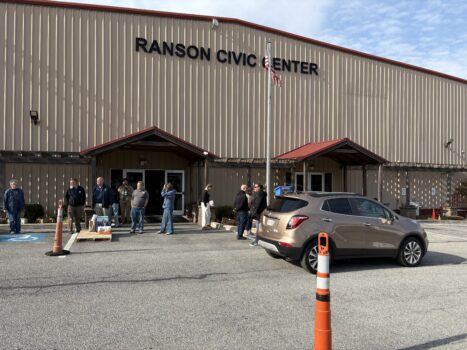
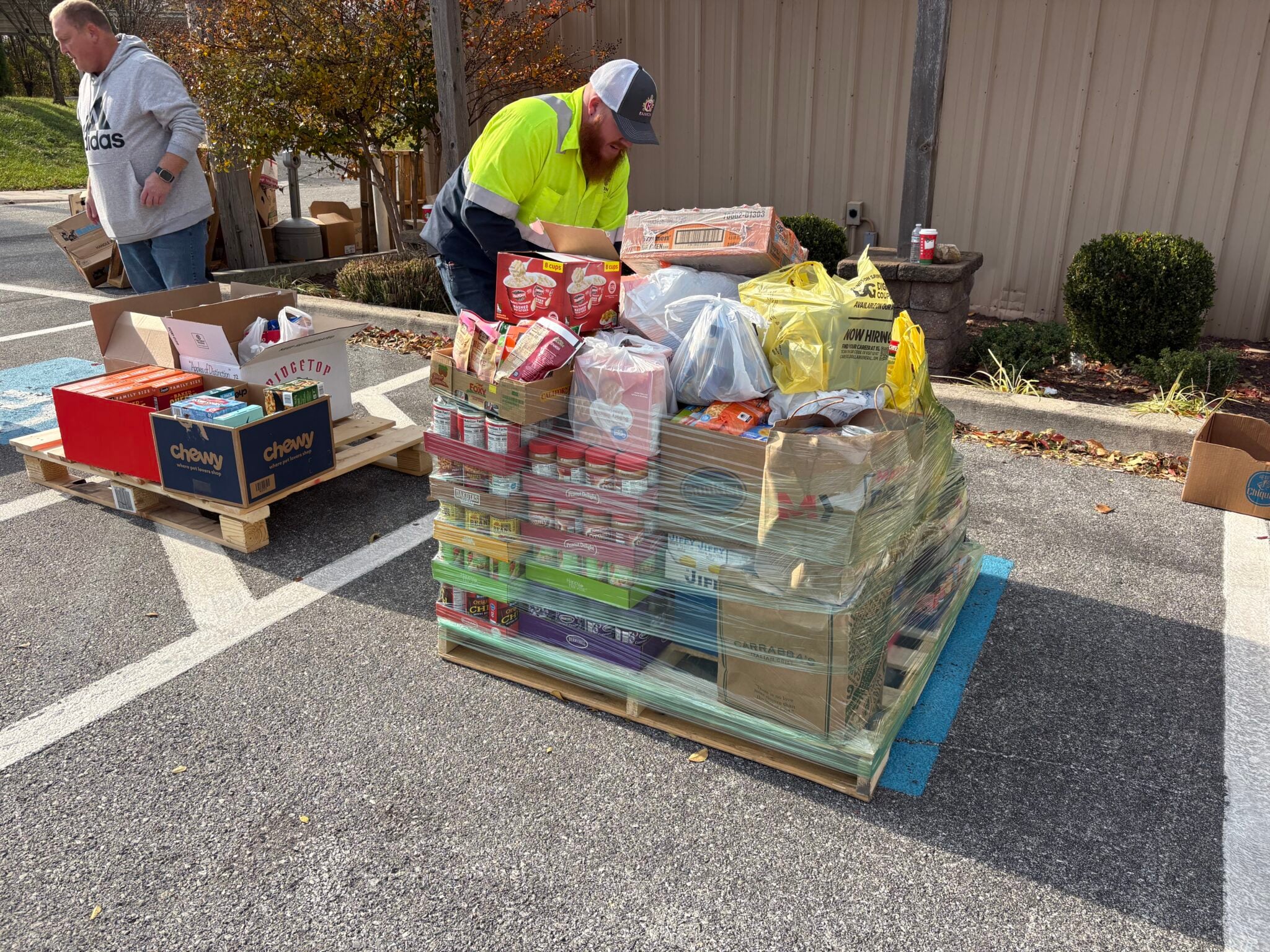
A food drive takes in supplies at the Ranson Civic Center in Jefferson County. (Brad McElhinny/MetroNews)Food drive in growing area
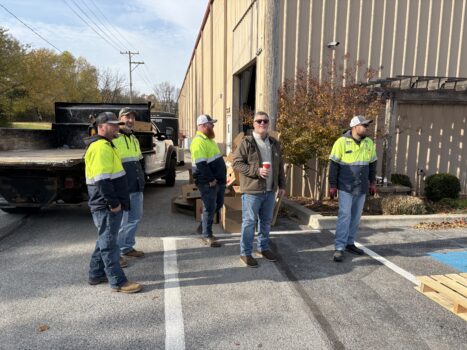
A steady flow of vehicles pulled up outside the Ranson Civic Center on Friday to donate food and supplies. The event was a cooperative effort by neighboring Ranson and Charles Town to replenish supplies for Jefferson County Community Ministries.
“Ranson and Charles Town got together and said this is something we need to do,” said Charles Town Mayor Mike George.
“I know a lot of people who were federal government workers, and they’ve missed three paychecks. They were living paycheck to paycheck, and so you have to stop doing things and find other avenues for food.”
This is a growing area of West Virginia, with new residents and homes being added steadily in communities only about an hour from the Washington, D.C., corridor.
As the traditional population and the newer population blend, each are having economic challenges. In particular, many of the federal employees who live in the area are furloughed or working without pay.
“With the shutdown and the SNAP benefits pause,” said Ranson city manager Todd Wilt, “the needs just continue to grow.”

Stephanie Fagan, an at-large member of the Ranson council, is a social worker and pushed for the food drive. Her husband is a furloughed worker. And Fagan, who is a licensed therapist, said many of her clients are furloughed federal workers. “So we’re feeling the impact of that as well.”
“The need has skyrocketed,” Fagan said, noting that the Title 1 designation for the school district means 40% or higher of the students qualify for SNAP benefits.
“I do know of a lot of children who are going to school hungry. Fortunately, because we’re a Title 1 community, we have free meals at schools so they’re able to get that breakfast right when they get there. But we are seeing an increase in hungry kids, which leads me to believe they’re not getting that big, hefty dinner that they might have been getting before.”
Fagan said she is grateful the community has come together.
“I’m really thankful,” she said, “for the community stepping up at this time. It’s wonderful and beautiful to see our community stepping up in such a big way.”