

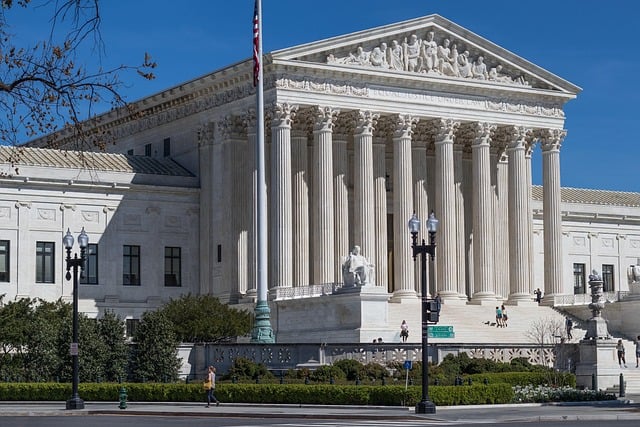
The U.S. Supreme Court will hear oral arguments this week in a challenge to a West Virginia law forbidding the participation of transgender athletes on school sports teams.
The case is West Virginia vs. B.P.J., which represents the initials of a young transgender athlete.
The questions being posed to the Supreme Court are:
— whether Title IX of the Education Amendments of 1972 prevents a state from consistently designating girls’ and boys’ sports teams based on biological sex determined at birth;
— and whether the equal protection clause of the 14th Amendment prevents a state from offering separate boys’ and girls’ sports teams based on biological sex determined at birth.
Justices will actually be hearing two related cases, starting at 10 a.m. Tuesday.
The first, expected to go about an hour, is Little v. Hecox.
That case is named for Gov. Brad Little, who in 2020 signed a law prohibiting transgender women and intersex individuals from playing on female sports teams in Idaho public schools, and transgender athlete Lindsay Hecox, 24, who wanted to compete on the women’s track and cross-country teams at Boise State University.
Oral arguments in the West Virginia case will follow the first case.
The Supreme Court does not broadcast video of oral arguments, but live audio is available here on the day of the case or archived here.
The West Virginia case focuses on student athlete Becky Pepper-Jackson, who was born male but identified as a girl from a very young age. By third grade, she was living as a girl at home and told her mother and father she did not want to keep going to school dressed as a boy.
More recently, she was diagnosed with gender dysphoria and had been receiving puberty-delaying treatment for almost a year when West Virginia passed a bill affecting transgender athletes. Her federal lawsuit, where she is referred to as B.P.J., was aimed at being able to participate on the cross-country and track teams in Bridgeport.

Pepper-Jackson has been allowed to compete as the case has gone through the federal court system. Last spring, she qualified to compete in shotput and the discus throw in the West Virginia High School State Track & Field Championships. She placed third in discus and eighth in shotput.
“I play for my school for the same reason other kids on my track team do–to make friends, have fun, and challenge myself through practice and teamwork,” Pepper-Jackson said in a press release distributed by ACLU-West Virginia.
“And all I’ve ever wanted was the same opportunities as my peers.
She is challenging a law passed in 2021, when West Virginia joined dozens of states in placing restrictions on transgender athletes’ participation on sports teams.
House Bill 3293 defines male and female “based solely on the individual’s reproductive biology and genetics at birth.” A key part says, “Athletic teams or sports designated for females, women, or girls shall not be open to students of the male sex where selection for such teams is based upon competitive skill or the activity involved is a contact sport.”
In 2024, U.S. District Judge Joseph Goodwin of the Southern District of West Virginia upheld West Virginia’s law.
“The question before the court is whether the legislature’s chosen definition of ‘girl’ and ‘woman’ in this context is constitutionally permissible. I find that it is,” Goodwin wrote last year in a 23-page ruling that also found the state’s law complies with federal Title IX.
Goodwin’s ruling was appealed to the Fourth Circuit Court of Appeals, which covers the area that includes West Virginia, where a three-judge panel’s majority largely disagreed.
The appeals judges concluded that the application of West Virginia’s law would discriminate against Pepper-Jackson only because of her transgender status, disregarding her puberty blocking treatment that held off the effects of testosterone or the non-contact nature of running sports.
“The question before us is whether the Act may lawfully be applied to prevent a 13-year-old transgender girl who takes puberty blocking medication and has publicly identified as a girl since the third grade from participating in her school’s cross country and track teams,” Judge Toby Heytens wrote in the majority opinion. “We hold it cannot.”
The case now winds up at the Supreme Court of the United States.
The West Virginia Attorney General’s Office will be defending the state law, with state Solicitor General Michael Williams addressing the court.

“This is a commonsense law that is enforceable in a way that is rational,” said Attorney General J.B. McCuskey, a Republican. “And it’s important because this is a place where size and strength and speed matter.”
At a press conference last week, McCuskey continued by saying, “Every child in West Virginia deserves to have the opportunity to play sports and to play sports against people who have the same immutable physical characteristics as themselves.
“This law was not created to stop anyone from playing sports. This law was created to ensure our athletic playing fields were fair and safe for women. And I think that is a very, very important thing — not just for women but for athletics in general.”
Becky Pepper-Jackson Becky and her mother are represented in the case by the American Civil Liberties Union, the ACLU of West Virginia, Lambda Legal and Cooley LLP.
The case is fundamentally about the ability of transgender youth to participate in school and community activities, said Joshua Block, senior counsel for the ACLU’s LGBTQ & HIV Project.
“School athletics are fundamentally educational programs, but West Virginia’s law completely excluded Becky from her school’s entire athletic program even when there is no connection to alleged concerns about fairness or safety,” Block said.
“As the lower court recognized, forcing Becky to either give up sports or play on the boy’s team – in contradiction of who she is at school, at home, and across her life – is really no choice at all.”