


West Virginia lawmakers have begun considering the governor’s $5.493 billion budget, including whether the state can afford another proposed income tax cut over the longer haul.

“Governor Morrisey is presenting a balanced budget as required,” Revenue Secretary Eric Nelson told senators.
The biggest drivers of budget growth were:
- the Hope Scholarship for families with students outside the public school system, with an increased base of $127.3 million in the coming fiscal year. This is the first year of full implementation to all families who want to use the money.
- an aggregate pay raise amount of $78.4 million
- and an increase for the employers of the Public Employees Insurance Agency costs of $35.1 million.
Over the next couple of months, some of the key budget calculations could change — particularly when it comes to the tax cut as well as a proposed public employee pay raise averaging 3 percent.
In a briefing before the Senate Finance Committee, administration officials said the budget proposal actually was calculated with a 5% tax cut in mind. Gov. Patrick Morrisey, during his State of the State address, made a pitch for a 10% tax cut.
In dollars, the 5% would add up to about $125 million. The 10% would equate to about $250 million.
“This budget will include a 5 percent reduction in PIT in the numbers presented to you,” Nelson told lawmakers.
“The governor last night talked about a 10 percent cut. We are very focused on getting to that 10 percent, but the additional 5 percent is one that the governor is committed with working with you, the members of the Legislature, to look for offsets to help pay for that additional 5 percent.”
The Legislature and the prior administration cut its personal income taxes significantly in recent years through a series of legislative and trigger-based reductions, resulting in a cumulative decrease of more than 20% since 2023.
So now lawmakers will need to have ongoing discussions about whether the state can afford another tax cut at this moment, and how much.
A six-year plan, used as a budget forecasting tool by the administration, projects a $204 million gap in fiscal 2028 — growing to a gap of $411 million by fiscal 2031.

The governor addressed that today on MetroNews Talkline, saying his administration has made it possible by focusing on financial fundamentals.
“We have been aggressively auditing agencies, and we’re looking for savings constantly,” Morrisey said.
He continued, “Absolutely we can. The numbers for the six years are better than they were last year because of the decisions we made. But I look at it as this is a priority to keep pace with our competitors.”
State Budget Director Mike McKown, a veteran of state financial wrangling, said the anticipated budget gaps in coming years are problems to be solved.
“That doesn’t mean we’re going to run out of money and we’re broke. It means if things stay in place today, these are the types of adjustments that need to occur to balance next year’s budget,” McKown told senators.
He continued by saying it’s worth watching future years for preparation and said the future gaps are such that “I could balance that in my sleep some nights. It’s a problem, but it’s not an unsolvable problem.”
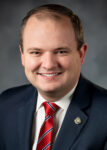
Senator Ben Queen, R-Harrison, followed up by asking about the effect of the tax cut proposal on those future budget gaps.
“Do these gaps contemplate a 5 percent PIT cut — or a 10 percent PIT cut?” Queen asked.
Five percent was the answer.
Queen continued, “Five percent is what we’re looking at — so these grow a little bit at a 10 percent tax cut.”
McKown responded, “If there’s not offsets to the 10 percent personal income tax increase the governor spoke about — this budget contemplates a net 5 percent.”
Queen then asked, “What happens if we don’t cut that at all?”
“Don’t cut any? Those gaps get better,” McKown said. “The money in people’s pockets gets lower, though.”

After the meeting, Kelly Allen, executive director of the West Virginia Center on Budget & Policy think tank, said the numbers should flash as a warning signal.
“The budget Governor Morrisey presented to the legislature is one he might have complained about inheriting from his predecessor as fiscally irresponsible,” Allen said.
“He proposes more tax cuts despite needing to use one-time dollars to pay for ongoing base budget costs and projecting looming budget gaps in upcoming years that impact our ability to invest in PEIA, schools, and infrastructure. In his own words, his proposed tax cuts will require hard budget decisions for many years to come.”
She concluded, “West Virginians are already dealing with the consequences of years of tax cuts that failed to reach most families or to create promised growth and economic opportunity. Instead they resulted in significant public sector job losses, degraded infrastructure, and far too many neighborhood schools closing. More of the same is not an option.”