

West Virginia’s first pitch to the federal government to become a nuclear energy hub began with a proposition for spent fuel recycling and interim storage.
But Gov. Patrick Morrisey now says “West Virginia will not be a dumping ground for nuclear waste.”
The difference, the administration has now said, is that one source of information is a bureaucratic document and the other is the governor’s word.
The first proposition was made in writing last April as West Virginia responded to a proposal from the U.S. Department of Energy to be designated a Nuclear Energy Lifecycle Campus, a designation for a range of nuclear energy activities from beginning to end.
The Department of Energy call-out explicitly asks candidate states to detail how they will handle nuclear waste, used nuclear material and secondary waste streams. The DOE framed waste management as a core function.
West Virginia’s initial, 48-page response proposed a phased approach that begins with spent fuel recycling and interim storage before expanding into advanced reactor deployment and manufacturing.
COMMENTARY BY T.J. MEADOWS: Breaking Down the Nuclear Lifecycle Innovation Campus Story
“West Virginia is intentionally beginning with nuclear initiatives that are actionable and high‑value, particularly those tied to the spent and partially spent fuel stream and backend services, areas where the state can quickly demonstrate success and build momentum,” the West Virginia energy office wrote in the letter.
Furthermore, “West Virginia is the 39th most populous state in the U.S., the country’s fifth‑largest energy producer, and a long-standing net supplier of energy.”
Although it was not an end point or binding, that letter was the State of West Virginia’s official communication to the federal government to state its interest and to lay out a framework for what it could do.

Early this month, Governor Morrisey announced that West Virginia had rallied to become one of six finalists. The governor acknowledged that did not mean that West Virginia had received final go-ahead, but he expressed excitement that the state had an opportunity. “We’re at the table.”
That same day, The Charleston Gazette-Mail submitted an information request to the state for documents related to West Virginia’s bid for a nuclear hub.
Late last week, the newspaper published a story headlined, “WV touted ability to fast track permits, listed potential sites in nuclear campus bid.” The print headline was, “W.Va. offers to store nuclear waste.”
The story accurately reflected West Virginia’s first written response to the federal government and described some areas of the state with potential to be considered for a nuclear hub, including the former Hobet mine site in Boone County and parts of Jackson and Jefferson counties.
State officials cautioned that potential sites have not yet been fully vetted or geologically qualified.
The details caught some people off guard, including state Delegate Josh Holstein, who represents communities in Boone County. He is also chairman of the state Republican Party.
“Unfortunately, I nor any other elected official that represents Boone County that I have spoken to today, has been given any information nor was notified about this development at all,” Holstein posted on social media.
Holstein followed up with another post to say he had been “assured by Governor Morrisey’s office that there will be no nuclear waste dumping in Boone County or in any other site in West Virginia” and expressing relief.
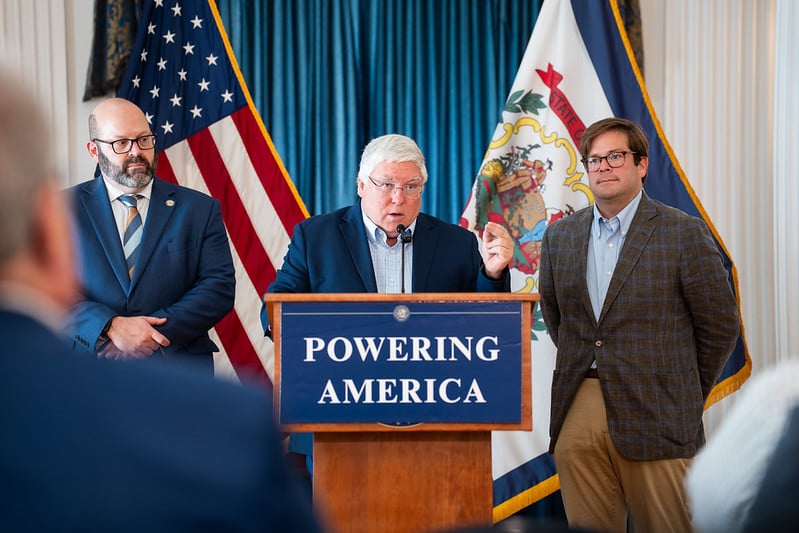
The governor went on social media this Sunday afternoon to express his displeasure with the newspaper article and to say “West Virginia will not be a dumping ground for nuclear waste. Period.
His post continued, “I have directed my Office of Energy to ensure that every site identified in our final Nuclear Campus application is considered only for nuclear generation or manufacturing — not as a dump.”
The newspaper responded with a post standing by the story.
The state’s correspondence with the U.S. Department of Energy had not used the word dump (and neither had the newspaper article), but it had listed a consolidated interim storage facility as its first priority and research for final disposition/long-term storage boreholes, engineered caverns as the second.
“West Virginia has identified partially spent and spent nuclear fuel streams management as a near-term actionable strategic opportunity,” the state had told federal counterparts.
“West Virginia proposes anchoring the Nuclear Lifecycle Innovation Campus around advanced fuel recycling, materials recovery and responsible long-term nuclear materials stewardship.”
The proposal specifically highlights four neighboring states — Pennsylvania, Maryland, Virginia and Ohio — and envisions West Virginia’s proposed Consolidated Interim Storage Facility as a centralized regional resource.
West Virginia’s response emphasizes that taking spent fuel from surrounding states is intended to support advanced fuel recycling, materials recovery and research into closed fuel cycle technologies, rather than serving as passive long-term waste disposal.
In a social media post intended to reconcile the State of West Virginia’s written response to the U.S. Department of Energy with what the governor said this week, Morrisey administration spokesman Lars Dalseide said “Governor’s clear directive trumps bureaucrat letter. No nuclear waste. Once again, it couldn’t be more clear.”
Asked to clarify whether the governor had made this position official anywhere besides a social media post, Dalseide responded, “You have confirmation that the Governor will not allow any nuclear waste and will ensure that all bureaucratic actions and letters in the future reflect that fact. As the Governor’s spokesman, I am confirming this.”
All sides have acknowledged that the application to be a nuclear hub is flexible and fluid. West Virginia still might not even be chosen.
Another step occurred earlier this month when the governor signed a memorandum of understanding that serves as a broad framework for how the state and federal governments can collaborate moving forward.
The memorandum, which is not binding, specifies that coming negotiations must address the acceptance and management of out-of-state used nuclear fuel, spent nuclear fuel, high-level radioactive waste and Greater-than-Class-C waste.
An important step coming up right away is a legally binding Host Agreement to be executed by Sept. 30, which is this week. If a Host Agreement is not signed by that date, either party has the right to terminate the partnership.
The Host Agreement will establish the enforceable terms, conditions and funding mechanisms for the Nuclear Lifecycle Innovation Campus.
Among its functions, the Host Agreement will outline the physical infrastructure required — including facilities for safe waste disposal —and define the specific nuclear and industrial product lines developed for the hub.
The written documents across the proposal — including the memorandum of understanding, West Virginia’s response to the federal request for information and the Department of Energy’s guidance — all emphasize that public communication must be early, transparent, continuous and focused on education to build durable trust.
“Beyond economic gains, Innovation Campuses may provide long-term societal benefits to local communities, including high‑quality employment opportunities, educational and training programs, and infrastructure improvements,” federal officials wrote in their call-out to states.
“These benefits should be designed and implemented alongside robust community engagement, and clear communication of risks and responsibilities associated with long‑term waste management or site remediation.”