

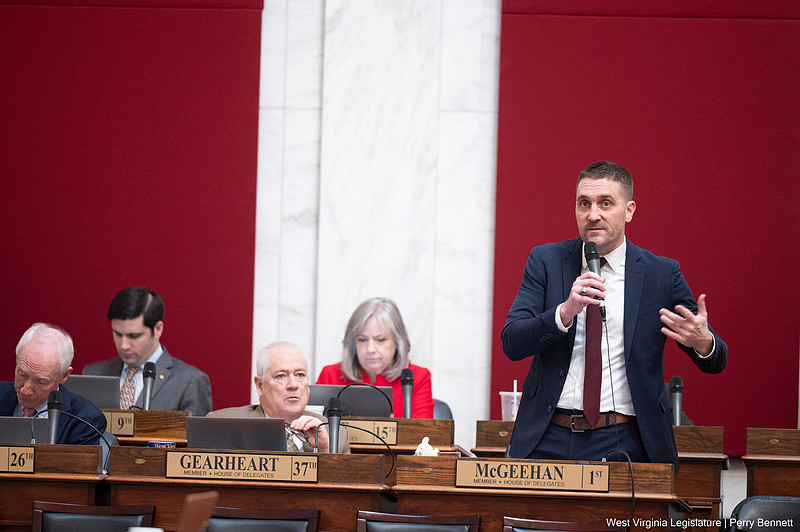
West Virginia delegates swiftly moved bills to establish an emergency fund for distressed county school boards while appropriating $8 million, in response to a fiscal crisis in Hancock County.
The full House of Delegates suspended rules and overwhelmingly passed the bills out. The emergency fund could be used for any county defined as financially distressed, but officials said Hancock is the only one known to be eligible right now.

House Majority Leader Pat McGeehan, a Republican from Hancock County, has been monitoring the local school system financial situation and told his colleagues, “It was gross mismanagement. Hopefully it’s not more than or something worse than that.”
This follows a move by the state Board of Education on Friday to take over Hancock County schools and fire top personnel.
The county has been described as being roughly 140 employees over what the state school funding formula could support. State officials have said the county used federal covid relief dollars for ongoing expenses and then did not ween off adequately when that funding dried up.
Altogether, state officials have said Hancock County’s troubles include a $5 million cash shortfall, a $2 million high school overspend and a $1 million turf project with dollars from the county board’s general fund.
The House bills introduced today establish a temporary shortfall supplement fund, making loans available to counties with reserve balances below 5% to ensure they can meet payroll and essential costs.
As efforts to maintain accountability, the legislation mandates strict financial reporting, requires the implementation of electronic tracking systems, and sets conditions for repaying the state.
A second bill designates an initial $8 million from the state’s surplus to establish the fund.
COMMENTARY by T.J. MEADOWS: School bailout bill lacks ultimate consequence

Delegate Bill Anderson, R-Wood, said during the finance committee hearing that he would support the legislation as a precaution, but that he would like to see additional teeth.
“So I think the state board needs to establish standards if you need to tighten it up to where we don’t have this situation created in the future,” he said.

Testifying before the House Finance Committee, which initially took up and advanced the two bills today, state Superintendent Michele Blatt, said only Hancock County would currently qualify for the emergency financial relief.
Blatt said the financial mess snuck up on state officials because local officials gave no indication of trouble in their mandatory reporting data and had no prior track record of trouble.
Referring to the state’s West Virginia Education Information System, Blatt told delegates, “There are triggers that can be turned on in our WVEIS system that would allow it to flag certain things, not only for the county, but for us. They were not using any of those features.”

Delegate Daniel Linville, R-Cabell, responded by commenting, “Effectively, you’re telling me they intentionally misled the department.”
Blatt didn’t disagree: “It appears that they intentionally misled, or just had no idea what they they had on hand.”
State school board President Paul Hardesty also spoke before the committee and said what happened in Hancock County “is like in your home — if you don’t want people on the outside to see what’s going on, you turn the lights out, do you not?”
He continued by telling lawmakers there’s reason for continued concern “because if these counties don’t start making the tough cuts, and now that we’ve got this lifeline possibly coming into play, there’ll be others within two, three years, heading your way.
“You cannot continue to spend money that you do not have. It does not work.”
The financial safety net package now goes to the state Senate for consideration.

Senator Rollan Roberts, a Republican from Raleigh County and a member of the state Senate Education Committee, expressed skepticism about the state education department’s oversight.
“Here we go again. Here we go again. What in the world is the state Department of Education supposed to be doing, but providing appropriate oversight over the counties to prevent this from happening? This has not this is nothing new,” Roberts said on Radio Roundtable on WJLS AM.
He continued by saying, “Now they’re going to come to the state and say, ‘You know what? We need money to bail them out, and we need to set up a fund to bail all the others out. They’re doing the same thing because we can’t control what we’re hired to do.’
“No, I’m not happy with how this thing is playing out.”