

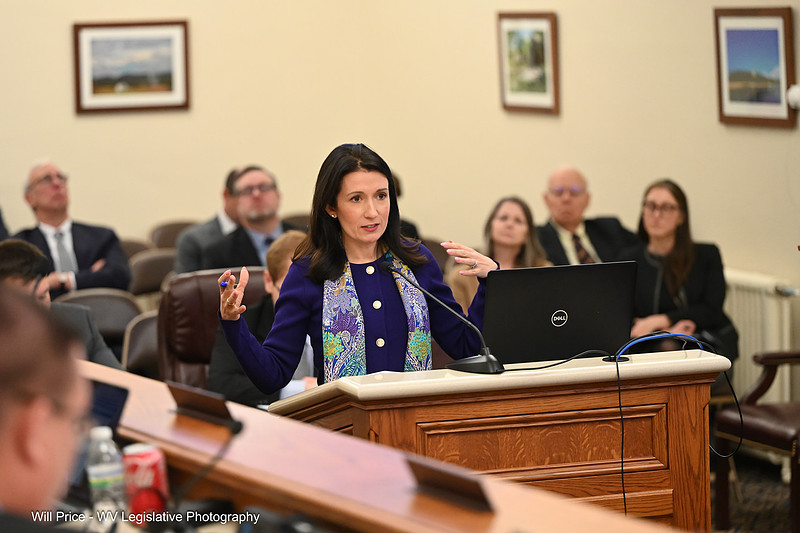
West Virginia’s court system proposes only a slight budget increase for the coming fiscal year, .81%, with the largest portion of the increase going toward bolstering the family treatment court system.
Chief Justice Haley Bunn presented the budget proposal Tuesday afternoon to the Senate Finance Committee, saying lawmakers and legal officials share a goal of “the best bang for the taxpayer dollar.”
Last year, the court system requested $173,114,659.
This year, the court system requested $174,529,140.

“We are not here to pad our budget. We are here to ask you for what we need to run our branch of government,” Bunn told senators.
The largest single increase that Bunn proposed was $1.4 million for the family treatment court.
The court system budget also proposes increases of:
— $220,000 for 4 peer recovery support specialists.
— $266,587 for changes to court reporter pay scales.
— 319,804 in pay step, merit and market pay scale adjustment increases.
— $470,000 for the proposed 3% employer premium increase for the Public Employees Insurance Agency.
The court system proposes a couple of budget cuts:
— a $1 million reduction/reallocation in technology costs.
— and a $224,347 decrease in other expenses.
The court system budget does not account for the governor’s proposed average 3% pay increase for public employees. The estimated cost for non-elected court system employees would be $2,886,881, so lawmakers would need to choose to help the court system achieve that amount for those pay raises to be granted.
The West Virginia family treatment court system is a specialized court program helping parents with substance use disorders safely reunify with children in foster care by providing intensive treatment, counseling, drug testing, and support services.
The program has 13 courts serving 19 counties in West Virginia. Officials propose using the additional $1.4 million to continue operations and add at least two more courts.
“It’s about $100,000 for each family treatment court, and that cost is primarily people,” Bunn said. “You need a family treatment court coordinator who is the glue that keeps the team together and keeps the participants on the road.”
Last year, uncertainty arose about funding for the program.
Historically, Bunn said, the program has been funded through grants. At first, that was through McKesson Corporation opioid settlement funds administered by the West Virginia Office of Drug Control Policy.
The transition of settlement fund distribution from that office to the West Virginia First Foundation resulted in a funding gap “until essentially the 11th hour last year,” Bunn said.
Stopgap funding eventually came by way of a grant through the Public Defender Services’ Impacting Child Abuse and Neglect (iCan) program.
“But we did come down to a position where, essentially we didn’t know if we were going to continue to be able to allow these programs,” Bunn said.