

An immigration sweep that resulted in more than 600 arrests in West Virginia was built on collaboration with a growing number of local law enforcement agencies, which in recent months have been rewarded with hard-to-pass-up incentives to work with U.S. Immigration and Customs Enforcement.
“We couldn’t have done it without the help of the state and locals,” Michael Rose, the acting field office director in the Philadelphia region for ICE’s Enforcement and Removal Operations, said this past week on MetroNews Talkline.
ICE is giving in return: The agency late last year announced that an influx of federal cash meant it could offer valuable incentives like equipment, vehicles, overtime and bonuses for local law enforcement agencies signing cooperative agreements. Since then, the number of West Virginia agencies participating has ballooned.
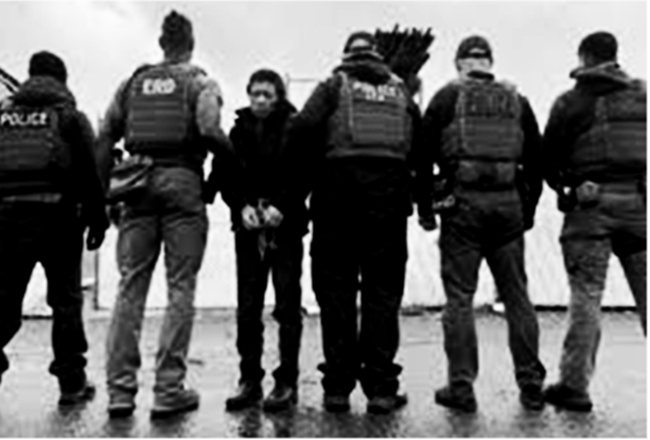
Those valuable relationships were key last month when ICE Philadelphia deployed surge teams to West Virginia towns like Martinsburg, Moorefield, Morgantown, Beckley, Huntington and Charleston as part of an operation that led to 650 arrests.
“Well, we chose the locations because of the partnership that we have with the State Police and with a lot of the sheriffs down there,” Rose said on statewide radio. “And so these were some of the most populated locations and also had, again, great, great cooperation from the local law enforcement.”
Soon, the relationships between ICE and West Virginia law enforcement might not be based solely on mutual benefit.
West Virginia’s legislature is moving a bill that would mandate that “any individual who has been determined to be in the country illegally by local, state, or federal law enforcement in this state shall be immediately turned over to Immigration and Customs Enforcement (“ICE”) for purposes of deportation.”
That legislation does not mention the kind of contractual relationships and incentives that ICE and local law enforcement agencies currently find agreeable. It would just be the law.
‘That’s not true’
Federal, state and local law enforcement have already worked together on the arrests of hundreds of people described by federal officials as presenting “dangers to national security and risks to public safety, as well as those who entered the United States illegally or have otherwise undermined the integrity of U.S. immigration laws and border control efforts.”
Since then, questions have arisen in federal courtrooms in West Virginia over due process. In about a dozen cases that have come under scrutiny so far, some of the people arrested have maintained that they have consistently attended immigration proceedings and should not be summarily deported following arrest.
COMMENTARY by HOPPY KERCHEVAL: Trump loses support on immigration
Federal judges in West Virginia have thrown out several cases involving immigrants just in the past week, saying the people who were arrested were entitled to due process within the immigration system itself.
“A threat to anyone’s constitutional rights is a threat to us all,” wrote U.S. District Judge Thomas Johnston, a George W. Bush appointee, who concluded that the government had violated the due process rights of Danny Briceno-Solano, a Venezuelan citizen under Temporary Protected Status.
According to the court record, Briceno-Solano fled upheaval in his own country and was arrested in 2022 near Laredo, Texas, by U.S. Border Patrol, which concluded he had unlawfully entered the United States. He was released with conditions that included attending immigration court, checking in with ICE, and not committing crimes.
He participated in removal hearings that were ultimately dismissed on Jan. 7.
Just four days later, Jan. 11, Briceno-Solano became one of the many people arrested and detained by ICE officers within a few days of each other while travelling on Interstate 77. Briceno-Solano was pulled over because his vehicle had “unclear, paper license plates” because he had “no documentation” allowing him to reside in the United States.
“This is not true, though,” wrote Judge Johnston, outlining the defendant’s years-long history with the U.S. immigration system.
Briceno-Solano applied for and received Temporary Protected Status, a work permit and a North Carolina driver’s license, the judge wrote. He is employed as a contractor and pays his taxes. He is a husband and a father. “After being lawfully released in the United States, Petitioner settled into a productive and meaningful life for years.”
‘Serve as a force multiplier’
Announcements of the sweep described several of the cases quite differently.
On Jan. 8, a citizen of India, Sagar Singh, was stopped by a commercial vehicle enforcement officer after failing to stop for a mandatory brake check station, according to ICE. He was cited for numerous commercial vehicle infractions for operating an unsafe commercial vehicle. ICE said he had been previously ordered removed.
On Jan. 11, Ling Jan of China was arrested. ICE said he was convicted of two counts of endangering the welfare of children in Ravenna County, Ohio, and has a final order of removal.
ICE described arresting a convicted child sex abuser, a criminal convicted of drug possession charges and many others during the operation.
Officials said the arrests highlight how official partnerships “serve as a force multiplier” for federal resources, enabling local officers — under ICE training and supervision — “to identify and help remove individuals who may pose threats to public safety or have violated U.S. immigration laws.”
A description of the sweep distributed by ICE included testimonies from some of the participating local law enforcement agencies.
“The Jefferson County Sheriff’s Office has just completed a two-week operation with Immigration and Customs Enforcement,” said Jefferson County Sheriff Tom Hansen. “The Sheriff’s Office was impressed with the professionalism and work ethic of the agents and how well they interacted with the citizens and local law enforcement officers.”
A press release from the U.S. Attorney’s Office in Southern West Virginia included similar statements from local law enforcement.
“The Putnam County Sheriff’s Office is always proud to assist our federal partners in the enforcement of the law,” said Putnam County Sheriff Bobby Eggleton. “Illegal immigrant enforcement actions are a way to make our communities safer and that is my ultimate goal and responsibility.”
Cabell County Sheriff Doug Adams said, “By participating in this campaign, we have been able to successfully assist in removing dangerous fugitives. As always, we remain committed to protecting our citizens both native born and legal immigrants who call our community home.”
On multiple days during the operation, West Virginia led the nation in daily arrests by law enforcement agencies with federal partnerships.
‘Unprecedented reimbursement opportunities’
The local agencies are among a growing number of West Virginia law enforcement organizations officially partnering with ICE through 287(g) agreements enabling designated local officers to perform certain immigration officer functions under ICE’s direction and oversight.

Last August, Gov. Patrick Morrisey announced that the West Virginia National Guard, the West Virginia State Police and the West Virginia Division of Corrections and Rehabilitation had signed memorandums of agreement to participate in the 287(g) Program.
“This level of coordination between West Virginia’s law enforcement and ICE will significantly speed up the process by which we arrest, detain, and deport illegal aliens,” Morrisey said.
Shortly after that, on Sept. 2, ICE made clear that it would be boosting valuable incentives like equipment, salary support and overtime for officers for local law enforcement agencies to participate as well.
As of Oct. 1, the immigration enforcement agency said the benefits could kick in for local law enforcement agencies, describing the incentives this way:
- ICE will fully reimburse participating agencies for the annual salary and benefits of each eligible trained 287(g) officer, including overtime coverage up to 25% of the officer’s annual salary.
- Law enforcement agencies will be eligible for quarterly monetary performance awards based on the successful location of illegal aliens provided by ICE and overall assistance to further ICE’s mission to Defend the Homeland:
- 90% – 100% – $1,000 per eligible task force officer
- 80% – 89% – $750 per eligible task force officer
- 70% – 79% – $500 per eligible task force officer
“By joining forces with ICE, you’re not just gaining access to these unprecedented reimbursement opportunities —you’re becoming part of a national effort to ensure the safety of every American family.” ICE Deputy Director Madison Sheahan said in the announcement.
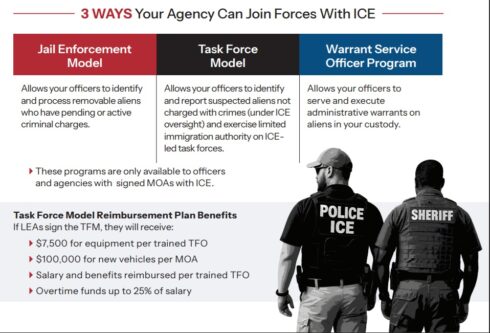
Flyers for ICE also underscore the availability of $7,500 for equipment per trained task force officer and $100,000 for new vehicles for each memorandum of understanding.
Yet the federal funding now being offered under the 287(g) program is not guaranteed over the long haul, not permanent and not anchored in statute. It exists as a matter of executive policy, possibly to be reversed by a future administration just as easily as it has been expanded now.
West Virginia agencies find the relationship enticing.
Participating agencies include: Berkeley County Sheriff, Cabell County Sheriff, Fayette County Sheriff, Fayetteville Police Department, Hampshire County Sheriff, Hardy County Sheriff, Harrison County Sheriff, Hinton Police Department, Hurricane Police Department, Jefferson County Sheriff and Lewis County Sheriff.
Also: McDowell County Sheriff, Mineral County Sheriff, Moorefield Police Department, Morgan County Sheriff, Nicholas County Sheriff, Oak Hill Police Department. Richwood Police Department, Putnam County Sheriff, Summersville Police, Upshur County Sheriff, Village of Clearview (Ohio County) Police Department and Wood County Sheriff’s Office.
Sixteen of those got on board after the incentives were announced.
The West Virginia police agencies are operating under ICE’s task force model, which “allows your officers to identify and report suspected aliens not charged with crimes (under ICE oversight) and exercise limited immigration authority on ICE-led task forces.”
Rapid growth of Section 287(g)
The Section 287(g) program has gone through a “hyper-evolution,” transforming from a narrow statutory provision into a widespread mechanism for street-level immigration enforcement.
That section of federal code was enacted in 1996 as part of the Illegal Immigration Reform and Immigrant Responsibility Act.
The law allows the federal government to enter into voluntary written agreements with state and local law enforcement agencies, permitting trained officers to perform specific immigration enforcement functions under federal supervision.
Notably, the original statute did not include a statement of purpose or defined limits, so its meaning and reach have been shaped over time by the policy preferences of successive presidential administrations rather than by congressional design.
While the structure of the law suggests it was intended as a narrow tool to supplement federal capacity, it has evolved far beyond that original conception.
Over time, the program solidified into three distinct models:
• Jail Enforcement Model: Limits enforcement to custodial settings, such as county jails, after an individual has already been arrested on local charges.
• Warrant Service Officer Program: A limited, ministerial role where local officers execute administrative immigration warrants already issued by federal authorities.
• Task Force Model: The most expansive model, allowing local officers to perform immigration enforcement during routine policing activities like traffic stops and patrols.
As of early this year, the program has reached a new peak with 1,378 active agreements nationwide. For the first time, the task force model has become the dominant category, with 767 agreements, reflecting a decisive shift toward embedding immigration policing into everyday local law enforcement.
Under the task force model, local officers may perform immigration enforcement functions in the field during routine policing activities such as traffic stops, patrol encounters and investigations.
The task force model may collapse the distinction between criminal law enforcement and civil immigration enforcement and effectively embeds immigration policing into everyday local police work.
The task force model has drawn sustained criticism from civil rights organizations, federal courts and the Department of Homeland Security’s Office of Inspector General, which identified deficiencies in supervision, data collection, and safeguards against discriminatory enforcement.
The OIG has noted that ICE failed to properly train and supervise local partners, leading to potential civil rights violations and failure to meet the program’s objectives.
Almost all of the West Virginia law enforcement agencies have agreed to participate in the task force model. Just one, West Virginia Corrections, operates under the warrant service officer program.
That’s a contrast with neighboring states like Virginia, which recently ordered the termination of all such agreements at the state level, citing concerns public trust and constitutional policing.
Maryland currently has a small number of Section 287(g) agreements and no task force model agreements, and state policy is moving toward prohibiting participation altogether.
In comparison to bigger neighboring states, the federal immigration enforcement authority is embedded more densely in West Virginia communities.
In Berkeley County, sheriff describes supportive perspective
Berkeley County, in West Virginia’s Eastern Panhandle, is one of the fastest growing areas of the state. Interstate 81 bisects the county and connects it to Virginia to the south and Maryland to the north. Driving to Washington, D.C., takes a little more than an hour.
By West Virginia standards, Berkeley County is also home to a fairly large immigrant population. Just shy of 5% of Berkeley County’s population were born outside of the United States.

Berkeley County Sheriff Rob Blair, in a telephone interview, said he believes his department’s partnership with ICE has benefited the community.
“I can promise you that I expect my deputies to follow the law and the Constitution and also expect my deputies to cooperate with any police agency that needs help, and that’s all we’re doing,” he said. “We’re not out here trying to target someone or harm someone or… it’s just the rhetoric has gotten pretty heated and, and there’s things that are said.”
Berkeley County’s agreement with ICE was signed last July 28. The sheriff said that happened after Governor Morrisey sent a letter to local law enforcement agencies to encourage the partnerships. “My response back to him was clear that the Berkeley County Sheriff’s Office would absolutely be in support of any agency doing their job,” Blair said.
The incentives from ICE were offered after Berkeley County was already on board. But Blair said they help. Police agencies aren’t overfunded, he said. Sometimes agencies are short of manpower.
Just this fiscal year, Berkeley County wrestled publicly with how to fund basic law enforcement needs when the sheriff’s office is already stretched. County commissioners debated raising the local property tax levy rate to hire five additional deputy sheriffs, a discussion that delayed the adoption of the annual budget pending further cost analysis.
When the budget was made final, the county kept the levy rate unchanged. Within that budget, funding was allocated for 68 uniformed law enforcement positions.
“Obviously, anytime you can receive reimbursement for your the work you’re doing or receive funds for, whether it be equipment or overtime or what it what it may be, it not only helps the agency, but it helps you, the individual,” Blair said.
“Every citizen in Berkeley County pays federal taxes. This is where it comes from. So we would certainly not turn that away.”
The relationship does not mean deputies are ICE agents, Blair maintained.
“We are not ICE agents. That’s not our primary responsibility. Our primary responsibilities are to the citizens of Berkeley County to uphold the Constitution and to work with other law enforcement agencies. And we don’t make calls on whether someone’s deportable or not,” he said.
“If one of my deputies would would make a traffic stop and and through their investigation have a suspicion or a reason to question someone’s say, citizenship, they make that call to ICE and they’re the ones that determine whether or not someone is to be detained or deported.”
The sheriff said deputies typically go about their regular duties, such as responding to domestic calls or conducting traffic stops. Then, he said, if there’s a question about citizenship, that is referred to ICE.
“We’re not going out here seeking out people of trying to trying to determine their status. Like, we have DUI checkpoints quite often, and social media up here will will say we’re having an ICE check. Well, that’s not true. We’re having a DUI checkpoint,” he said.
“If someone would come through, and there would be indicators that, you know, potentially they may have a an issue, then that would be passed on to ice, and they would make that determination.”
ICE has had a major presence in major American cities like Los Angeles, Chicago and, most prominently, Minnesota. It’s in Minnesota where thousands of people have protested in freezing temperatures, inflamed by the shooting deaths of residents Renee Good and Alex Pretti.
In Berkeley County, Sheriff Blair’s lesson is that communities should be more prepared to cooperate with ICE.
“Minnesota is a spotlight, and everyone can see what’s going on there — and it is my strong opinion that that is result of not having cooperation from state and local authorities and just putting ICE out there on an island by themselves to fend for themselves,” Blair said.
“And you know, people talk about protests and peaceful protests. I think anyone that watches what you’re seeing, it’s anything but peaceful. And you know, those ICE agents deserve the same protections as anyone else, and there’s been some really bad instances up there, and obviously those are being investigated.”
The sheriff continued, “And again, I think if, if they were being supported more, those type of things could not happen. And we don’t want those things to happen in Berkeley County or throughout West Virginia. That’s why we are cooperating and trying to make it as safe as possible.”
‘Erosion of trust’
The number of West Virginia local police agencies entering into agreements with ICE keeps expanding. Pending agencies in the pipeline now include the Pleasants County Sheriff’s Office and the White Sulphur Springs Police Department.
The intertwined priorities that these agreements represent can be challenging for communities to process, said Sara Whitaker, senior criminal legal policy analyst for the West Virginia Center on Budget and Policy think tank.
When additional shifts, overtime, equipment, and compensation are linked not to local crime prevention but to the success benchmarks of a federal immigration program, citizens may begin to wonder where accountability truly lies: with local policing or with federal immigration policies.

“In addition to the direct harm done by ICE, there are other issues raised by this collaboration,” Whitaker said. “When it comes to 287(g) agreements, state officials ought to be concerned with the erosion of trust between communities and their local law enforcement agencies.”
Whitaker observed that state-level lawmakers regularly raise concern about eroding respect for law enforcement by members of the public.
“For many reasons, a surprising number of people – including victims of violence – already choose not to engage with police. More than half of violent crime victims, 52 percent, did not report the incident to police.”
She concluded, “Any policy that commits local police agencies to an increasingly unpopular federal agency may mean more people turning away from local police — even after ICE moves on to other states.”