

The majority of the U.S. Supreme Court has upheld West Virginia’s law preventing athletes born male from participating in girls sports.
The court’s majority today held that schools can determine eligibility for women’s and girls’ sports teams based on biological sex. The majority concluded that West Virginia did not violate Title IX, which bars educational programs that receive federal funding from discriminating based on sex.

“This is a monumental victory for every female athlete who has ever competed, or dreamed of competing, on a fair and safe playing field,” said West Virginia Attorney General J.B. McCuskey.
“Today’s Supreme Court decision affirms what common sense and the law have long made clear: states have the right to designate sports teams based on biological sex, not gender identity. Without that delineation, Title IX is turned on its head and decades of hard-fought progress to advance female athletes is erased.”
It was a 6-3 opinion delivered by Justice Brett Kavanaugh joined by Chief Justice John Roberts, Clarence Thomas, Samuel Alito, Neil Gorsuch and Amy Coney Barrett.
“No student-athlete on either side of the issue, whether a biological female or transgender, deserves to be ostracized or vilified,” Kavanaugh wrote.
Justice Sonia Sotomayor concurred in part and dissented in part, joined by justices Elena Kagan and Ketanji Brown Jackson. Sotomayor agreed with the majority that state bans on transgender athletes do not violate Title IX.
But she said that Becky Pepper-Jackson should have been allowed to pursue her constitutional challenge to the ban under equal protection principles because of her particular circumstances. Sotomayor wrote that the Supreme Court should have affirmed the Fourth Circuit’s decision to remand back to the district level for further factfinding.
Sotomayor asserted the case needed to further explore the specific circumstances of transgender girls who have never experienced male puberty and who receive gender-affirming treatment. Essentially, she said the Supreme Court fell short of its constitutional due diligence.
“West Virginia may well have satisfied its burden and seen its ban upheld,” Sotomayor wrote. “The point, rather, is that this Court’s equal protection precedents require a very different approach to B. P. J.’s claim than the one the majority follows today.”
The nine justices of the U.S. Supreme Court heard arguments on Jan. 13 about a West Virginia law forbidding the participation of transgender athletes on school sports teams.
The plaintiffs, 16-year-old Bridgeport resident Becky Pepper-Jackson and her mother, were challenging a law passed in 2021, when West Virginia joined dozens of states in placing restrictions on transgender athletes’ participation on sports teams.
McCuskey said the ruling provides clarity for oversight bodies like the West Virginia Secondary Schools Activities Commission.
“What happens right now is that the Save Women’s Sports Act of West Virginia is good law,” McCuskey said on MetroNews Talkline.
“And so the SSAC and all the governing bodies can move forward confidently under the language of our Save Women’s Sports Act to make sure that women and girls are playing on playing fields that are safe, that are designed for them, and give them all of the opportunities that we know that they need in order to play competitive sports and feel confident that their efforts are going to be rewarded because they’re playing against people that don’t have an advantage physically over them.”
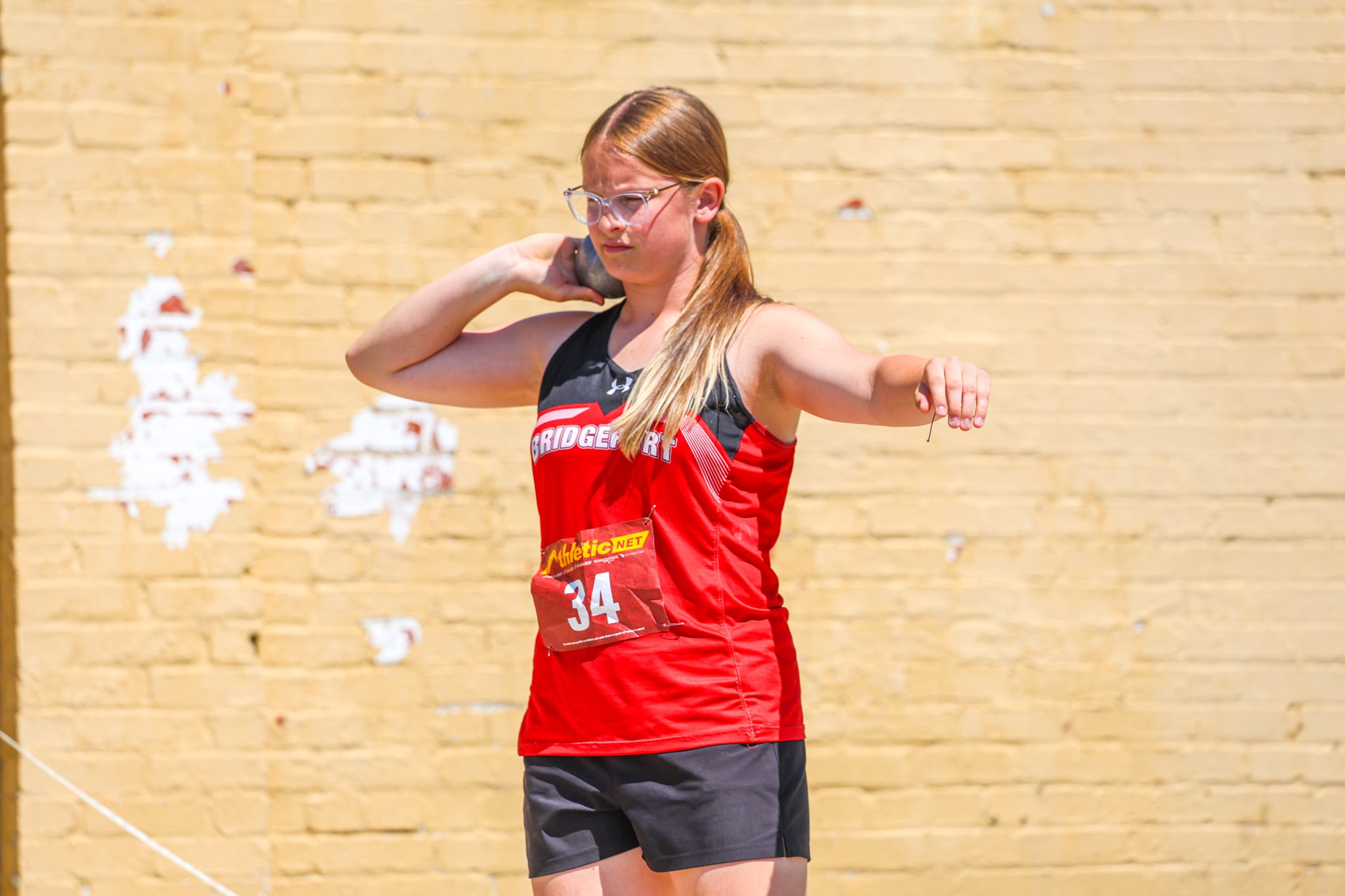
Becky Pepper-Jackson has been allowed to compete as the case has gone through the federal court system, culminating with a win in West Virginia’s shot put championship at the state high school track meet just weeks ago with a personal-best throw of 38 feet, 11.75 inches.
(Becky Pepper-Jackson’s winning shot put throw in the 2026 Class AAA state meet)
Her final distance was recorded on her sixth and final throw of the competition, allowing her to finish just over two feet ahead of the runner-up.
“Either way, it is an unhappy occasion whenever a student who wants to play school sports cannot do so. We appreciate the desire of every student, including B. P. J., who wants to play school sports,” Kavanaugh wrote in the majority opinion.
“And we recognize that student-athletes are understandably disappointed and upset when they do not make a team or otherwise cannot participate. But the Title IX regulations guarantee ‘equal athletic opportunity.’ The regulations cannot and do not guarantee every student a spot on a team’s roster.”
U.S. Supreme Court justices heard almost an hour and a half of arguments earlier this year about West Virginia vs. B.P.J., which represents the initials of the young transgender athlete. As with most appeals cases, this was a back-and-forth with justices asking questions one after another on finer points of law, with lawyers defending their positions.
Analysts who cover the Supreme Court on a regular basis assessed from the questions that the court seemed likely to uphold West Virginia’s law.
The West Virginia Attorney General’s Office defended the state law, with state Solicitor General Michael Williams addressing the court.
“I am immensely proud of my team for not only getting this issue before the Court but for delivering sound and successful arguments,” McCuskey said today.
Becky Pepper-Jackson Becky and her mother are represented in the case by the American Civil Liberties Union, the ACLU of West Virginia, Lambda Legal and Cooley LLP.
“This is a heartbreaking ruling for our clients and transgender girls like them who’ve asked for nothing more than the same opportunities afforded to their peers.” said Joshua Block, Senior Counsel for the ACLU’s LGBTQ & HIV Rights Project.
“The reality is that the equality of transgender women and girls takes nothing away from, and in fact promotes, the equality of all women and girls. We will continue to advance the fundamental principle that all young people deserve equal opportunity to thrive and succeed.”
The questions being posed to the Supreme Court were:
— whether Title IX of the Education Amendments of 1972 prevents a state from consistently designating girls’ and boys’ sports teams based on biological sex determined at birth;
— and whether the equal protection clause of the 14th Amendment prevents a state from offering separate boys’ and girls’ sports teams based on biological sex determined at birth.
The justices concurrently considered the circumstances of another case, Little v. Hecox.
That case is named for Gov. Brad Little, who in 2020 signed a law prohibiting transgender women and intersex individuals from playing on female sports teams in Idaho public schools, and transgender athlete Lindsay Hecox, 24, who wanted to compete on the women’s track and cross-country teams at Boise State University.
West Virginia’s law, House Bill 3293, defines male and female “based solely on the individual’s reproductive biology and genetics at birth.”
A key part says, “Athletic teams or sports designated for females, women, or girls shall not be open to students of the male sex where selection for such teams is based upon competitive skill or the activity involved is a contact sport.”

The legal case for the state was first handled by Patrick Morrisey, now the governor, when he was attorney general. Morrisey commented today to say the ruling is consistent with the Constitution and “a matter of basic fairness.”
“This began in West Virginia, but its impact reaches every corner of the country. Future generations of female athletes will benefit from the certainty, fairness, and opportunity this decision protects,” Morrisey said today.

The West Virginia case focuses on student athlete Becky Pepper-Jackson, who was born male but identified as a girl from a very young age. By third grade, she was living as a girl at home and told her mother and father she did not want to keep going to school dressed as a boy.
More recently, she was diagnosed with gender dysphoria and had been receiving puberty-delaying treatment for almost a year when West Virginia passed a bill affecting transgender athletes. Her federal lawsuit, where she is referred to as B.P.J., was aimed at being able to participate on the cross-country and track teams in Bridgeport.
“This ruling is deeply harmful for transgender women and girls who only asked for the ability to participate in sports with their peers,” said Sasha Buchert, senior attorney and director of the Non-Binary and Transgender Rights Project, Lambda Legal.
“Countless studies have demonstrated the myriad benefits that come with participation in team sports. Now, one population, transgender youth and collegians, are targeted for specific and baseless discrimination. We will not be deterred and will continue to fight back to secure the equal participation that all youth, including transgender youth, deserve.”