

SHEPHERDSTOWN, W.Va. — Residents, government leaders, proponents and opponents of the proposed Valley Link Transmission Line expansion gathered at an open house held on the campus of Shepherd University Tuesday.
Tuesday’s focus was the project impacting the Eastern Panhandle, called the Valley North Project aimed at building “approximately 260 miles of new 765-kilovolt (kV) transmission lines connecting Putnam County, West Virginia, to Frederick County, Maryland.”
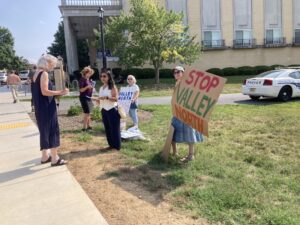
Among in attendance were property owners and community members, as well as protesters from groups like Jefferson County VOLT (Voices Opposed to Line Transmission) and WATI (West Virginians Against Transmission Line Injustice).
Representatives of those groups could be seen holding signs and talking to people about their cause as they stood in a grassy area some distance away from the doors to the event.
Also in attendance were members of the Jefferson County Commission.
Jefferson County Commissioner Mike Mood talked about what he was hoping to learn during the open house. “Well, I do have questions for them. I hope to learn some facts about directions they’re trying to go. They haven’t really given a whole lot of information yet, but they are looking to bring a power line through that’s supporting Loudoun County and not West Virginia and it’s adversely affecting our residents,” Mood told MetroNews. “And that is concerning. I want to do the best I can to help our residents.”
As to whether the commission has any influence or power over large-scale projects like Valley Link, Mood said, “Currently, a single county commission really has none because it’s being done at state level. Now what we can do is we can try to look at other counties and communicate with other counties and see can we try to get all of us together and start putting some pressure on them as to where they go, where they don’t go, the best information available. And so far, we haven’t seen that.”
Evelyn Claeys, acting president of Jefferson County VOLT (Voices Opposing Line Transmissions) talked about how she became aware of the large scale transmission.
“We learned first about Gore-Doubs-Goose Creek (project) coming through, and that’s where my neighbors and I got together to be able to oppose them and build an organization that could actually help and protect our land because the Gore-Doubs-Goose Creek project does come right behind our house.”
Asked what her chief concerns are about the project, she said, “Well, the first one is environmental. Regardless of whether the project is for ‘improvement,’ or brand new, it affects the environment around it, within the easement and outside of the easement. And that is all-encompassing. It affects the houses, it affects the forest, it affects the fauna, it affects the trees, it affects everything. You find out that It doesn’t benefit West Virginia at all. It’s for data centers in Northern Virginia.”
Inside the open house held in the Storer Ballroom, Lauren Siburkis the media relations representative for First Energy explained the open house process.
She likened the open house to a job fair “Where you can come in and ask questions about any aspect of the project, ranging from the project needs and benefits to how it might impact your specific property, and learn all about the different structures that might be used or some of the environmental impacts.”
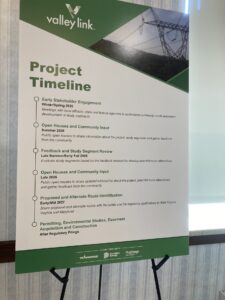
Tuesday’s open house was not meant to be an official public hearing, but as attendees walked around the room, they could look at informational signage about the scope of the project, the size of the transmission towers, and potential substation locations.
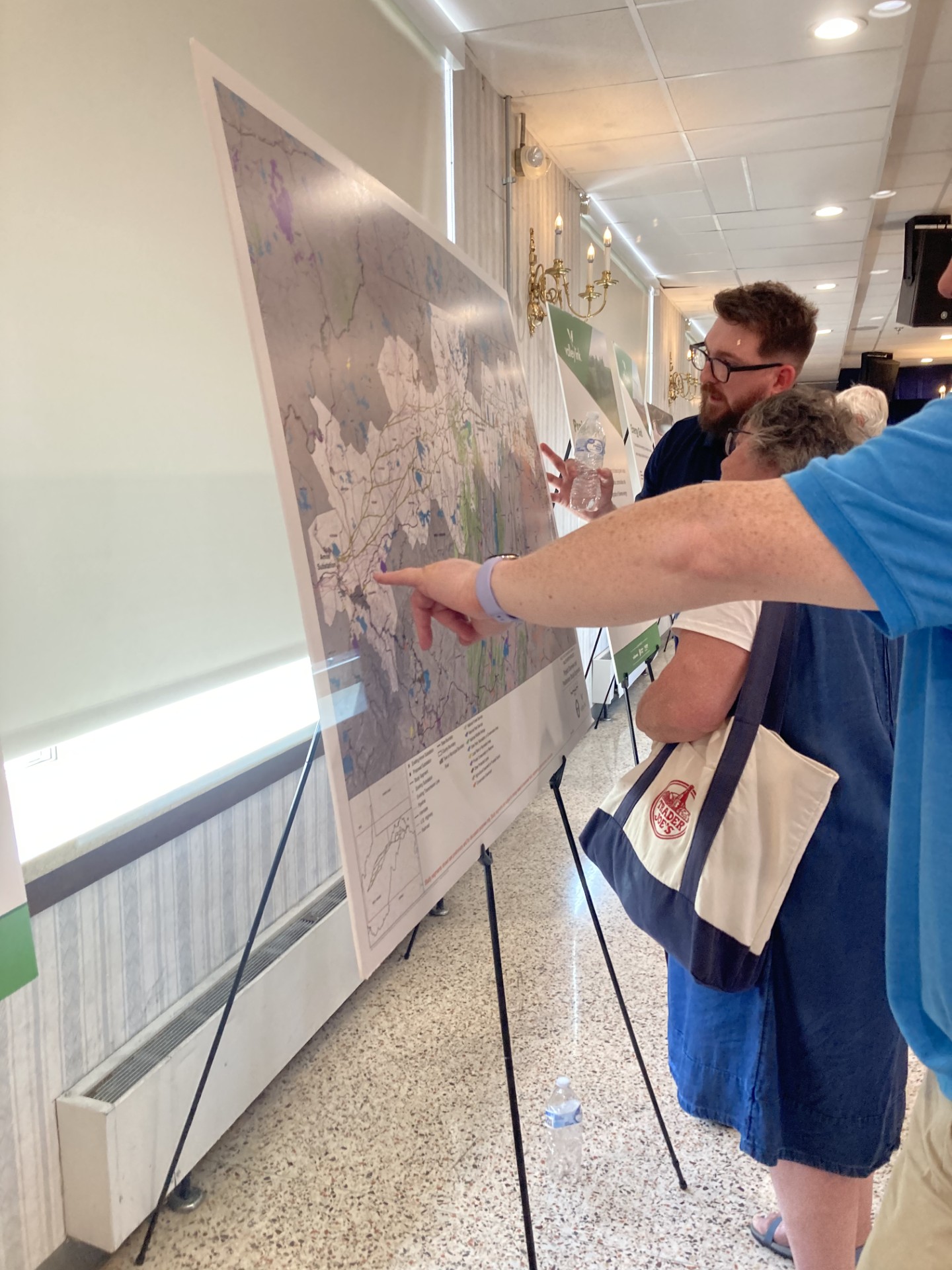
Several tables were set up with large map books. Each was equipped with a computer that showed interactive maps of the ‘study area,’ including suggested routes.
The address function was not working for a quick search of a given address, but property owners could look for their location on the screen and point out to the First Energy representatives any features of the property of note, like conservation easements or other considerations.
Some of those in attendance reported that the maps of their particular property were not up to date and did not reflect current features or developments.
Said Lauren Siburkis, “The open houses are really to take a look at the communities within that starting point and the ending point and see where it makes the most sense based off of the feedback that we’re hearing within the community to build this final line.”
“We are having very open and honest conversations with landowners. We’re hearing their concerns. They’re asking great questions, and they have the opportunity to leave formal feedback through our GeoVoice platform, which is on our website, and in the form of hard copy comment cards.”
As to the scope of the project and the proposed routes for the transmission line project, Siburkis said, “Right now, we have a starting point and an ending point. So the starting point is in Putnam County, West Virginia, and the ending point is in Frederick County, Maryland. Between those two counties, we have a big study area. And within that study area, we have numerous proposed routes. The purpose of these 23 open houses is to gather community input, have their concerns addressed.”
Siburkis said they are hearing from property owners about their concerns, for example, “Why don’t people want the transmission infrastructure running along their property? Do they have conservation easements? Is there anything located on their property that wouldn’t be conducive for a transmission line? From there, we will take all of that feedback into consideration and go back to the drawing board and see where it makes sense to maybe refine our routes,” Siburkis said. “And then in the fall, we’ll come back for another round of open houses and have more refined route options for the public to review.”
As to whether the comments from residents will affect the outcome, Siburkis said, “Whenever we put together a project like this, we always try to pick a route that has the least impact on the communities and the environment. So, today we’re hearing from residents. We’re in real time documenting their concerns. We’re documenting protected lands on their property. And we’re going to take all of that into consideration when it comes to putting together a final route for review from the public.
One of the reasons the transmission line project is needed, according to proponents, is to shore up the grid. Asked if the electric grid is in trouble, she said, “We are in trouble.”
“I think it’s important to take a step back and keep in mind that this project was developed because of a need that was identified by PJM, which is our regional grid operator. So PJM took a look at its system across 13 States and identified this region as an area that could see outages and blackouts in the future if we don’t build infrastructure to support the growing energy demands in this area,” Siburkis said.
“And so I think it’s very timely right now, especially as we’re in the midst of a a very dangerous heat wave. Everybody’s cranking their electricity.”
“We’ve got a population boom in this area that we’ve experienced in recent years. And we have a lot more advanced manufacturing and just large load customers that are really straining our system and we need more capacity to serve them,” said Siburkis.
Among the concerns expressed by the public about a large scale transmission line cutting through home sites and farms, the cost of the expansion being carried by residents, and the environmental impacts as well as who ultimately benefits from the expansion.
“One of the biggest misconceptions about this project is that it is an extension cord to service data centers in Virginia. That is simply not true,” said Siburkis.
“Think of this project as an interstate highway of electricity with the ability to build off ramps in local West Virginia, Maryland, and Virginia communities to provide grid reliability benefits within those local communities, but also economic development opportunities because businesses are looking to start and expand when they know that they have a reliable grid to operate on.
Among the informational displays lined up around the Storer Ballroom were infographics about the size of the transmission lines, EMF effects, as well as information about potential substations along the route.
Property owners and residents who spoke to MetroNews after attending expressed concerns about the route running through long-time family farms. A man in attendance showed a map screenshot of his granddaughter’s home, newly built, with what he described as a beautiful view of the mountains below. Ringing the property on three sides were the yellow hash lines that indicated a proposed route for the transmission line. Someone from First Energy had noted, “New Home” by the property on the interactive map.
Other attendees could be seen at a table filling out comment cards. Although Tuesday’s event was not a formal public hearing, First Energy is inviting feedback through their website.
This story has been corrected to accurately reflect the spelling of First Energy spokeswoman Lauren Siburkis.