

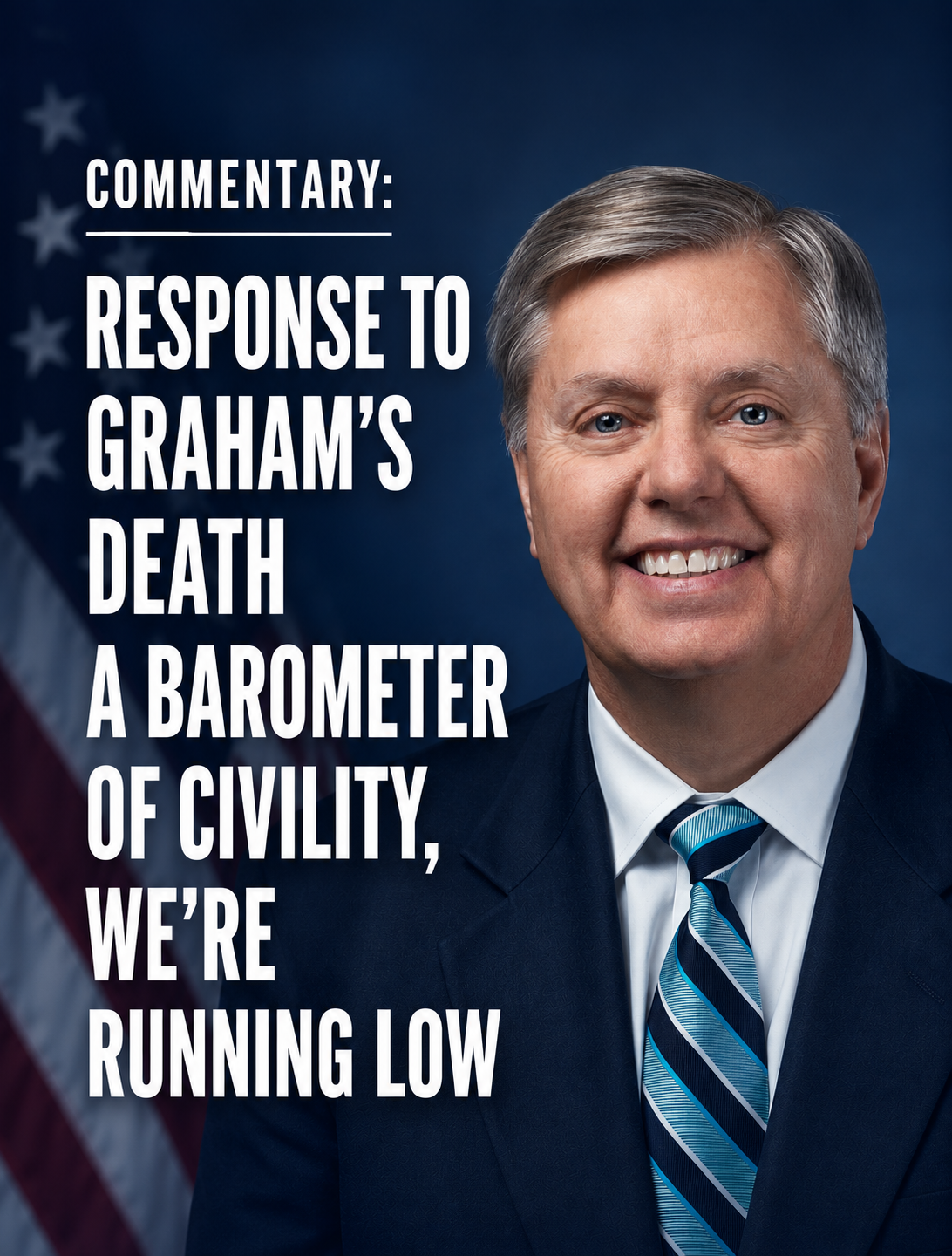
Listen to “Response to Graham’s Death a Barometer of Civility, We’re Running Low” on Spreaker.
Lindsey Graham, the longtime United States senator from South Carolina, has died. He was 71.
News of his passing broke early Sunday morning. Sadly, for many, it seemed to serve as a “call to the post” for an onslaught of vitriol — a torrent of venom directed at a man who had spent decades in public service.
Why?
Was Graham perfect? Of course not. He was human. Was he ever wrong? Certainly. Again, he was human.
There’s no requirement that anyone agree with Graham’s policies. Agreement has never been the standard for good citizenship. Disagreement is at the heart – the very essence – of the American experience, as is the freedom to speak one’s mind without government interference.
But speaking with a civil tongue is not a crime, either.
For reasons that defy explanation, many Americans – even West Virginians – have come to regard cruelty as acceptable… as though civility were not a virtue but a vice.
Don’t take my word for it. Look at social media. You’ll find the ugliness there, including from fellow Mountaineers. None of it bears repeating.
But Sunday’s response raises a concern much larger than Lindsey Graham: the American system cannot function without civility.
Perhaps this pen returns to that theme too often. But the growing lack of civility in American society only makes the message more necessary.
A constitutional republic depends on more than written rules – it depends on a people capable of self-restraint. Many appear to have lost that capability.
The Constitution can separate powers, protect rights and limit government. What it can’t do, by itself, is make citizens behave with honesty, humility, patience or respect for opposing views. That ingredient is assumed.
When the public loses the habit of civility, every political disagreement becomes a fight for total control. Constitutional limits then begin to look like obstacles to be overcome rather than safeguards to be preserved.
That is why civility really matters; responses to Graham’s death are a barometer of our collective mind.
The measurement isn’t good.
Lose enough civility or lose it all together, and a nation becomes susceptible to rot from within. Perhaps some of that rot has already begun?
And understand this, civility does not mean weakness. It does not require surrendering principles or pretending serious disagreements are insignificant. It means recognizing that political opponents are still fellow citizens — not enemies to be humiliated or destroyed.
It means debating ideas without dehumanizing people. It means remembering that today’s majority may become tomorrow’s minority. It means looking out for the other person and treating him as you would want to be treated — even when you believe he is wrong, and even when you believe he has wronged you.
Civility makes us better, not weaker.
Graham’s death should prompt a moment of reflection. So should the response to the death, defeat or downfall of anyone we consider a political opponent.
Before joining the mob, perhaps each of us should ask a difficult question: is this really the America we want?
The honest answer should be, hopefully is: no.
Editor’s Note: Yes, I wrote about President Trump’s comments regarding Bob Mueller’s death. Perhaps posting it here will alleviate some additional questions – it’s already been asked dozens and dozens of times.