

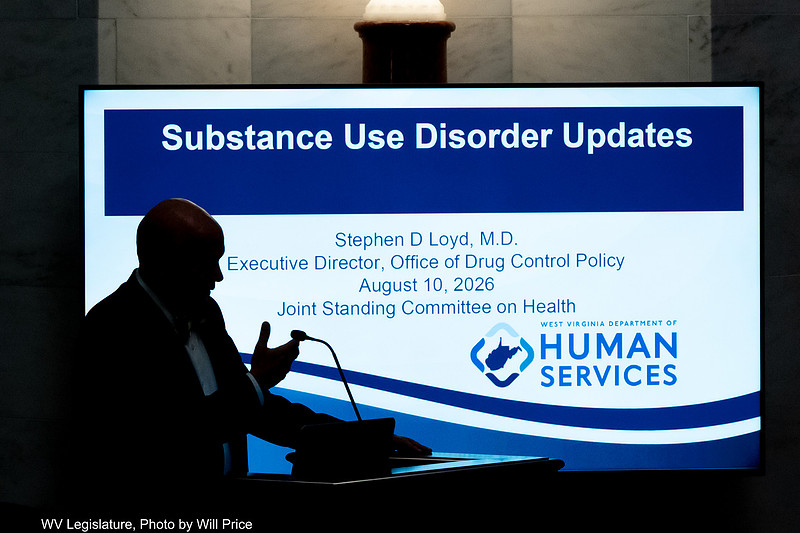
The director of West Virginia’s Office of Drug Control Policy told lawmakers the state is improving in several key measurements of its long battle against drug addiction.

Dr. Stephen Loyd highlighted a 41.6% decline in overdose deaths from pre-pandemic levels and a 44.2% reduction in neonatal abstinence syndrome rates.
He noted that West Virginia had the highest overdose death rate in 2021 but is now outpacing the national average in overdose reduction.
Loyd was speaking before the Joint Standing Committee on Health during legislative interim meetings.

Senate Health Chairman Brian Helton, R-Raleigh, asked for a sense of perspective toward the end.
“We’re not spiking the football today, are we?” Helton asked. “We’re like still two and a half times the national average of overdose rates.”
Loyd agreed there is much more to be done to help West Virginia cope with its pervasive addiction problem.
“No, we’re not spiking the football at all. You know, I hope it didn’t come across that way,” he said.
“But I’ve been in this chamber when we were headed in the wrong direction and really hard in the wrong direction, and I think that we’ve got light at the end of the tunnel. I think some of the things that we’re doing are working and I think there’s a lot of things we can do to start to tie the system together.”
Loyd credited improvement to a range of policies and practices, especially aggressive overdose responses and widespread use of naloxone, the fast-acting medicine that reverses an opioid overdose. Naloxone acts as an opioid antagonist, meaning it binds tightly to the brain’s opioid receptors.
“We distributed 136,276 naloxone kits across our state, and so you want to look at one of the reasons that that number is trending down, I think you can point to that,” Loyd said.
“Now, keep people alive is a good thing. We’ve got to start to help them with resources, and guys, people get better whenever they have a safe place to live and they have a job.”
Loyd also credited tightened, more responsible prescribing of opioids as painkillers. He said prescribing is down in all 55 counties, about 11% overall year‑over‑year. Nearly 6 million fewer opioid doses have been prescribed in 2025 than 2024, he said.
“Now we’re not talking about withholding pain medication from people who need it. We’re talking about responsible opioid prescribing for a finite amount of time, and giving patients informed consent and being a little more strict with how many we prescribe up front,” he said.
“Because the real deal is, when you write that second prescription, by the numbers, there’s a 70 percent chance that your patient is still on it a year later.”