


MORGANTOWN, W.Va. — Whether or not Pat White is West Virginia’s greatest all-time football player is up for debate.
Whether or not White’s No. 5 should be retired certainly is not.
The most accomplished player in the history of the Mountaineers’ program will forever be enshrined into WVU lore Saturday when White has his No. 5 retired in an 11:45 a.m. ceremony just before the start of West Virginia’s noon season opener against Coastal Carolina.
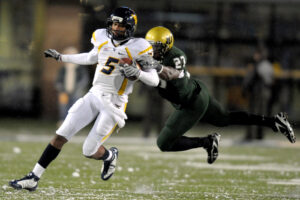
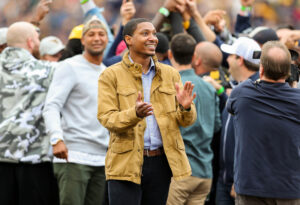
“It means a lot of friendships, a lot of ups and downs, a lot of lessons and a lot of 15-hour drives,” said White, a native of Daphne Ala., who now serves as Assistant Quarterbacks Coach/Assistant to the Head Coach for the Mountaineers. “More importantly, it means I’m forever connected to a unique state that sits somewhere in the middle of the south and the north that because of many reasons is unique way before even this moment or anytime that I spent here in West Virginia. It means that I helped prove to or show a lot of young men from lower Alabama that there’s more out there in this world than just Alabama and Auburn football. Help people venture out and go explore and try to make a name for yourself.”
The matchup with the Chanticleers has been deemed a “white out” game in honor of White, who played his final regular season game as a Mountaineers with the same theme in the show against South Florida.
After redshirting as a true freshman in 2004, White starred for the Mountaineers over the next four seasons.
The Mountaineers’ part-time quarterback over the first half of the 2005 season, White grabbed a stranglehold of the job in the seventh of 11 regular-season games that year during a 46-44 triple overtime win against Louisville. He went on to start the remaining four regular season contests, which WVU outscored opponents 156-39 in to secure a Big East Championship and a berth in the Sugar Bowl against a top 10 foe in Georgia.
Normally held in New Orleans, the matchup was moved to Atlanta as a result of Hurricane Katrina.
Widely considered an underdog, WVU raced out to a 21-point first-quarter lead and held on for a 38-35 victory that ranks among the best in program history to this day.
“We had a lot of young guys. I was a little nervous,” said Rich Rodriguez, the Mountaineers’ head coach then and now. “The game was moved to like a home game for Georgia, and all this SEC stuff and they had experience. I can remember during practice that week it was almost uncanny how dialed in the guys were. I don’t know if they made a single mental mistake all week.
“Even the day of the game, I was a lot more nervous than Pat was. I can remember going to Pat, ‘you ready?’ He could tell I was a little nervous and he was like, ‘coach, we’re good.’ He was as calm as could be, couldn’t wait to get out there. There was no anxiety whatsoever. He played lights out. This guy is a redshirt freshman playing in this big arena and he kind of calmed my nerves down a little bit going out there and doing what he does.”
“Once I got it on my back, it felt right”
Pat White on donning the No. 5 jersey: pic.twitter.com/CHwfutjrYe
— MetroNews Sports (@MetroNewsSports) September 2, 2026
The rest, as they say, is history.
White helped lead WVU to an 11-2 mark in 2006, which culminated with a 38-35 win against Georgia Tech in the Gator Bowl and a top 10 national ranking.
The Mountaineers also finished 11-2 in 2007, narrowly missing out on a berth in the National Championship and instead claiming a 48-28 win against Oklahoma in the Fiesta Bowl after Rodriguez left the program to be head coach at Michigan.
White passed for 176 yards and two touchdowns and rushed for an additional 150 yards to garner MVP honors against the Sooners, and completed his junior season with a 26-4 record as starting quarterback.
“It’s really about being your best self every time you step into the arena, or the weight room, or the film room,” White said. “Regardless of your skill set, regardless of the traits that you possess that make you special, as long as you give your greatest effort and trust the preparation, then good things will happen for you.”
White led WVU to a 9-4 season and a 31-30 victory against North Carolina in the Car Care Bowl that served as his final collegiate contest — one in which the southpaw became college football’s first quarterback to start and win four bowl games.
All told, White set Big East Conference records for most touchdowns responsible for (103) and total offensive yardage (10,529) and finished as the all-time leading rusher among quarterbacks in college football history with 4,480 yards — a mark that leaves White third at present.
Just before kickoff Saturday, he will take a moment to step away from his coaching role and soak in the experience as he becomes West Virginia’s seventh player to have his jersey retired, joining a list that in numerical order, includes: Major Harris (9), Ira Rodgers (21), Chuck Howley (66), Sam Huff (75), Bruce Bosley (77) and Darryl Talley (90).
“For me personally, it’ll be excellent to see my parents get back to Morgantown and experience Mountaineer madness again,” White said. “It’s been a while since they’ve been in that stadium. To see my brothers here enjoying it, my wife, my kids and allow my nephew to get the gold and blue running strong through his veins.”
And to think, it was entirely possible none of it would ever happen.
White was a fourth-round selection of the Los Angeles Angels in the 2004 Major League Baseball Draft, but opted to try his hand at football.
“Sitting down with my father, it was what’s the figure that would keep you from going and getting an education and pursuing a football career,” White recalled. “They didn’t come anywhere close to it. Drafted, I was definitely excited. When the number came back, they made it very easy on me to make that decision.”
He ultimately wound up at WVU largely because of an opportunity to play quarterback, a position other programs weren’t willing to let White play.
“I’m barely 6 foot. I’m a lefty. I’m very unorthodox as a quarterback and I’m of African descent, especially back in 2004, so those are all things that sort of go against you in the eyes of the decision makers at that position,” White said. “So I was told no a lot. I was told from teammates in high school and in college that I should think about switching positions. In baseball, it was more Mano y mano. I was pretty good, at least in my mind. So it was always ‘you can.’ It was a lot less scrutinized, and so, I guess I wanted to prove to myself and those that refused to believe, and more importantly those that did believe I was capable.”