

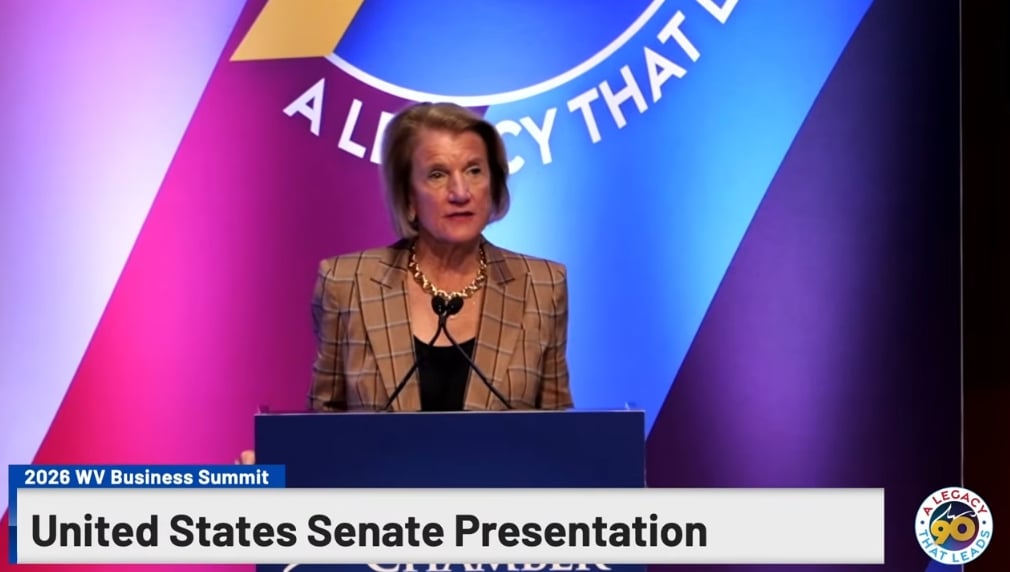
WHITE SULPHUR SPRINGS, W.Va. — U.S. Senator Shelley Moore Capito is cautiously optimistic that permitting reform will happen at the federal level soon.

Capito said during last week’s West Virginia Chamber of Commerce Business Summit that something has to be done about the permitting process in the country. She cited concerns about the drawn-out nature for businesses obtaining a permit for projects. Now, she said, they’re “as close as we’ve ever been” to making some changes and if something is going to happen, it’ll likely come to pass this week.
The topic of permitting reform is something she deals with every day, Capito said. She chairs the Senate Environment and Public Works Committee, as well as serving on the Energy and National Resources Committee. Both committees have been working on solutions to remove barriers from development across the country.
“We know what not having permitting reform is doing,” Capito said. “It’s stifling $2 trillion of investment, and several studies have shown this. Large projects are not going to put their shareholders’ dollars or their own business dollars behind projects that they don’t know are going to be able to sustain the political winds that may be blowing.”
Capito said a serious issue with the current regulations are that projects, which have spent “billions of dollars” and have gotten the necessary permits, are subject to having those permits taken away abruptly. She said that isn’t right.
“Is that fair, that if you’ve crossed all the T’s and dotted all the I’s, that you can have your permit yanked? That is not fair,” Capito said. “So, certainty is one of the main things we want. NEPA (National Environmental Protection Act) reform; to make the process more efficient, quicker, (along with) judicial reform.”
In judicial reform, Capito said the current window for lawsuits over permits, six years, is not sustainable. She said they’re looking to “tighten that up.” Other potential tweaks include the Clean Water Act, Capito said, along with endangered species and historic preservation regulations.
Sheldon Whitehouse, D-Rhode Island, is the ranking member on the Environment and Public Works Committee. Capito said that she and Whitehouse work “great” together as they both represent their respective parties’ interests. Meanwhile, Senator Mike Lee, R-Utah, chairs the Energy and Natural Resources Committee, and Martin Heinrich, D-New Mexico, serves as ranking member. Capito said it’s important to get the “western perspective” from those two.
Additionally, Capito said there’s been an effort to get President Donald Trump on board with the proposal.
“We’ve been working with the White House because obviously, the president and his folks have to agree with this,” Capito said. “Knowing that they’re not going to get everything and knowing that it needs to be bipartisan and it needs to be meaningful, legacy setting, long lasting, and efficient.”

T.C. Energy President and CEO Francois Poirier is no stranger to the permitting process. He said on MetroNews “Talkline” recently that reform is necessary; the timeline continues to become longer and longer.
“It’s typically 18-to-24 months before you get your permits now, just to get your permit,” Poirier said. “Then, usually, it’s about a year, a calendar year, once you have shovels in the ground, once the gas starts flowing. Compare that to 10-or-15 years ago, it was about half that time to get permits.”
Poirier said there are several explanations for those problems.
“A lot of it is through different interpretations of who has jurisdiction over different parts of the application process,” Poirier said. “A lot of states have imposed their views, policy and ideology views, that have slowed down development of infrastructure, but we got to get building here.”
A committee hearing in January covered many of the issues facing the permitting process, Capito said. She noted that the committees have received a “lot of help” constructing this, from reviewing environmental rulings at the Supreme Court level to getting perspectives from many different industries.
Capito said they’re going to have “one swing at the bat” with this. She said there’s strong support for the reform.
“It can be done,” Capito said. “We had the laborers union there; we had the solar folks there. So, the coalition that’s built around this, is not just the energy industry. It’s not just data centers. It’s not just transmission; transmission is in there. It’s you all, it’s communication towers, it’s housing, it’s manufacturing site, it’s pads for space, it’s everything.”