

A proposal to place a hold on removing students from public schools if there is a pending child abuse or neglect investigation could get consideration again by the state Legislature, but the details of crafting a bill could again be complicated.
The West Virginia policy, usually called “Raylee’s Law,” is named for an 8-year-old girl who died of abuse and neglect in 2018 after she was withdrawn from school, eliminating contact with educators under mandatory reporting requirements.
Raylee Browning’s father and two other adults were sentenced in 2023 to prison time in her death. The adults were accused of mistreating her and then ignoring her symptoms when she got sick before dying the day after Christmas in 2018. The cause of death was sepsis caused by a bacterial pneumonia infection.
The bill has been introduced since 2019, but has never passed. This year, the policy was under consideration by lawmakers in dramatic and emotional circumstances when the clock hit midnight on the final day of the legislative session.
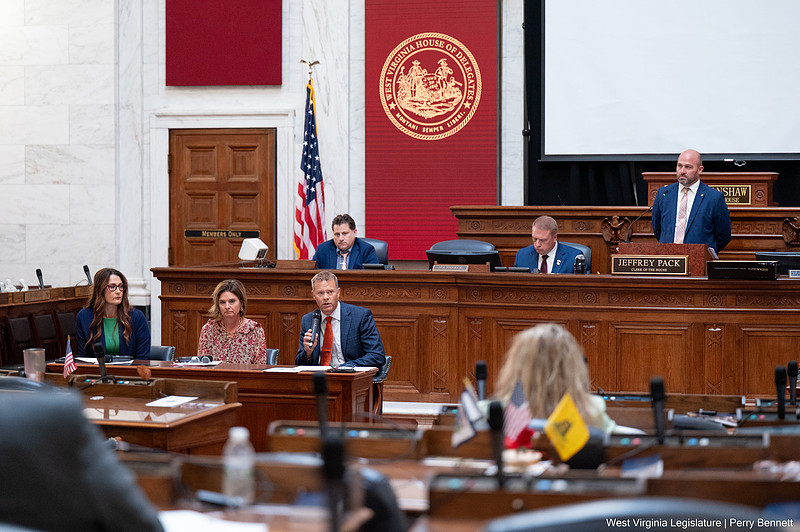
In preparation to potentially bring back the proposal for legislative consideration, lawmakers on the Joint Committee on Children and Families discussed “Child Welfare System Safeguards” during interim committee meetings.
They examined possible legislation that requires school officials to notify principals of student transfers or withdrawals and for principals to notify Child Protective Services if the child was the subject of a substantiated abuse or neglect report within the previous 12 months. CPS would also have to be notified in cases of absenteeism.
CPS would be required to treat principal notifications of imminent danger as an immediate priority, requiring a face-to-face interview with the child within 72 hours.
Panelists discussing the policy included Kevin Boden, director of legal and legislative advocacy for the Home School Legal Defense Association; Kim Legg, lead social worker and attendance director for Kanawha County Schools; and Kendra Boley-Rogers, deputy commissioner for the state Bureau of Social Services.
Boden expressed opposition, arguing that the proposed bill’s focus on changes educational setting is at odds with parental rights and that a 12-month-old substantiated report does not necessarily constitute current imminent danger. He said lawmakers should focus on actual risk factors rather than educational choices.
“There’s no reason, in our opinion, that there would be any involvement with social services or any other agency other than education officials on where that child is going to be educated,” he said.
“After all, when they transfer from public school or private school or a micro school or a learning pod, they’re simply transferring their educational decision for their child to a different modality, and the the choice of modality of education has no need to involve other services, in particular, child protective services, or any other agency outside of the educational sector.”
Legg said the proposal could work a safeguard, saying “I think this is a wonderful piece of legislation.”
“We’ve just had way too many children, just in my short time being in this position at the board office for the last three years, horrific things that have come across my desk: children who have been harmed and handcuffed in barns, not educated at all. So if we can save one child with this legislation, it is definitely worth it,” Legg said.
She noted that in Kanawha County, 48 out of 123 recent homeschool notices involved students with histories of chronic absenteeism.
She acknowledged the potential for additional administrative burden but emphasized the need to protect children who might otherwise fall between the cracks of oversight.
“Our schools are a very safe place for our students and our families, and we support all of them. And typically, when there is that allegation, usually there is something going on,” Legg said.
“And what we have seen in the past, when we have made CPS reports or have started the truancy process, families tend to leave our system, and we don’t have eyes on those students. So this would just be an extra safeguard to make sure that child is safe.”
Boley-Rogers described logistical challenges, specifically that principals currently lack access to confidential CPS records to know if a prior substantiation exists. She recommended clarifying the proposal’s language so the bureau can verify records before triggering an imminent danger response.
“When you look at the way that the legislation is laid out, it requires the department to respond when there has been a substantiation of abuse and neglect within the 12 months prior to that report,” Boley-Rogers said.
“I think one of the challenges may be that a principal may not know that information, and so not knowing that information, how they are going to report that to the Bureau for Social Services to ensure that we are addressing those children that are in danger.”
Delegate Kayla Young, D-Kanawha, asked a series of questions about how principals would gain access to confidential Child Protective Services records without violating existing privacy laws.
“Do principals currently know if abuse and neglect has been called in for students in the schools?” Young asked.
Boley-Rogers responded that principals get preliminary information but not final conclusions.
“So when a referral was called in, they get the mandated reporter letter indicating that their report was received and whether or not we have accepted that to assess it,” she said.
“And so they don’t get information, though, to let them know that through an assessment a family was abusive and neglectful, and there is a finding, a substantiated finding. That information they do not get.”
Legg noted, though, that those mandated reporter letters might not be known to the school system if someone outside it, like a neighbor or a doctor, placed the initial call. “We might not even know,” she said.
Young then wondered how the policy would work at all if it’s based on information that principals might not even have.
“So even if we pass this bill, we would have to also change the law to make it so principals would have access to all of that information, and how would they have access to all that information? And how would they have access to all that information?”