

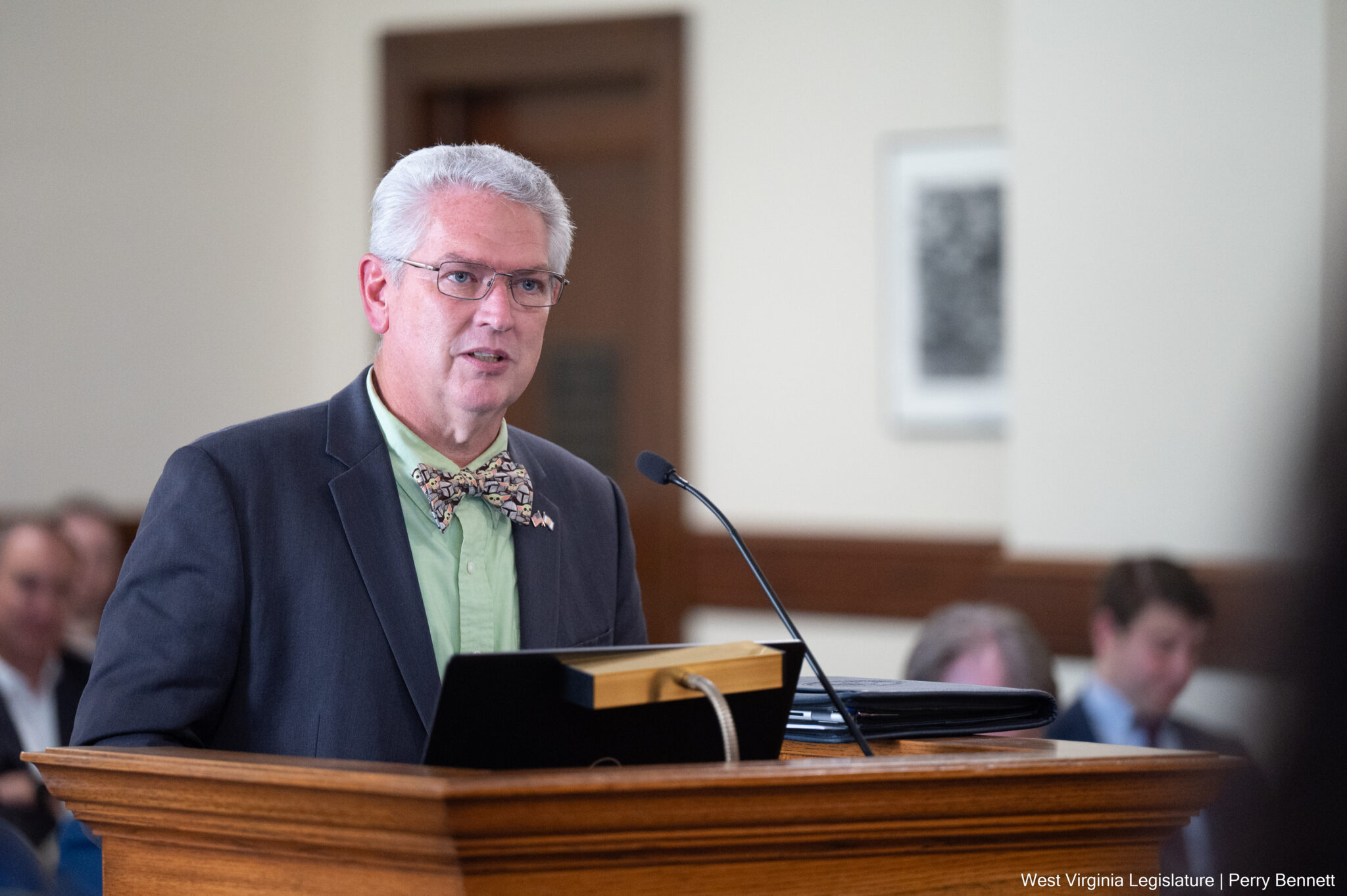
CHARLESTON, W.Va. — State Transportation Secretary Todd Rumbaugh says construction crews are dedicating lots of time to projects on and around West Virginia’s busiest bridge.
The Eugene A. Carter Memorial Bridge, which carries Interstate-64 over the Kanawha River and carries around 100,000 vehicles daily, is set to undergo a rehabilitation project that will span from mid-January to December next year. In the interim, Rumbaugh reported during the Joint Committee on Transportation Accountability meeting on Tuesday in Charleston, there has been paving work done off both ends of the bridge.

Additionally, Rumbaugh said, the Department of Transportation has gone out to contract on high-friction surface treatments on the bridge.
“Before the end of the year, you will have the whole area in Charleston paved, along with those areas redone with the high-friction treatment,” Rumbaugh said. “We are also having folks go out and they’re looking at the signing.”
Del. Dana Ferrell, R-Kanawha, pressed Rumbaugh about the elevated interstate as it enters the Capital City. Several crashes have made their way into the headlines this summer, including one that claimed the lives of four Raleigh County men in late August.
Rumbaugh said there are many safety initiatives at work on the interstate in that area.
“They will be adding additional pavement markings and the pavement marking delineation out there and barrier delineation, which means they’ll be adding more reflectors on the barrier,” he added. “You’ll see the outside of those barriers as you’re going around those curves, too. Along with some additional cautionary signing for speed out there.”
Ferrell wondered whether there would be any flashing lights in the area. Rumbaugh replied that he’s not sure about flashing lights at the moment, but there is signage that he’s confident will be updated.
“I know there will be the 50 mile-an-hour warning-type yellow signs that will be put up out there,” Rumbaugh said. “There’s already 50 mile-an-hour warning on the I-64 up on the large sign. But, some of those are getting old and worn, so we’re looking at, we have a signing contract out to replace signing. We’re hoping that they can get to those and get them refreshed before we get things locked up with a lot of traffic out there.”
Calls for the elevated interstate to receive elevated barriers, as a defensive measure, have followed those high-profile and sometimes-fatal accidents. Rumbaugh noted that, with historic structures such as the Carter Bridge, it’s not as simple as deciding to raise barriers. Assessments have to be done, he said, as those structures have been there a while.
Rumbaugh said the DOT is working on a solution.
“We’re in the process of getting a contract together to review those, to see if we can put larger barrier wall on there, if they will handle that loading,” Rumbaugh said. “Along with other safety features that we may consider for out there.”
Rumbaugh cited a bridge between Charleston and Nitro, that travels across 40th Street, to showcase why barriers can’t always rise to the new standard 42-inch wall. He said that, on that bridge, the wall drops down to 32 inches because it can’t be overloaded.
“Most of the contracts that we put out now, they have received the 42-inch barrier instead of the 32, and they’re designed to hold that,” Rumbaugh said. “The problem is, these older bridges, they were not designed to carry that additional weight.”
September’s three-day interim committee meeting schedule concluded on Tuesday.