

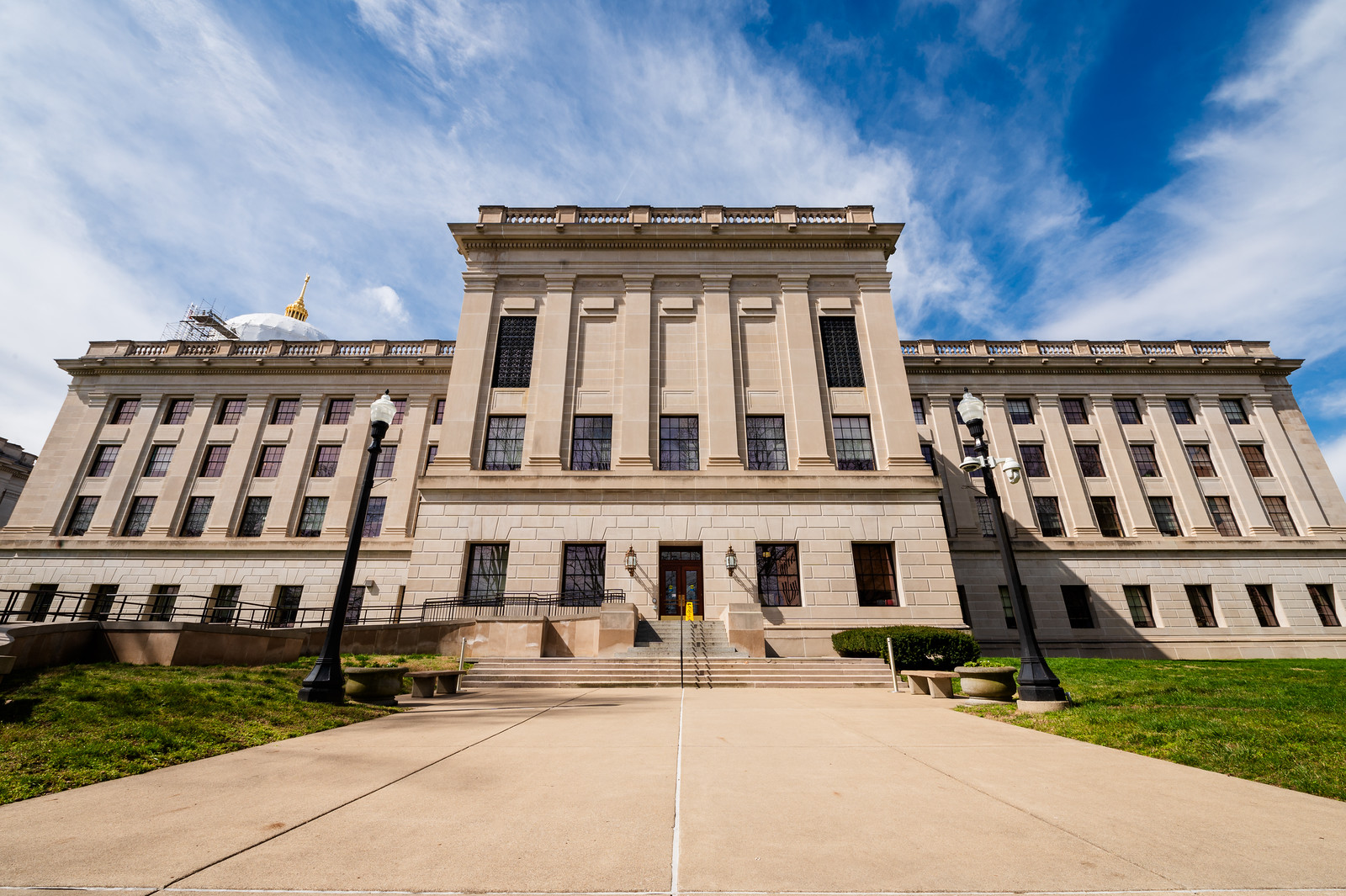
West Virginia Supreme Court justices heard arguments in a power struggle over who has the final authority over education regulations, the Legislature or the state Board of Education.
Retired Justice Beth Walker joined the court for the oral arguments. Newly elected Justice Bill Flanigan, who recently served as a state delegate, stepped aside.
At the center of the conflict is a bill passed during the 2025 legislative session, House Bill 2755, which makes a case that the Legislature exercises authority over the state Board of Education and thus has ultimate say-so on the rules governing the state education system.
That runs counter to the way the board has operated until now. The state board has had the final say on the policies that fill in the details on how to carry out education laws passed by the Legislature.
Lawyers for the state board contend the new law is unconstitutional.
“This is a case about toolboxes. The legislature is trying to take the board’s rulemaking power, and this court should hold that the law that does so is unconstitutional and issue a writ,” said attorney Christopher Smith, arguing for the state Board of Education.
The West Virginia Constitution says, “The general supervision of the free schools of the State shall be vested in the West Virginia board of education which shall perform such duties as may be prescribed by law.”
There is some duality of the responsibilities because the Constitution also says, “The Legislature shall provide, by general law, for a thorough and efficient system of free schools.”
The way the balance has typically been struck in practice is that the Legislature passes laws about education and the superintendent and state board are responsible for filling out the details through specific rules.
“The legislature has grafted, given itself a veto, over the board’s rulemaking powers,” Smith argued.

“Counsel, your arguments are awfully broad,” countered Chief Justice Haley Bunn.
“Doesn’t there have to be at some point where these powers give way? I mean, we have a legislature with clearly the power of the purse. So, don’t we have to look at what we’re dealing with in this particular case, rather than making broad, sweeping arguments that the legislature can’t ever do anything as to the supervisory power?”
Smith responded, “This is not a case saying the legislature can’t do anything or that the legislature has no powers. This is a case saying that the legislature cannot wrest from the Board of Education its rulemaking powers.
“The legislature has a tool in its toolbox, and that’s the legislative tool. If it doesn’t like a particular policy passed by the board, then it can go enter into its legislative session, pass a bill through two houses of law, and pass a particular educational initiative that it wants to see done, and it’s done that time and time again.”
Arguing in favor of the policy passed by the Legislature, Solicitor General Michael Williams argued the law is nuanced and “doesn’t seize the board’s rulemaking power, but merely gives the legislature one regular session to decide whether to in fact legislate.”
Chief Justice Bunn pushed back by commenting, “Counsel, but you’ll concede that the Constitution itself treats the school board differently than other constitutional officers.”
Citing a limiting phrase in the Constitution’s definition of the state board’s authority, Williams responded, “We’re just saying though that the the legislature does continue to retain some amount of supervisory authority in itself because otherwise that ‘prescribed by law’ phrase wouldn’t actually mean anything. It would be an empty phrase.”
“Where else in the Constitution is the power of general supervision granted?” Bunn asked.
Williams suggested “general supervision” doesn’t necessarily mean ultimate authority but instead references broad supervision compared to local boards.
“Your Honor, that specific phrase is admittedly nowhere else in the Constitution. But we think that, read in context, general supervision is meant to explain that the state’s board authority is statewide, as opposed to the supervisory authority that rests in local school boards,” he said.
This balance of power question between the state board and the legislature has arisen over and over in West Virginia.
Four years ago, West Virginians rejected a constitutional amendment that would have given the legislature authority to review and approve the state Board of Education’s rules and policies, leaving the board’s current constitutional authority intact.
Years before that, the issue was considered in 1988’s West Virginia Board of Education vs. Hechler, referring to then-Secretary of State Ken Hechler, whose office was being asked to file rules approved by the board.
The state Supreme Court, reviewing the situation then, concluded that the Board of Education has “general supervision” of state schools under the Constitution and that any statutory provision that interferes with such rule-making is unconstitutional.

“Hechler is pretty strong too, isn’t it?” asked Justice H.L. Kirkpatrick. “In other words, it says that the rulemaking powers are impervious to legislative impairment.”
“That’s exactly right, Justice Kirkpatrick,” responded Smith, the lawyer for the state board. “It is a power that is solely vested in the Board of Education and rests with the Board of Education.”
“But again, the legislature is not powerless. It’s just that it cannot take the tools that were given to the board by the Constitution.”