

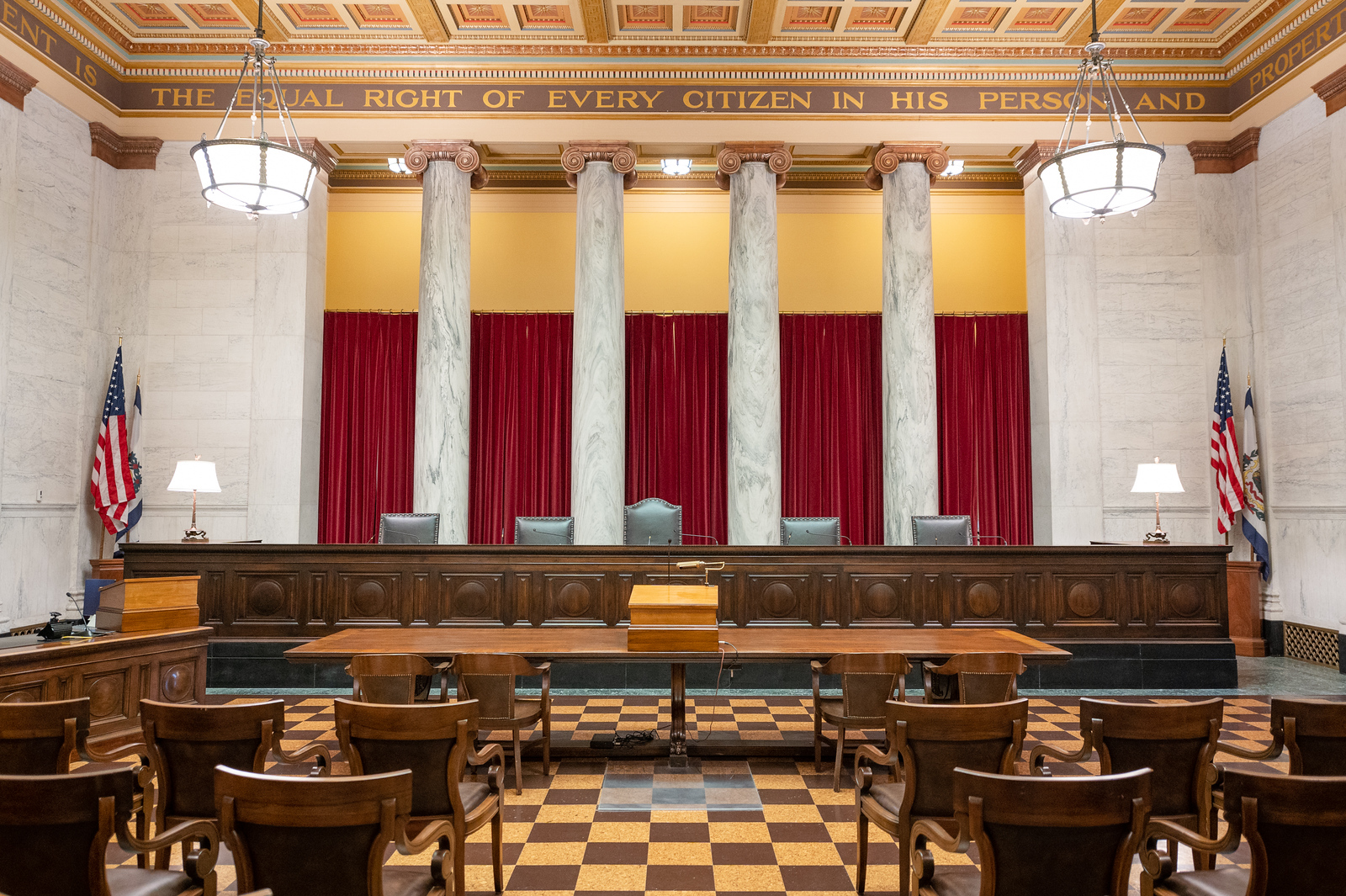
West Virginia Supreme Court justices considered the question of what happens when a local congregation wants to disaffiliate from its denomination but keep the church land, buildings and bank accounts.
A major part of the legal battle is over whether a secular court has the authority to hear the case, or whether the court should stay out of a religious conflict on First Amendment grounds.

“What you’re challenging here is the denomination’s decision as to when and how the local churches can disassociate. I mean, that’s the relief that you’re asking for, and so how can this this court or the lower court give that relief without running smack into the First Amendment?” asked Chief Justice Haley Bunn during a Wednesday afternoon hearing.
At the core is a dispute between the West Virginia Conference of the United Methodist Church and 33 local congregations seeking to disaffiliate while retaining their property. The local churches are being supported by an organization called the National Center for Life and Liberty.
The local churches have sought to leave the United Methodist Church because of “issues of conscience” following shifts in the denomination’s policies on human sexuality, particularly over the issues of same-sex marriage and allowing openly gay people to act as ordained clergy.
The United Methodist Church had a disaffiliation process allowing churches to leave and keep property after fulfilling specific financial obligations, such as pension liabilities. that expired Dec. 31, 2023. While the process was open over four years, about 25% of UMC congregations, more than 7,600 churches, moved to split from the denomination.
Some congregations that disagree with the UMC’s direction but did not disaffiliate before the deadline are still trying to find ways to exit with their church property, leading to ongoing denomination-versus-local-church litigation.
The lawyers for the local congregations in West Virginia say the case does belong in the court system because they are asserting a fraud claim that has to do with whether the United Methodist Church schemed to prevent the local churches from disaffiliating before the deadline to do so passed.
“This case is not about church doctrine; it’s about fraud and broken promises,” said David Gibbs, a lawyer representing the local churches.
The United Methodist Church maintains that all local church property is held in an irrevocable trust for the benefit of the entire denomination, a principle known as “connectionalism.”
“Any church member is free to leave the church. Just like churches have the right of to exercise the freedom of religion under the First Amendment, so do individuals, and they can choose a church that they want to go and to be faithful and express their religion,” said Wendy Adkins, a lawyer representing the trustees of the West Virginia Annual Conference of the United Methodist Church.
“But in doing so, and in joining that religious institution, they in turn consent to be bound by the laws of that church, as well as to be governed by the hierarchy of that church. Here, the local churches not only want to leave the United Methodist Church; they want to leave with their property, and that’s in violation of the trust clause.”
The local churches counter that they paid for, maintained and insured the property, and that the Conference’s attempt to retain it constitutes unjust enrichment and a deprivation of their contractual rights.
“I guess you can always leave, but leave your bank accounts, leave your EI number, leave your property, leave the cemetery, leave everything to us, so we can come in and liquidate it,” said Gibbs, the lawyer for the local churches.
“And then that will then create funds that will allow us to continue to pay lifetime salaries to the people that lied to you, the bishops and the other church leaders.”
In Mercer County, the first circuit judge assigned to the case, Ryan Flanigan, originally dismissed the local churches’ claims late last October, citing the First Amendment and the ecclesiastical abstention doctrine that prohibits civil courts from interfering in the internal governance, discipline, or religious law of a hierarchical church.
Judge Flanigan ruled that the church’s high judicial council has final authority over property trusts and separation protocols.
However, early this year, Judge Flanigan recused himself by saying he had a “conflict in presiding over this matter” that was not publicly specified.
The matter was transferred to Judge Mark Wills, who reinstated the case on March 13.
“As there are, indeed, allegations of fraud and collusion, the Court believes that those are questions of fact for a jury,” Wills wrote in his order.
The West Virginia Conference of the United Methodist Church responded by filing a petition with the state Supreme Court to try to block the circuit judge from proceeding with the case, arguing he lacked the constitutional authority to review these church decisions.
“With respect to fraud, it’s creative pleading, trying to get around the ecclesial abstention doctrine,” said Adkins, the lawyer for the United Methodist Church.
The question being asked of the justices is:
Whether the First Amendment of the U.S. Constitution and Article III, Section 15 of the West Virginia Constitution deprive the Circuit Court of Mercer County of subject matter jurisdiction to review decisions of a religious nature made by the United Methodist Church and its highest judicial tribunal, the UMC Judicial Council.
Attorneys for the local churches filed a response that asked a different question about the matter:
Whether the ecclesiastical abstention doctrine prohibits the circuit court from presiding over a case of fraud and collusion committed by a statewide conference of a claimed hierarchical church against local churches