

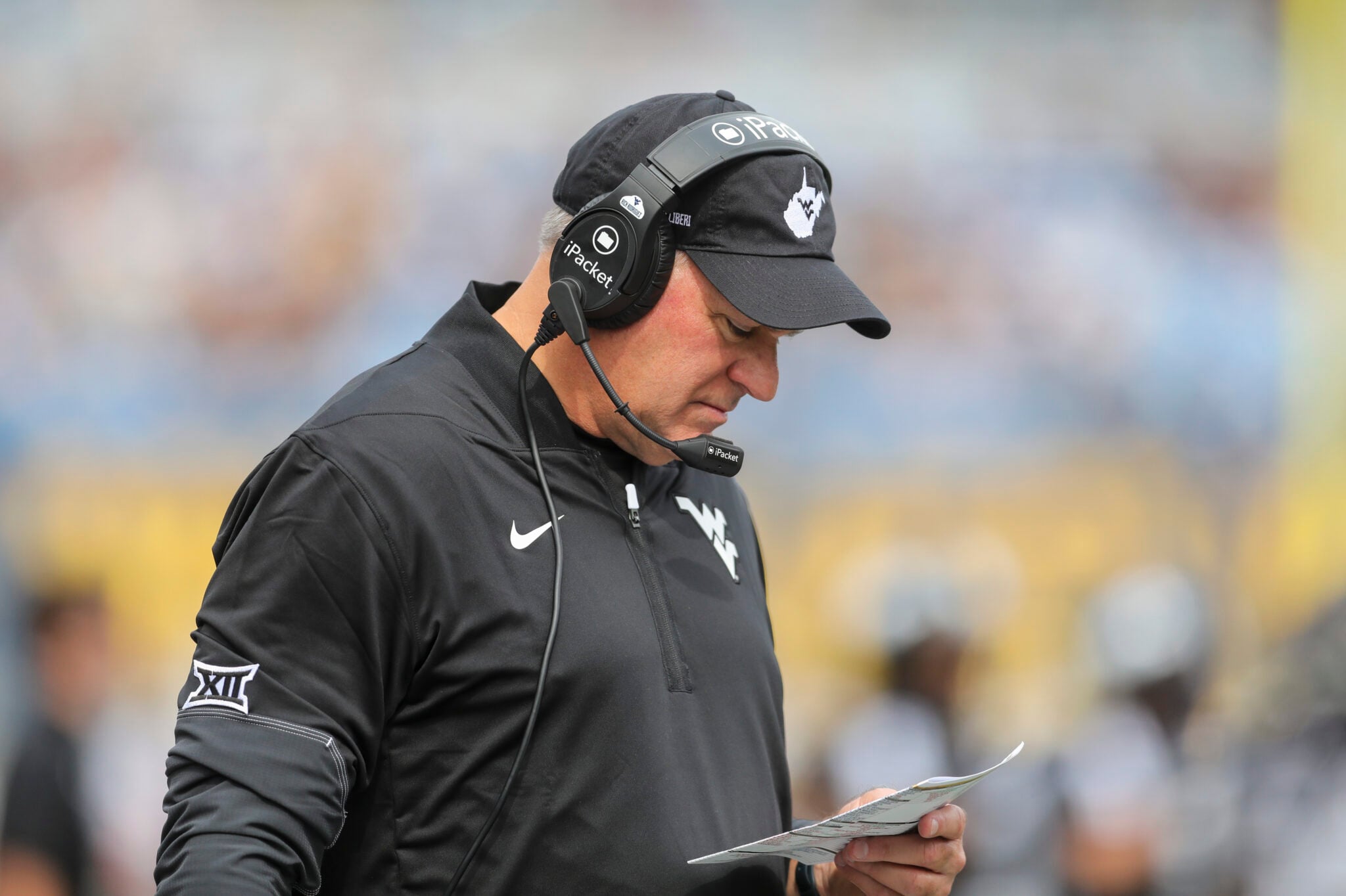
MORGANTOWN, W.Va. — West Virginia football finds itself in a similar position this week as to the one it was in each of the previous two.
Fresh off a 52-31 loss to Arizona last Saturday, the Mountaineers (3-3, 0-3) are in sole possession of last place in the Big 12 Conference and have yet to come close to slowing down an opposing offense in a league game.
Defensive cracks that surfaced in spots throughout non-league play have been far too prevalent while allowing an average of 46 points and 552 yards in setbacks to Oklahoma State, Iowa State and the Wildcats. The Mountaineers are allowing 8.6 yards per play and 13 yards per pass attempt in their three losses.
“We’ve looked at everything,” head coach Rich Rodriguez said. “The whole staff watched the film for 4 and a half hours Sunday morning, and watched it with the whole defense Sunday afternoon. Trying to get to the bottom of exactly why, because there have been different issues every week, but there were cracks defensively in the first game, and I met right after the game because of it.
“It showed up more in the last three weeks, so it’s frustrating. I know what the answers are and the coaches know what the answers are. We have good enough players to play better. As a staff, we have to find ways to get our guys to play better and that includes everything — how we’re practicing, who’s playing where, fundamentally, schematically. Everything needs to be reviewed and looked at. Potential is a bad word, but there is the ability for us to be pretty good on defense with the guys that we have and the coaches that we have, but it’s not shown up. Until it shows up, we’re not going to be insane and keep doing the same thing and expect a different result.”
Arizona had six touchdowns on 51 offensive plays, including four on 22 snaps after halftime. The Wildcats’ last five touchdown drives were as follows: Four plays for 58 yards; three plays for 75 yards; three plays for 75 yards (again); two plays for 75 yards and two plays for 52 yards.
“You have to play every single play with the same standard,” WVU defensive coordinator Zac Alley said. “It can’t change because of whatever the scoreboard looks like or however you’re feeling. We had a lot of plays this last week I felt like the effort across the board wasn’t there.”
Whereas the Mountaineers ran six more plays than their opponents and possessed the ball for less than 53 of a possible 120 minutes over the first two Big 12 games, the matchup with Arizona was far different. WVU had the ball for nearly 36 minutes to Arizona’s 24:10, and the Mountaineers accounted for 104 of the 155 plays. The play total wasn’t far off the school record of 110 set in 1923 against Washington & Lee.
“If we’d have had two or three fast drives, it could’ve been worse. I’ve certainly looked at that, but that’s never been a factor in my mind on how the defense plays,” Rodriguez said. “In fact, if we got a few three-and-outs defensively, we could’ve run maybe 140 plays. It’s really frustrating. Obviously, if I had seen this coming, we’d have tried to make more adjustments earlier. I don’t think anybody saw it coming to this degree, even though I thought there would be some growing pains on both sides, because of the newness. I didn’t see this coming. But I’m also encouraged that I know we can play a whole lot better and I know we have to play a whole lot better. I’m not throwing in the towel and giving up either.”
The 44 plays of 20 or more yards that WVU has surrendered this season are nine more than the next closest FBS team, and the 22 allowed of 30-plus yards is last among 138 squads.
Against Arizona and Oklahoma State, the Mountaineers gave up 730 passing yards on 36 completions. Iowa State also had success through the air and passed for 312 yards, but the Cyclones gashed WVU on the ground with 265 yards on 47 attempts — and that came one week after the Cowboys had 220 rushing yards on 41 carries. Even Arizona had a plenty respectable ground game with 141 yards on 27 rushes as the Mountaineers have yet to find anything close to an answer for just about everything thrown their way in league play.
“The biggest thing is getting them comfortable to have confidence in the execution,” Alley said. “There are gray areas sometimes maybe in the players’ minds. ‘OK, well this split wasn’t exactly what we saw in practice. He’s 2 yards tighter, so I didn’t do what you said I was supposed to do on every play because he was 2 yards tighter.’ There becomes indecision when there are changing pictures. You’re trying to clear that up and give them hard-to-find, no matter what, do this, because we believe that’s what’ll help us have the best chance to win.”
The defensive struggles and lack of Big 12 success have come despite WVU rushing for at least 291 yards in every Big 12 game and no fewer than 247 in any of its six contests this season.
“I told everybody it’s an open job. Nobody is solidified as a starter,” Alley said. “We aren’t good enough to say we have 11 starters out there. We’re trying to put the most athletic guys we can to give us an opportunity in positions that we feel like they can be successful in.”