

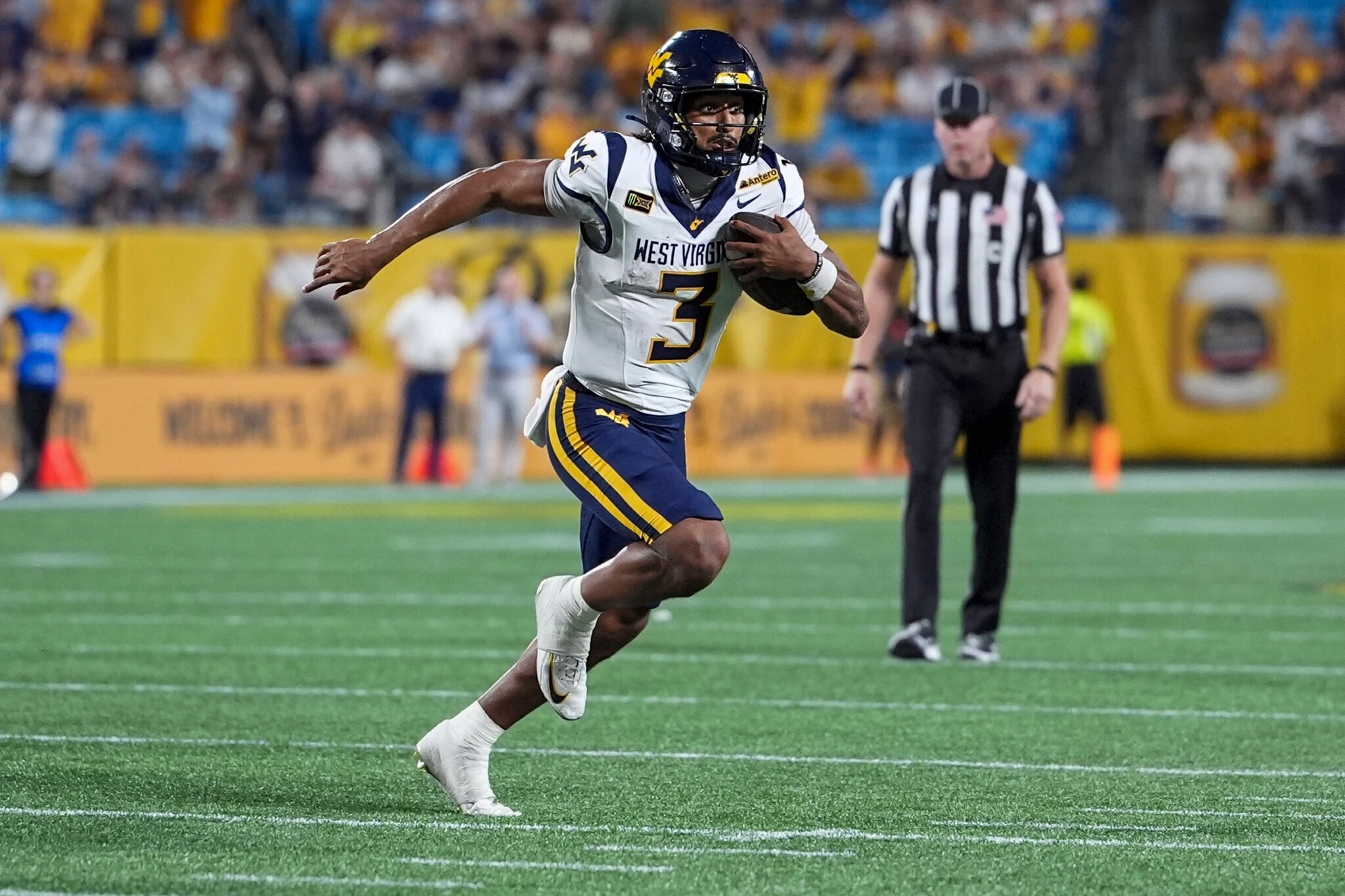
For West Virginia to record its second three-game win streak this season, the Mountaineers will need to produce their most notable victory of the year and find success against a program they’ve hardly had any against of late.
No. 15 Texas Tech welcomes WVU to Galaxy Stadium for Saturday’s 9:30 p.m. matchup airing on ESPN.
The Mountaineers defeated the Red Raiders annually from 2014-18, but have won once in seven tries since in the series, which includes a 49-0 loss to conclude the 2025 season.
After playing eight straight Saturdays to start this season, West Virginia (5-3, 2-3 Big 12) enters the matchup off its only bye week and within one win of bowl eligibility.
“I don’t bring it up a lot, because every game is important and has a life of its own, but now that you’re at five, getting to six to be bowl eligible is something you want to be every year at least,” Mountaineers’ head coach Rich Rodriguez said. “That’s not the top of the list goal-wise, but one of them is to play in a bowl game.
“I still think the bowls themselves are great for fans and players and maybe it’s been diminished a little bit with the playoff, but it’s out there. So now that we’re at five, the next one is to get six. It would be great for us to be able to go to a bowl game in our second year back, and more than anything else, for our fans and players to enjoy that experience. Some of our guys have never been to one, so to go to one would be nice.”
Texas Tech (7-1, 4-1) claimed a 34-26 win over nationally-ranked Arizona last week, a result that allowed the Red Raiders to move forward from their lone setback one week prior at Cincinnati.
Despite surrendering the most yards (483.9) of any Big 12 Conference team on average by a wide margin and ranking next-to-last in that category nationally among 138 FBS squads, West Virginia has confidence and momentum from wrapping up the October portion of its schedule with a 24-20 win at TCU in its last game.
In that contest, the Mountaineers were significantly out-gained, 484-272, but forced three of the game’s four turnovers, including a late fumble recovery off a sack with the Horned Frogs in the red zone to seal the outcome.
TCU had 82 plays to 57 for WVU, and while the Mountaineers were held in check and averaged 4.8 yards per play, a struggling defense put forth a better performance while holding the Horned Frogs to 5.9 yards per play.

“Defensively, I don’t think we played great, but we battled and made them earn things,” Rodriguez said. “Instead of a two-or-three-play touchdown drive, we made them go on longer drives. Sometimes, when you make a team go 10, 12 or 13 plays, you hope they screw up somewhere along the line and you get a stop. That’s what happened in that game a little bit.”
West Virginia regularly utilized a 3-3-5 alignment, and it remains to be seen how much of what worked can translate to a matchup against the defending Big 12 champion.
“The availability was a big part of it with some guys who were down and didn’t make the trip,” West Virginia defensive coordinator Zac Alley said. “We’ve always had a flavor of that in the system. It’s how I think. I want to be diverse and hard on people. We try and match it to our personnel and that’s something we’ll always try to do. How do you get your best guys out there who are available right now?
“Part of being able to be diverse and do different things is being able to plug and play guys when it happens. I think it was a little bit of both of those things. Availability and feeling like they probably hadn’t worked that and prepped for that in practice.”
The Mountaineers have one of college football’s most productive running quarterbacks in Michael Hawkins Jr. and are set to oppose another in Thomas Castellanos, who made his first start as a Red Raider last week.
Castellanos completed 11-of-24 passes for 144 yards with two touchdowns and rushed 19 times for 117 yards and a TD against the Wildcats.
Castellanos joined Tech late in the summer after gaining a fifth season of eligibility through the legal process, and he was briefly ineligible during the season before taking on a featured role last week. The quarterback previously played at UCF, Boston College and Florida State, and rushed for 1,113 yards and 13 touchdowns one season at BC as well as 557 yards and nine scores last year as a Seminole.
The Red Raiders ripped off 328 rushing yards against Arizona, including 175 on 14 carries from tailback J’Koby Williams, who paces the squad with 794 rushing yards and six TDs on 100 carries. Fellow running back Cameron Dickey returned from and played for the first time since October 3. Dickey rushed for 34 yards to bring his season total to 276 with four touchdowns on 67 attempts.
The Red Raiders average 207 rushing yards, while WVU has relied heavily on Hawkins and tailback Cam Cook to create one of the top rushing attacks in the country with a Big 12-best 261.6 yards on average.
Cook is second in the Big 12 with 923 yards on a conference-high 186 carries and has seven rushing TDs, while Hawkins easily leads the league with 16 rushing touchdowns and is No. 4 in rushing yardage with 836 on 163 attempts.
The Mountaineers’ run-heavy approach figures to be an intriguing matchup for the Big 12’s best run defense. The Red Raiders are No. 12 nationally surrendering 94.9 yards on the ground per game on 3.1 yards per rush.
Defensive lineman A.J. Holmes Jr. is among the most disruptive defenders in college football and has 6.5 sacks, 7.5 tackles for loss and six quarterback hurries. Linebackers Austin Romaine and Ben Roberts are the team’s top tacklers with 66 and 61, respectively and that duo has combined for 10.5 TFLs and three of the team’s 13 interceptions — a mark that leads the Big 12 and is fourth nationally.
“It’s been well known that they’ve resourced it really well, but you still have the right guys and coach them up, and they do that,” Rodriguez said. “They have a lot of guys that will be NFL guys. They’re very well-coached and play really hard. They have really good players and do a great job coaching them as well. That combination is why they’ve been the best team in the league the last two years.”
Texas Tech allows 285 yards on average through the air, leaving the Red Raider pass defense ahead of only three FBS teams in that category. One of those is WVU, which is last at 317.9 yards.
“I made a big emphasis last week and will again this week of, we have a good offense, they can score. If we just don’t give it up fast and get an opportunity to make them kick a field goal, get a turnover, stop them on third down,” Alley said. “If we win more of those than we lose, there’s a good chance we’ll score right after that happens.”