

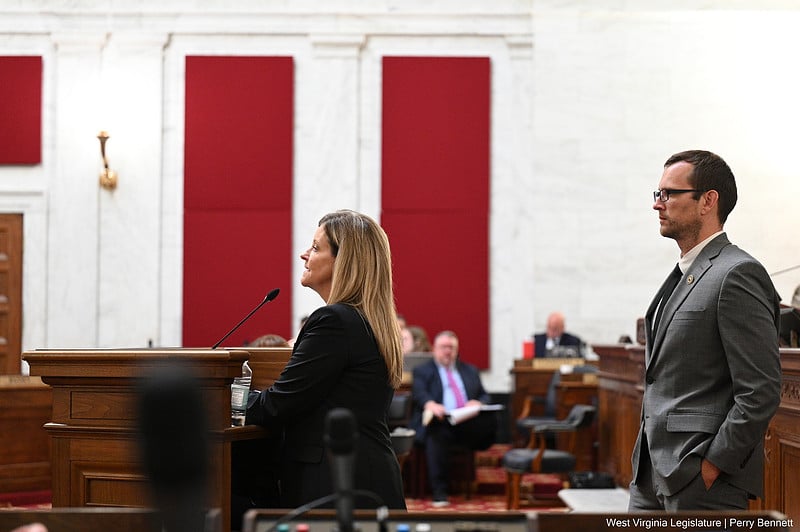
State lawmakers got a primer on school funding proposals by the state Department of Education, receiving possibilities that could amount to an additional $410 million.
This is a part of a dialogue over whether school funding is adequate in West Virginia and how to make it better. Right now, state funding in West Virginia amounts to about $1.406 billion. Various aspects of the proposals would bump that to about $1.816 billion under the framework being rolled out.
Lawmakers have discussed school funding for months, even as increasing numbers of schools close or consolidate around the state. Yet they have not reached a resolution on how to deal with the issue.
A current lawsuit asks the state Supreme Court to conclude that school funding doesn’t measure up to the state’s constitutional mandate and for justices to direct officials in the executive and legislative branches to fix it. Attorneys for state officials have asked for any Supreme Court action to be held off until spring, after the next regular session of the legislature.
The state Department of Education has been working on a framework that could be a starting point for lawmakers. That’s what state education leaders presented to the Joint Standing Committee on Education.
“Human capital is essential infrastructure. Our students and educators are just as important to West Virginia’s future and economic sound infrastructure as our roads, our broadband, and the industrial sites that we’re bringing into West Virginia. So we have the opportunity to do what’s right for today’s students,” said state Superintendent Michele Blatt.
The draft includes:
- student funding weights for special education, students whose family incomes qualify at poverty levels, English learners, gifted students and career technical education studets;
- a three-year enrollment average for counties to buffer in case of sudden enrollment drops;
- revised facilities and substitute funding;
- and support for additional operational positions.
The estimated total cost is $410 million.
Of that, increased funding for special education accounts for about $190 million. Adjustments for students with lower socioecoomic status amount to $63.9 million. The enrollment smoothing would be about $50.7 million. Facilities recalibration is estimated to cost $42.8 million.
This is not a final product, and it’s not intended to be. Once the regular legislative session begins in January, lawmakers can pull it apart, keep what has consensus or what’s achievable and hold off on what can’t be accomplished right away.
“So this is truly a draft piece,” she said, “we’re going to get into your hands so that you can pull apart, you can look at those nine components and you can have discussions, and then we’ll also have the the cost as it’s aligned to each one of those. So this was simply just a starting point, so that we would have something and hopefully be able to end next session with some changes.”
Legislators’ questions were detailed and skeptical. Several focused on whether the proposal was justified, affordable and workable. Some pressed on the overall potential costs whether measurable outcomes could show the investment was working.
“How will you assure that the additional spending per pupil follows the student, and what are your accountability measures for that?” asked Delegate Lori Dittman, R-Braxton.
Senator Rollan Roberts, R-Raleigh, asked “Does the department have any plans on giving the legislature some measurable performance measures so that we can figure it out and see that there is progress being made as we report to constituents?”
Delegate Mike Pushkin, D-Kanawha, said he’s tired of waiting for the Legislature to act.
“I’m tired of seeing schools close. It makes the problem worse,” he said. “You talk about population loss. Nobody’s going to move to a state where they can’t get their kids to a school in the neighbor in the neighborhood they live in, but go ahead.”
House Education Chairman Joe Statler, R-Monongalia, said this won’t be the last look at school funding.
“I can tell you, with all surety, this is just the first of the meetings that will take place. There will be many more discussions on this subject,” he said.