

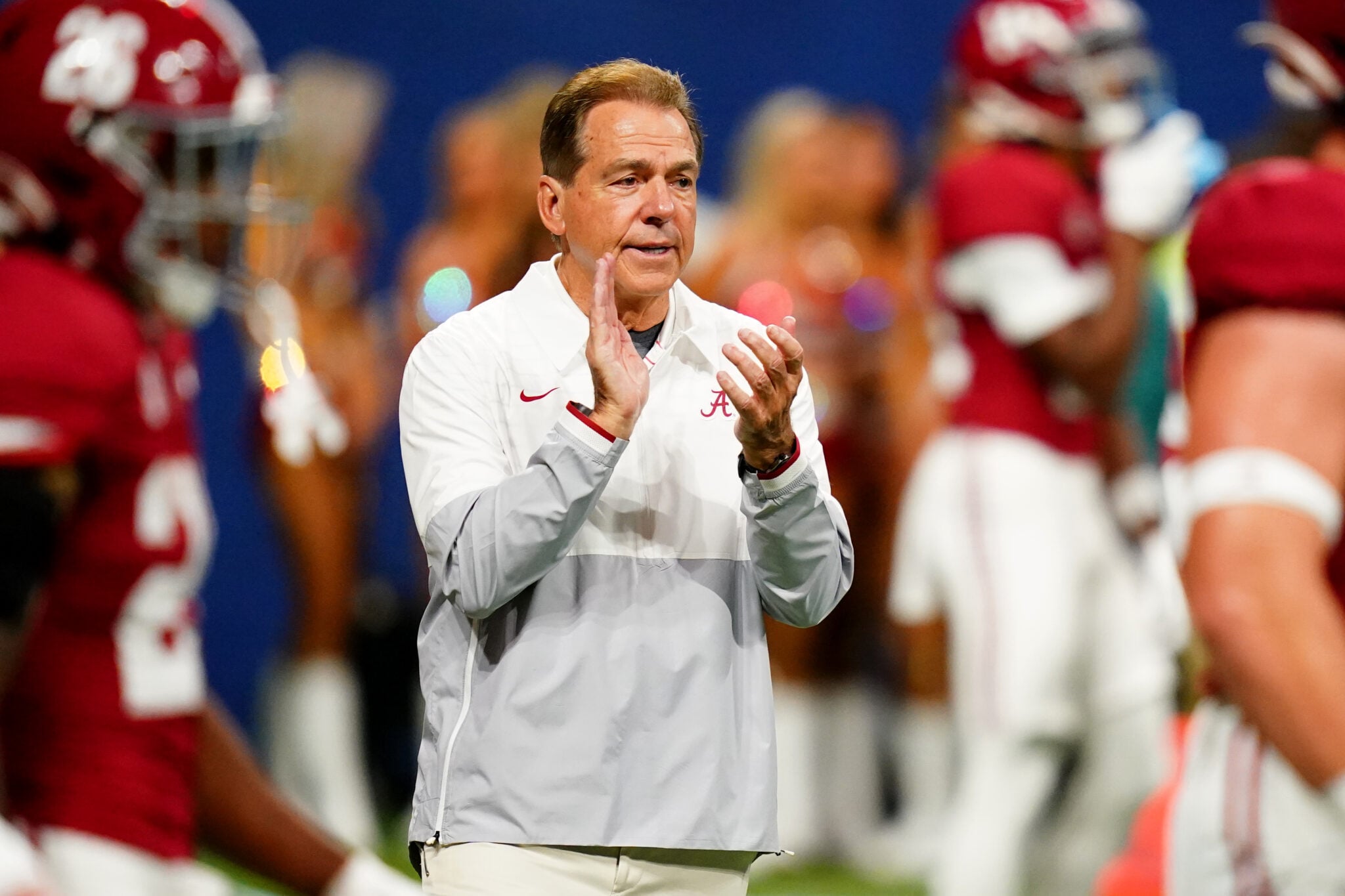
MORGANTOWN, W.Va. — Legendary college football coach and Marion County native Nick Saban is hopeful Congress can pass the Protect College Sports Act before time runs out.
A seven-time national champion, Saban has advocated for the legislation that would institute guardrails to the current landscape of collegiate athletics. The bill passed through the U.S. Senate by a 77-22 vote and now requires approval from the U.S. House of Representatives to move forward. The clock is working against proponents of the bill, as it needs Congress to act before the end of the year. A floor vote is scheduled for the week of December 8.
Saban has testified before lawmakers that there are “no rules” when it comes to major money-making sports like football and men’s basketball. With student-athletes’ ability to profit of their Name, Image and Likeness (NIL) and unlimited transferring without having to sit out a year, the landscape has completely shifted since years gone by.
Saban, who grew up in Monongah, visited with MetroNews “Talkline” host emeritus Hoppy Kercheval on the most recent edition of “State of Minds” to underscore the importance of the Protect College Sports Act.
“The reason we have no rules is the NCAA could not enforce their rules because of litigation,” Saban said. “That’s why we need something passed in Congress that has antitrust protection, that allows whatever rules we put in place to be able to be enforced.”
How did college athletics get to this point? Saban attributed it to student-athletes suing over the old model, which required them to sit out a year for transferring, and promptly winning each suit. Now, he said, there are no enforceable rules.
While the Protect College Sports Act isn’t a finished product to be relied upon for decades to come, Saban believes it’s a good starting place.
“I don’t think the bill is perfect, it’s probably 80-percent really, really good,” Saban said. “I think the goal is, can we get this bill passed so we take the 80 percent of what would control 90-percent of the problems, and maybe we have to fix it in the future to make it more applicable to everyone.”
Across the country, fanbases have grown more upset about a lack of consistency on their team’s roster from year to year. Saban said NIL has created a thinly veiled reality: it’s become pay for play. Universities have created “collectives” to connect student-athletes with ‘marketing opportunities’ for which they receive compensation, Saban said, but they’re essentially getting paid for their athletic ability.
“I think what people are most disgusted with is player movement and not being able to relate to their team,” Saban said. “The player movement is obviously caused by the ability to transfer, but also by compensation that can be afforded to you if you do transfer. So, it’s unlimited free agency.”
Players receiving compensation isn’t the root of the issue, Saban said, the problems lie with the lack of any enforceable rules. He said NIL has become a key recruitment tool for schools all around the country.
“Now, I’m all for players making money, I’m not against that,” Saban said. “But I think there should be some kind of guardrails, like they have a salary cap in the NFL, so that creates parity in terms of competition.”
As if that weren’t enough, Saban noted many universities are dipping into their general fund — money typically reserved for academics — to afford the exorbitant rates to field a competitive college football and college basketball team. Saban said that Olympic and women’s sports are going to suffer because of that.
“What are you going to do to eliminate that? You either going to have noncompetitive programs or you’re going to eliminate sports. Neither one of them are beneficial to what the spirit and tradition of college athletics has always been,” Saban said.
Saban highlighted the Protect College Sports Act as an opportunity to provide help to those sports. He said there would be a $21 million revenue sharing settlement with the House, if the legislation is approved, along with a $25 million cap for collectives to spend.
Notably, Saban said the $25 million in the collective could not be spend on recruitment. Rather, it would only be doled out to retain players on schools’ rosters. Saban estimated the $46 million combined is about “80 to 90 percent equal” to the money being spent right now in the Power Four conferences.
Saban said the Protect College Sports Act also mitigates concerns about ‘super leagues.’ Especially since Oklahoma and Texas moved from the Big 12 Conference to the Southeastern Conference (SEC) in 2021, growing the SEC to 16 schools, there has much significant conversation about the SEC and Big Ten Conference potentially breaking off, forming their own ‘super league’ and leaving the rest of the schools and conferences behind. Saban said the legislation provides a cap on the number of teams within a certain conference.
Additionally, there is media rights legislation for revenue creation as part of the Protect College Sports Act, Saban said. He said it requires 75-percent approval from Division-I schools, but noted that each school can decide whether or not they want to opt in.
A lost element in the current environment is education, Saban said. With unlimited transfers, he said, student-athletes’ ability to get a quality degree has suffered. He said more stability will help those student-athletes long term. Saban pointed out that with each transfer, the chances of a student-athlete graduating decreases.
Saban said he and his wife Terry were the first in their families to graduate. He noted when a student-athlete graduates, their entire family benefits. Saban said team values are lost in this current landscape, values that apply to life.
The Protect College Sports Act limits athletes to one transfer as an undergraduate, and one additional transfer upon graduation. Saban said athletes will be limited to just five years of eligibility, regardless of redshirts. Saban said that will force students to be “strategic” with their transfer decisions and gives antitrust protections for legislative bodies. He noted that overarching body calling the shots may not be the NCAA forever.
Along with that, it provides teeth to player contracts, Saban said.
“Every competitive league has some kind of guardrails on contracts, how much people make, and what their obligation is to the contract,” Saban said. “We don’t have that in college football.”
If the bill doesn’t succeed before the year ends, Saban said, they’d have to start all over. House Majority Leader Steve Scalise is pushing for an amendment to the bill restricting unionization. Saban said that amendment would need the Senate’s approval and could derail the bill from passing before the all-important December 17 adjournment.
He said the priority is just to “get it on the floor of the House” to see what support there is. Saban said he’s cautiously optimistic going forward.
“Look, everyone who I’ve talked to in Congress, most people didn’t understand the concept of the bill completely,” Saban said. “Once it gets explained to them, they’re logically in favor of it.”
Saban’s full visit with Hoppy Kercheval is available now on the MetroNews TV app.