


CHARLESTON, W.Va. — Legislative leaders consistently say they don’t want to raise taxes to fill an estimated half-billion dollar budget gap.
But they do express consistent interest in an alternative — eliminating exemptions in the state’s consumer sales tax.
 House Speaker Tim Armstead spoke with some enthusiasm about that possibility last week during a conversation with reporters about the upcoming legislative session.
“If all businesses, all industries are paying that tax, there’s a broader base,” Armstead said. “Then it has less of an effect on the whole. I have a book here that has a list of exemptions carved out to that sales tax over the years, including — would you believe? — soap used in car washes.
“The big ones we’ve talked about are looking at professional services, lawyers and accountants. They’re exempt from that tax.”
HOPPY KERCHEVAL: New taxes could also be part of the budget fix
The Legislature considered such a bill last year, but the House voted 92-2 to table it late in the session. The bill — dubbed the “Sales Tax Fairness Bill” — had passed the House Finance Committee just a couple of days earlier.
It died for a variety of reasons, observers say. It was birthed through a hasty Saturday rollout, lawmakers didn’t have enough time to digest it because debate over it occurred late in the session, and legislators experienced media anger over an advertising tax.
Last year’s bill would have eliminated parts of state code that waive sales taxes on certain types of services while also decreasing the state’s consumer sales tax from 6 to 5.5 percent.
The bill would have removed the sales tax exemptions on a number of professional services, including legal, accounting and engineering services.
The Legislature believed that would have generated more than $200 million in revenue at the 6 percent sales tax rate.
But lawmakers wanted to trim the sales tax rate to 5.5 percent. They estimated that would have boosted revenue by more than $70 million a year. They characterized those estimates as conservative.
Further annual drops in the sales tax percentage were considered under certain conditions:
If the state maintained a healthy balance in its Rainy Day fund — measured as at least 15 percent of the total of the General Revenue Fund budget on June 30 of each year — the sales tax would have continued to drop in .025 percent increments each Jan. 1 through 2020.
The schedule would have provided the Legislature with annual opportunities to revisit the plan.
In his conversation with reporters last week, Armstead said the plan to eliminate exemptions in the sales tax would not be considered a tax increase because of the desire to reduce the overall rate.
“It’s not the same if you lower the rate,” he said. “You’re not saying we’re going to create a new tax. If you an spread it out to where everyone is paying a fair share, you can lower it on everyone.”
Armstead expressed an overriding desire to broaden West Virginia’s tax base.
“We really believe the real way to solve our budgetary issue in the long run is tax reform,” he said. “We feel like there needs to be a tax structure that encourages growth, a tax structure that broadens the base, and hopefully we can lower some of these rates.
“We have a lot of exemptions, and I know it’s controversial when you get into those. The smaller the base is for any tax structure, it’s more volatile to change; the broader it is, the more you can weather storms.”
Bills can change from year to year, of course, but last year’s “Sales Tax Fairness” bill targeted exemptions for economic sectors like advertising sales for television and radio, newspaper and outdoor advertising space, fitness centers and their memberships, sales of computer hardware or software, plus purchases made electronically.
The advertising portion particularly stirred up West Virginia’s television stations, radio companies and newspapers — and they were quick to hop on the line with legislators representing their communities.
The associations representing West Virginia’s broadcasters and newspapers are already watching this issue for the coming legislative session.
The West Virginia Broadcasters Association has argued — and would argue again — that advertising helps local businesses grow, which helps the state’s economic recovery.
“Advertising drives sales of products and services, which in turn help produce jobs,” stated Michele Crist, executive director of the broadcasters association. “Taking away this exemption would create the opposite of what they are trying to accomplish. When stimulating the economy is the number one priority for West Virginia, an ad tax will send an anti-business message to those looking to setup shop here.”
Don Smith, executive director of the West Virginia Press Association, said the statewide media organization is against a tax on advertising and made a similar case.
“We understand that with the current budget deficit, West Virginia needs to increase revenue. We know that adding or increasing taxes is a method,” Smith said. “However, the state must be careful those actions aren’t counterproductive. The issue has been debated nationally. Taxing advertising means less money for actual advertising. Less advertising means fewer sales. That means less sales-tax revenue.”\
“The impact would be harmful to the people of West Virginia. It’s more than just higher costs on all products directly reducing sales and sales tax revenue. It would hurt the workforce: less advertising, less sales, fewer jobs.”
Both the broadcasters association and the press association agree that no surrounding states — no states at all, really — impose a sales tax on advertising.
But the urge to trim exemptions is fairly broad among legislators.
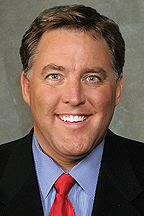
House Minority Leader Tim Miley, D-Harrison, during an appearance last week on “Talkline” with Hoppy Kercheval, said the approach has the support of his GOP counterparts and might make sense from Governor Justice’s perspective.
“I do know there is an effort to eliminate much, if not all, of the exemptions to the state sales tax – which does need to be addressed because we have turned into a service-based, consumption based economy. So I think we need to go down that path,” Miley said.
Miley said his own preference is to consider tax hikes on “choice” products such as sugary drinks.
Miley agreed that a general increase of the sales tax by a percent could raise a potential $200 million, but he said a more realistic approach, given the sentiment in the Legislature, would be to cut exemptions.
“I agree, and the benefit of doing it that way is that it would give Jim Justice and his administration time to go in and make structural changes to the way our government operates. So that to me might be the preferred route unless we’re ready to go in and eliminate the sales tax exemptions on so many services – which ultimately means raising taxes on people who pay for various types of services who aren’t paying now. But it satisfies some people’s beliefs that it broadens the base of tax payments being made,” Miley said.

The politics are similar in the Senate, where Craig Blair, R-Berkeley, is vice chairman of the tax reform committee. He favors a whole new approach to West Virginia’s tax structure, focused on eliminating exemptions.
“We’re looking at opportunities to change our tax structure in the state so it is more balanced, that government won’t be picking the winners and losers,” Blair said. “What we do is broaden the base and make it fair for all.”

Senate Majority Leader Ryan Ferns, R-Ohio, is also advocating for a tax structure overhaul that would include closing exemptions.
“I think it will be a very worthwhile endeavor to try to do a complete overhaul,” Ferns said in a telephone interview last week. “I’m not talking about one part here or on a specific tax. No matter what our budget situation is like, I don’t think the tax reform effort is ever going to be easy.”
The Cardinal Institute, a West Virginia think tank that looks at issues from a conservative perspective, agrees with that assessment.

“If you begin to notice in your tax code that you have tons of exemptions and credits and things like that, it’s probably a symptom of the overall tax code,” said Garrett Ballengee, executive director of the Cardinal Institute. “It’s a symptom that ‘We need to look at this fundamental overhaul.'”
Ballengee added, “You don’t want your tax code to play favorites. That allows you to broaden the tax base and lower the rate, which means you have a more stable revenue source so you don’t have these cyclical budget crises.”
The West Virginia Center on Budget and Policy, which generally favors finding ways to increase revenue rather than cutting state programs, put out a report last spring that includes a couple of suggestions for closing exemptions to the sales tax, some of which were included in last year’s bill or suggested by then-Gov. Earl Ray Tomblin:
Apply the sales tax to digital downloads: West Virginia has not updated its sales tax to reflect today’s economy. A good step is to cover various goods and services sold and delivered on the Internet – including books, music, movies, and other digital products downloaded electronically. There is an element of equity here because West Virginia taxes the sales of identical items sold in stores. This change would also slightly reduce the extent to which the sales tax falls disproportionally on lower-income households, since most digital goods are more likely to be purchased by higher-income households that make more online purchases. According to the West Virginia Tax Department, the revenue forgone from this exclusion is $10 million per year.
Apply the sales tax more widely to personal services: The sales tax now excludes the money paid to barbershops, beauty and nail salons, massage and tattoo parlors, and private fitness centers. While West Virginia taxes more services than most states, these personal services remain exempt for no discernable reason and should be part of the state’s sales tax base. According to the West Virginia Tax Department, the revenue forgone from this exclusion is $2.0 million for personalized fitness and $3.8 million for other personal services.
Apply the sales tax to telecommunications services: The governor’s proposal to apply the state’s sixth percent sales tax to telecommunications services (cellphone, telephone, and some ancillary services) would raise approximately $60 million per year in revenue. According to a 2014 report by the Tax Foundation, West Virginia has the fourth-lowest wireless state and local tax and fee rate on wireless communications in the nation.

Ted Boettner, executive director of the Center on Budget and Policy, said the sales tax is regressive in the sense that it more dramatically affects those with the least wealth.
Boettner’s organization’s approach would include restoring the corporate income tax back to 9 percent while possibly lowering it for small businesses, increasing the personal income tax on those making more than $200,000 and increasing the severance tax on natural gas.
Armstead said closing exemptions wouldn’t necessarily raise a lot of revenue to combat the state’s current budget woes.
“I think the long-range goal is to be revenue neutral or to actually give money back to the citizens,” he said. “You ask, ‘Well, how does that help with the current budget situation?’ It may not.
“You know the more you can create a tax structure that is more representative of where we are as a state right now, the more you’re going to do to create jobs and improve the economic climate overall. I’m not talking about it in the sense of ‘How can we fill this $500 million hole?’ I’m talking about ‘How can it overall address the long-term economic structure of our state?'”