

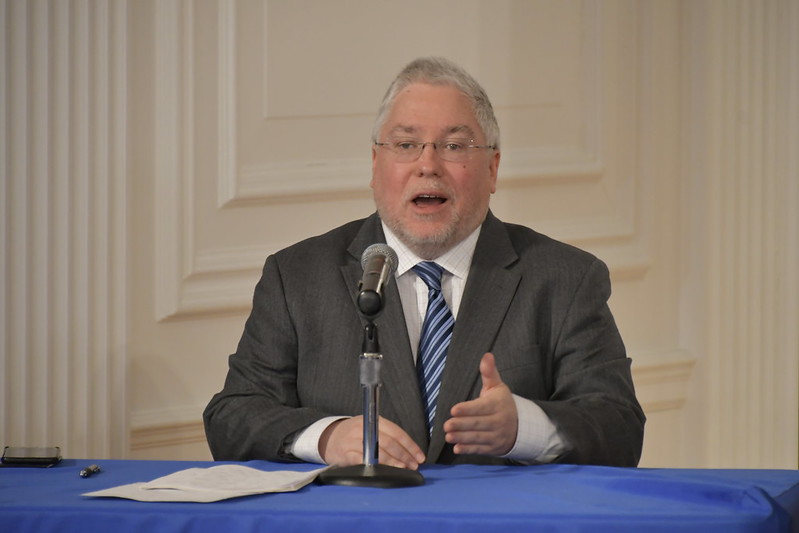
Attorney General Patrick Morrisey and others have filed suit over a provision in the most recent covid relief package restricting states from taking millions of federal dollars while also cutting taxes.
The lawsuit argues federal treasury officials cannot force states to relinquish control of their taxing authority in return for much-needed economic aid related to covid-19.
“Never before has the federal government attempted such a complete takeover of state finances,” Morrisey stated.
“We cannot stand for such overreach. The Constitution envisions co-sovereign states, not a federal government that forces state legislatures to forfeit one of their core constitutional functions in exchange for a large check equal to approximately 25 percent of their annual respective general budgets.”
The attorneys general filed the lawsuit against the U.S. Department of Treasury, Secretary Yellen and the department’s Acting Inspector General Richard K. Delmar, who could be responsible for seeking any potential claw back of federal funds. The lawsuit was filed in U.S. District Court for the Northern District of Alabama.
The attorneys general from 21 states sent a letter March 16 to U.S. Treasury Secretary Janet Yellen arguing that, absent an interpretation by her department, the legislation almost certainly is an unconstitutional intrusion on state sovereignty. Treasury interprets the federal law and makes the rules for recipients of the federal relief to follow.
In response, Yellen called restrictions in the enacted stimulus “reasonable conditions” on how states may use federal funding for tax cuts. She wrote that Treasury is working on more detailed guidance to address the specific issues raised by the attorneys general.
“Nothing in the Act prevents States from enacting a broad variety of tax cuts,” Yellen wrote in the response letter.
“It simply provides that funding received under the Act may not be used to offset a reduction in net tax revenue resulting from certain changes in state law. If States lower certain taxes but do not use funds under the Act to offset those cuts-for example, by replacing the lost revenue through other means-the limitation in the Act is not implicated.”
The American Rescue Plan includes $350 billion in direct aid to state and city governments. West Virginia is lined up to receive another $1.259 billion.
States and local governments may use the coming federal funding to cover revenue losses and for water, sewer and broadband. The money cannot be used for tax cuts, shoring up pensions, making deposits into rainy day funds or for non-pandemic related expenditures beyond state revenue losses:
“A State or territory shall not use the funds provided under this section or transferred pursuant to section 603(c)(4) to either directly or indirectly offset a reduction in the net tax revenue of such State or territory resulting from a change in law, regulation, or administrative interpretation during the covered period that reduces any tax (by providing for a reduction in a rate, a rebate, a deduction, a credit, or otherwise) or delays the imposition of any tax or tax increase.”

This comes at a moment when Gov. Jim Justice has talked up a big state income tax cut.
Justice criticized the restrictions — blaming U.S. Senator Joe Manchin, D-W.Va. — to both state and national media.
An outline of the governor’s plan estimates initial personal income tax reductions totaling $1,035,650,000 and rebates totaling $52 million for lower-income residents — but also tax increases of $902,600,000 to make up for most of those breaks.
Justice has sometimes described using the fruits of federal relief to establish a reserve “bucket” for just such an occasion. It’s been a few weeks since he described doing so, though.
At his State of the State address — and in comments after that — Justice has talked about the possibility of the federal government forgiving the relief money West Virginia has already allocated toward unemployment, as well ongoing reimbursement for pandemic-related costs.
If those were to occur, Justice has proposed setting aside any “surplus” into a reserve.
So, as the governor describes it, the reserve wouldn’t come directly from federal relief — but it would be built on money flowing to the state as a byproduct of federal relief. There’s one degree of separation.
“My additional rainy day bucket has nothing — and still has nothing in the world — to do with taking CARES money and putting it over here in a rainy day bucket that is for tax relief. Nothing at all. Nothing whatsoever,” Justice said about the idea.
But, the governor said, “It is our right, as other states, to draw down stimulus money that’s been given to us to pay us back for expenditures that we have expended toward covid. If we have just happened to run our states better than other states — that are run by Democrats and out of control — if, in fact, we have done that, should we not have the options to do with those monies whatever we want to do with those monies that will only help West Virginians and help us become better?”
Morrisey, in his comments about the lawsuit against Treasury, said the matter directly affects whether the federal tax mandate will infringe on the state Legislature’s consideration of proposals to eliminate the state’s income tax, specifically regarding how U.S. Treasury officials interpret the word “indirectly” as contained in the provision.
“Our lawsuit is designed to protect West Virginia from federal overreach,” Morrisey said. “This ensures our citizens aren’t stuck with an unforeseen bill from the feds years from now.”