

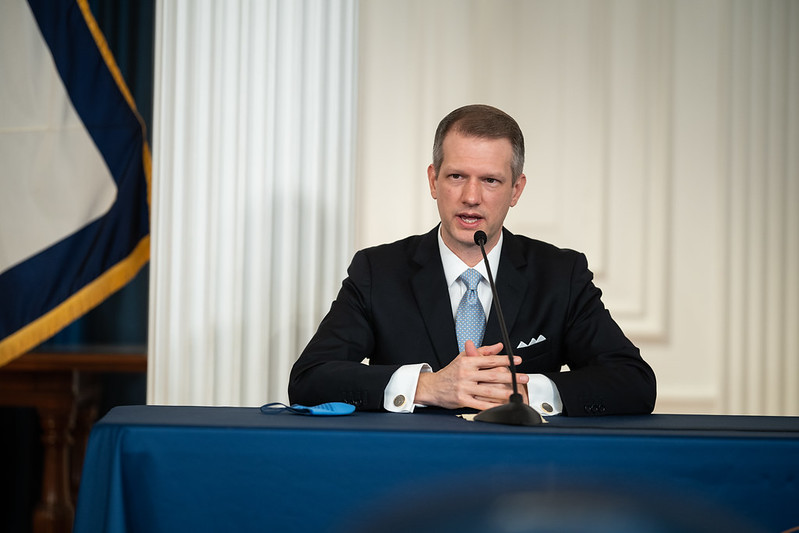
Big financial companies put on notice by West Virginia’s state treasurer are objecting.
The state Treasurer’s Office last month sent letters to six of America’s largest investment companies, warning that they may be ineligible for some West Virginia contracts, alleging that they engage in “boycotts” of fossil fuel companies that remain major aspects of the state’s economy.
The warnings came about after this year’s passage of Senate Bill 262, directing the Treasurer to keep a list of financial institutions that steer clear of investments in fossil fuel companies.
BlackRock Inc., Goldman Sachs, JPMorgan Chase, Morgan Stanley and Wells Fargo, each have responded to say they do not engage in boycotts of fossil fuel companies. Instead, they contend that they provide guidance to investors based on assessing risk.
MetroNews obtained the responses through a Freedom of Information Act request to the state Treasurer. A sixth company, U.S. Bancorp has until Wednesday to respond and has not done so yet.
JP Morgan’s response objected to the State of West Virginia’s proposed intervention in financial markets.
“It is regrettable that West Virginia is cutting itself off from parts of the market and attempting, via government action, to control the decisions made by private businesses,” JP Morgan representatives wrote.
“There are many examples across the country where this kind of state intervention ends poorly, including imposing unnecessary costs and additional expenditure of taxpayer funds.”
Wells Fargo objected that the notice sent last month by the Treasurer’s Office provided no specific examples of boycott activity.
“Complicating Wells Fargo’s response is the fact that the Treasurer’s Office has not shared the criteria it applied to determine inclusion on the restricted financial institution list as compared to other firms,” wrote company representatives.
Wells Fargo went on to question whether it had been placed on the list selectively. Without assessing all banks, Wells Fargo contended, the Treasurer’s office basis may be “at best, unclear and arbitrary.”
“Wells Fargo expects the Treasurer’s Office’s goal is to be comprehensive, fair, and objective in identifying the criteria that will lead to a financial institution’s inclusion on the restricted financial institution list. The Office’s actions to compile that list thus far, however, appear to be inconsistent with that intention,” Wells Fargo wrote.
“Notably, many large national and international banks have similar policies or positions as Wells Fargo. Yet many appear not to have been sent the Treasurer’s Notice, and therefore will not be assessed for placement on the list.”
West Virginia’s new law defines a “boycott” as refusal to deal with a company without “a reasonable business purpose” — particularly when the company seeking financing does business in fossil fuels markets or does business with other companies involved with fossil fuels.
A reasonable business purpose is then defined as promoting the financial success or stability of a financial institution, mitigating risk to a financial institution, complying with legal or regulatory requirements or limiting the liability of a financial institution.
The law indicates the Treasurer may rely on information such as a financial institution’s certification that it is not involved in a boycott of energy companies, publicly available statements or information made by the financial institution or its top representatives or information published by a state or governmental entity.
The potential penalty on the companies is to be considered ineligible for banking contracts with the state. The Treasurer’s Offices manages roughly $18 billion in state government receipts on an annual basis.

“Earlier this year our office proposed, and the Legislature passed, Senate Bill 262 to push back against unfair discrimination against our coal, oil and natural gas industries by the financial sector as part of the so-called ‘environmental, social and governance’ or ‘ESG’ investing movement,” state Treasurer Riley Moore stated when the warning letters first went out.
“We’ve now demonstrated we are serious about enforcing this law.”
Each of the financial firms responding so far has denied boycotting fossil fuel companies. Each then cited the “reasonable business purpose” aspect of the state law to describe guidance to investors based on assessments of trends and risk.
“Let us state categorically at the outset that Morgan Stanley does not boycott energy companies,” wrote representatives of that company. “In fact, Morgan Stanley currently has over a dozen fossil-fuel clients that have a meaningful presence in West Virginia.”
To emphasize that point, Morgan Stanley cited its inclusion on a list of “Dirty Dozen” top financiers of fossil fuels from 2016 to 2021 in a recent report called “Banking on Climate Chaos” by an environmental coalition called Rainforest Action Network. That list also included some firms on warning by the state treasurer, including JP Morgan and Wells Fargo.
Morgan Stanley said it has tailored risk-based approaches to fossil fuel-based energy sectors. And, like the others, Morgan Stanley says those approaches are “reasonable business purposes.”
“If, after having reviewed our response, you have not concluded that we should be removed from the RFI list, we would appreciate the opportunity to come to West Virginia and meet with you to discuss this topic more fully, including a review of the fossil fuel sector in West Virginia,” Morgan Stanley wrote.