

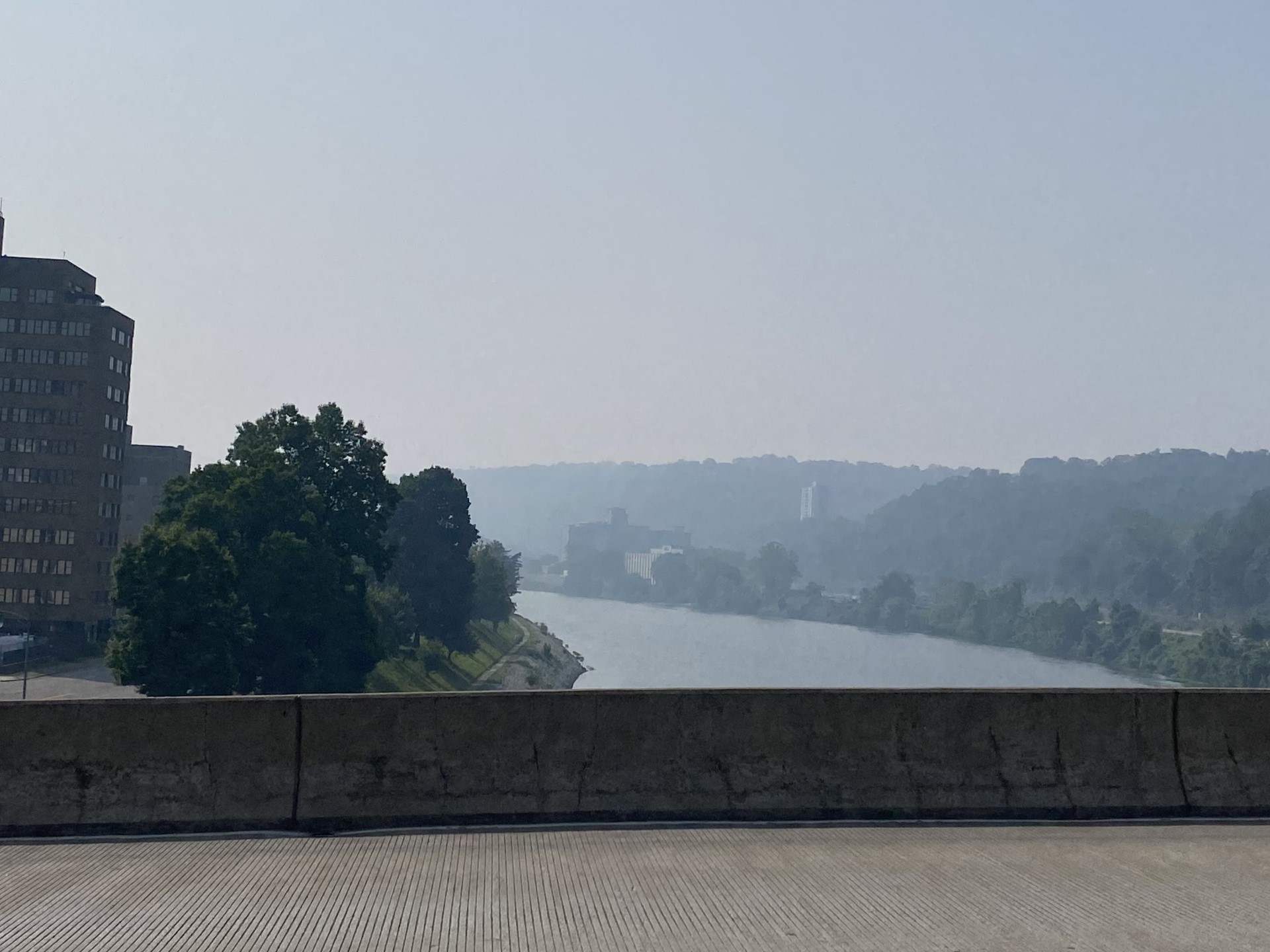


CHARLESTON, W.Va. — West Virginians say it’s slightly more difficult to breathe outside. Smoke from forest fires burning in Canada has made its way to the Mountain State which has resulted in poor air quality.
“I feel it in my chest,” Sam Bayes, of Charleston, told MetroNews. “I gotta keep constantly drinking water.”
Bayes was busy Thursday morning setting up the stage for the Charleston Sternwheel Regatta this Fourth of July weekend. His jobs requires him to be outdoors.
Bayes said it was much easier to be outside Wednesday compared to Thursday.
“The haze seems like it’s closer to the ground today than it was yesterday,” he said. “There’s air moving back it’s like stagnant air with the smoke coming through. You can see it.”
Kanawha County Board of Education member Ric Cavander didn’t notice much of a difference during his morning jog along the Kanawha Boulevard.
“I don’t feel anything. I feel fine, but luckily, I don’t have any respiratory issues,” Cavander said.
Exposure to particulate matter from forest fires can cause health issues, especially for those with chronic lung disease, COPD, heart disease, and asthma, as well as current and former smokers and pregnant women. @CDCEnvironment
Learn more: https://t.co/OwUjR4dubD pic.twitter.com/8FQLaJMf0T
— WV DH, DHF, and DoHS (@WV_DH_DHF_DoHS) June 29, 2023
The state Department of Enviornmental Protection has placed the entire state of West Virginia under an Air Quality Advisory through 12 a.m. Friday.
Air Quality Index scores for most of West Virginia were in the 151-200 range Thursday, which is considered unhealthy.

State Health Officer Dr. Matthew Christiansen said on Thursday’s MetroNews “Talkline” some residents could may experience health effects, but he’s mostly concerned about sensitive groups.
“The smoke consists of particulate matter which can exacerbate and make worse many chronic health issues especially for individuals at high risk like kids, the elderly population, pregnant woman, people with existing heart disease and lung disease need to be careful when they’re outside,” he said.
Christiansen said people who don’t have underlying health conditions could still develop symptoms if they’re outside for too long.
“It can effect all of us, even those of us who are blessed with good health and can cause things like coughing, congestion, runny nose, eye irritation, throat irritation, even wheezing or shortness of breath,” he said.
The effects of air pollution can be minimized by avoiding outdoor exercise or strenuous activity, staying inside with the windows shut and air conditioning on and by wearing N-95 masks.
If you do have to be outside, N-95 masks can reduce your exposure somewhat to that particulate matter,” Christiansen said. “Some of the cheaper masks that you get at the store that are not well-fitting don’t do as great of a job.”
There are currently over 250 wildfires burning out of control in Canada. More than 120 million Americans from the East Coast to the Midwest are under air quality alerts.