

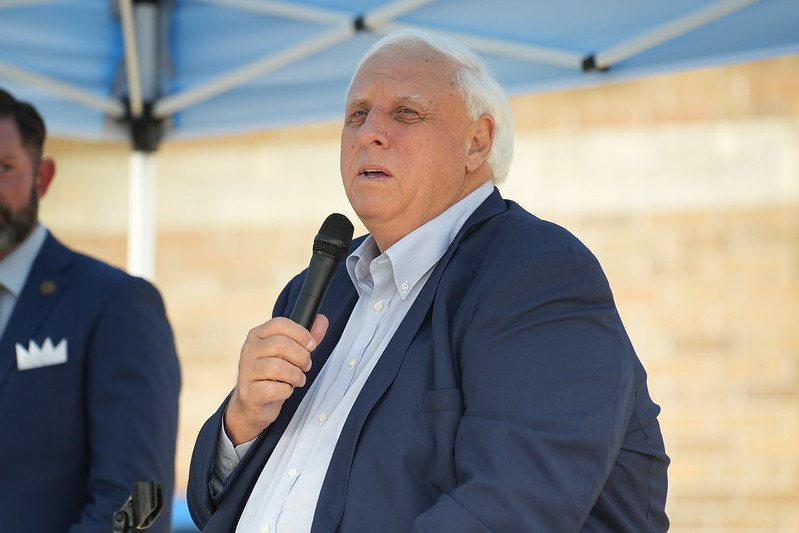
Gov. Jim Justice says he would be glad to provide sworn testimony in a case about the conditions in West Virginia’s corrections system, but he doesn’t have much to add.
Justice declared an emergency over staffing in the state’s jails more than a year ago, and he has been publicly confronted by the mother of Quantez Burks, who was beaten to death last year after spending less than 24 hours in the Southern Regional Jail.
Lawyers in a class action lawsuit want to depose the governor and his chief of staff about their priorities for the jails, but their lawyers have asked to halt those talks.

“I would welcome anyone at any time to swear me in to doing sworn testimony,” Justice said when asked by MetroNews today about the possible deposition. “But we don’t want to do something that’s an absolute, teetotal waste of time over something that I don’t know anything about.
“There’s no point in going in and sitting there and letting someone grandstand, some lawyer, so they can get their name in the newspaper to basically haul the governor in there to have the governor say ‘I don’t know anything about this, and I can’t help you with anything. I can say that right now. If that be the case, and that’s what we can do to make people feel better, then I’ll be glad to do it.”
U.S. Magistrate Judge Omar Aboulhosn this week issued a stay on subpoenas to depose Justice and chief of staff Brian Abraham in the jails case. Following a hearing, Aboulhosn wrote, the parties were unable to resolve a dispute over the value of the testimony and more time is necessary to work out a resolution.
The lawsuit filed in September, 2022, is a class action against against Southern Regional Jail, the West Virginia Division of Corrections and every county commission that pays Southern Regional to house inmates.
Allegations in the suit include inmates sleeping on mats soaked in toilet water, some being forced to sleep on concrete floors, poor air quality because of black mold and denial of nutritious food, running water or a toilet. The most recent battle in federal court has been over whether state officials improperly disposed of records that could have been evidence in the case.
State figures named in the case include retired Homeland Security Secretary Jeff Sandy and Betsy Jividen, former commissioner of the Division of Corrections.
Now the plaintiffs want to hear from Justice and Abraham.
“Both deponents have been identified by the Defendants in this case as having knowledge relevant to the issues alleged by the Plaintiffs. Specifically, Defendants such as Jeff Sandy, testified that for years his department requested of the Governor’s office funding to address pervasive overcrowding, pervasive understaffing, and over two hundred million dollars in deferred maintenance,” the plaintiffs lawyers wrote.
Part of the information sought has to do with the administration’s decisions to cite $28 million in covid-related expenses to the corrections system, draw down that amount in federal CARES Act funding and then send $28 million to a gifts and grants fund controlled by the governor. Of that amount, $10 million eventually went toward funding Marshall University’s new baseball stadium.
Those questions were the topic of a lengthy and contentious state Senate Finance hearing earlier this year. The chairman of that committee, Senator Eric Tarr, followed up by sending a letter of inquiry to the Office of Inspector General for U.S. Treasury and also sent copies to the West Virginia Ethics Commission and the United States Attorney for the Southern District of West Virginia.

Today, Tarr still said administration officials should provide more insight into the thinking behind the transfers.
“While his claim to ignorance of happenings within his agencies is very believable, given his very limited presence as a governor, he can not claim ignorance to the use of funds pseudo-laundered to his discretionary Gifts, Grants, and Charities Fund. There are pictures of him handing out the oversized check to Marshall for their artificial turf,” Tarr said in response to the administration’s statements.
“Also, he was acutely aware of the Senate Finance Committee’s questions to his Chief Counsel and correspondence with the United States Office of the Inspector General regarding these funds.”

Asked in today’s news briefing to explain the priorities reflected in those transfers, Abraham described the matter as an exaggeration or misunderstanding.
Abraham also said the state aimed other money toward encouraging staffing in the jail system and that the money in the grants fund went to more than just a baseball stadium.
“That’s an allegation in a lawsuit but sadly that’s nothing more than a regurgitation of a story in the Charleston Gazette. The simple fact of the matter is that money that came back in through covid and was redirected to gifts and grants went not only to Marshall but other economic development projects.
“The money would not have done anything regarding the salary items at the regional jails or at the prisons because that was one-time money. It would have done nothing for the budget and tens and tens of millions have already been allocated for deferred maintenance to our regional jails. Also, during covid, we put tens of millions of CARES money to into our regional jails to make up for medical contracts.”
Tarr pointed out that the specifics in the transfer were not just in a newspaper article but were the subject of a hearing before Senate Finance, with the administration’s general counsel going over the transfers.
Abraham continued, “That was a story in the Gazette that, sadly, that lawyer took as true and included in that lawsuit. I’m sure as the evidence portrays out in that case, everyone’s going to finally see what the truth is, but we’re going to have to wait until we get our day in court for that.”
Although current and former state officials have testified, lawyers for Abraham and the governor say they should not specifically have a day in court.
Their lawyers filed a motion to quash the subpoenas that would require depositions by the two.
“The chilling effect on the deliberative process of a decision-maker is clear,” according to the filing for Justice and Abraham. “If a Governor or his Chief of Staff knows they can be called to testify regarding any decision tangentially related to any civil lawsuit, they will be far less likely to engage in a robust consideration of the available options or render difficult decisions.”