

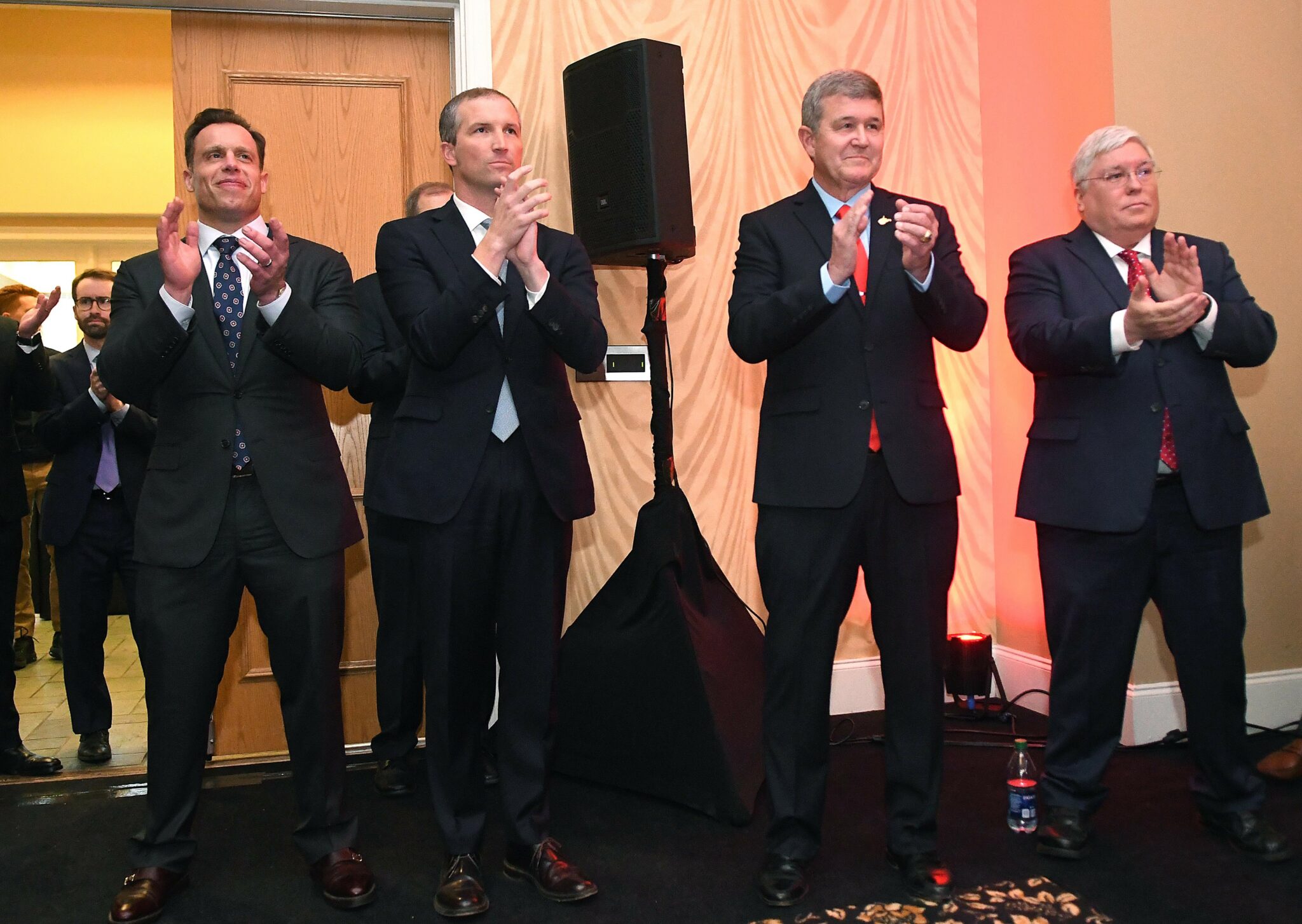
Patrick Morrisey’s critics have sometimes taken shots at his New Jersey upbringing and his early career as a D.C. lobbyist.
This electoral cycle, Morrisey is reversing fire in a way by saying he’s “not a product of political royalty.” It’s part of a broader theme where Morrisey, a three-term attorney general, says “the media and political elites are against me.”
Most obviously, this critique is aimed at former House Judiciary Chairman Moore Capito, son of Senator Shelley Moore Capito and grandson of former Gov. Arch Moore. Morrisey and his campaign have sometimes called his rival in the governor’s race “Kid Capito.”
It also may be pointed toward businessman Chris Miller, son of Congresswoman Carol Miller and grandson of longtime Ohio Congressman Samuel Devine.
And he may be jabbing Secretary of State Mac Warner, whose brothers have assumed a range of positions in West Virginia politics.
Kasey Warner was U.S. Attorney for the Southern District of West Virginia. Monty Warner ran for governor in 2004. George “Buffy” Warner, who died in 2004, had been a state senator. Kris Warner, a former state GOP chairman, is running to assume the Secretary of State position that Mac has held for two terms.
The dynamic arose early in the most recent gubernatorial debate hosted by the Raleigh County Republican Executive Committee.

Morrisey was asked about his “political royalty” comments and shared that his father worked for U.S. Steel and his mother was a Veterans Affairs nurse. He said many West Virginians can relate to that kind of upbringing.
“I’m the one person running who comes to this from the perspective of a lot of strong experiences advancing conservative values, but I wasn’t handed anything. I had to work hard,” Morrisey said at the debate. “Growing up, I was the first person who ever made it through to college and made it to law school. I know what it’s like to have a work ethic and not have things handed to me.
“I am very different from the candidates in this race because I don’t have another family member on the ballot, and I’m not someone who was handed something or put on third base expecting to be delivered to home.”
Miller, who runs businesses that include the family’s auto dealerships, was the first to respond. He said that when he was around 10, he asked for a pair of Air Jordans. When he told his father they cost $125, Miller recalled, “he told me to get a job.”

After that, Miller said he performed manual labor on a farm, erecting barbed wire fences, cutting down trees, running heavy equipment — “I’m talking about real work. If that’s third base, I don’t know what you guys are talking about. It sounds silly to me.”
Capito responded that West Virginians are all about family and community. In some of his appearances on the campaign trail, he has spoken more about the influence of his grandfather on his life than about his mother’s prominent political role.
During a forum last fall in Morgantown, Capito told a story about his grandfather, Arch, who served three non-consecutive terms as governor, served six terms in Congress and ran for U.S. Senate.
“He wrote me letters when I was young, and he wrote me one one time where he said he had found in his life that successful people were good listeners. And I don’t know if he was giving me a subtle hint or life advice,” said Capito, who described driving many miles across the state to listen to residents.
The question of “political royalty” didn’t land on Warner during the debate in Raleigh County. The flow had moved on before he could respond. In a later telephone interview, Warner said the “political royalty” term doesn’t apply to his family’s record of public service, but that he believes the knock was meant to include him.
Warner said his grandfathers were a coal miner and a railroad worker, and his father George “Brud” Warner — who was involved with local politics in the Kanawha Valley as a justice of the peace, magistrate and state delegate — was a small business entrepreneur who started six businesses while raising six sons.
He noted that his wife, Debbie, is serving in the House of Delegates but is not running for re-election because she is focused on supporting his campaign for governor.
“We don’t come from political royalty,” Warner said, “but Morrisey’s shot about somebody on the ballot, I think, was trying to make an attack on me. And the other person on the ballot would be my brother Kris, and my brother Kris was earning his stripes as the chairman of the Republican Party in the early 2000s when Patrick Morrisey was losing a congressional race in New Jersey.”
Warner said he has encouraged people who are qualified and eligible to run, including his brother.
“My family was raised to serve,” he said. “We see it with so many of us serving in the military, so many of us serving in the public arena, in community activities. That’s just how we were raised, so there’s nothing wrong with public service or community service.”
At the debate in Raleigh County last week, all of the themes of family legacy, public service, community roots and outsider status sloshed together in an exchange that was, at first, about how Morrisey dealt with litigation that resulted from West Virginia’s opioid addiction crisis.
After Capito criticized Morrisey for his handling of opioid settlement dollars and said the state’s share could have been more, Morrisey responded, “Quite frankly Moore, I didn’t listen to your mom who recommended I settle on the cheap.”
Miller piped up and said, “You must not be from West Virginia — because people from West Virginia know you don’t talk about somebody’s momma.”
Warner then jabbed Morrisey’s professional biography as a D.C. lobbyist for the pharmaceutical industry. “Patrick Morrisey has been deceiving West Virginians,” he said of his counterpart on the state’s Board of Public Works. “Folks that’s not the way we do it here in West Virginia.”