

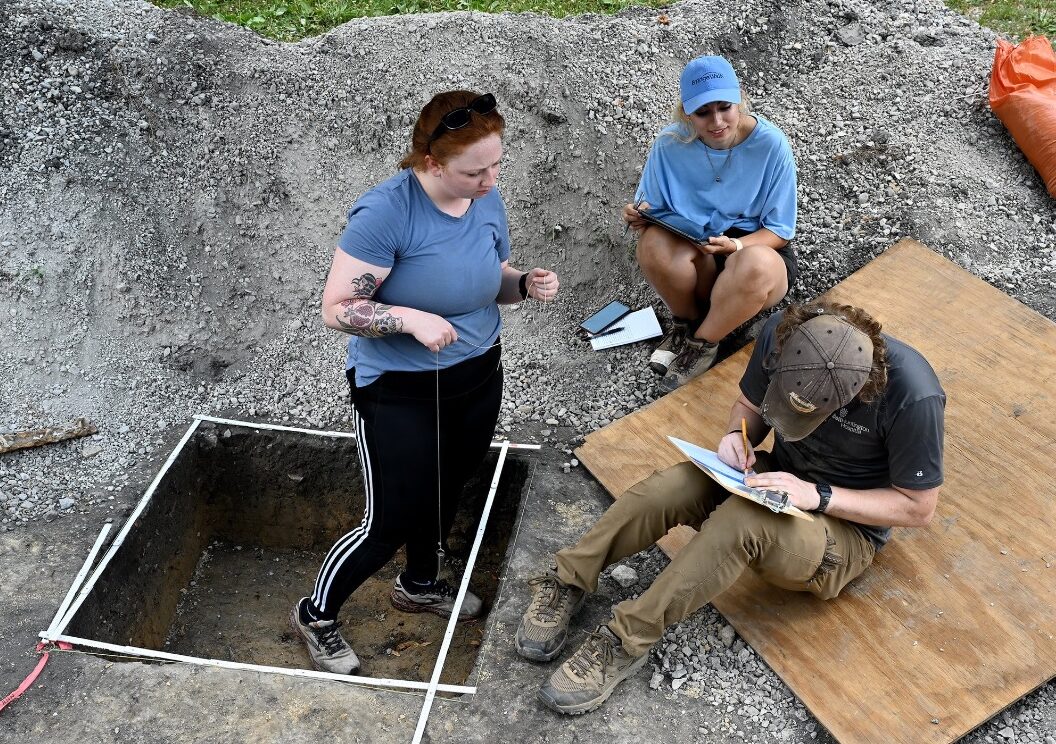
MALDEN, W.Va. — University students continue to uncover layers of the past at a local archeological dig site just outside of Charleston– from finding 1800 salt industry-era artifacts, to archaic pieces dating back long before.
Students and staff from West Virginia State University’s Archeological Field School as well as university students from neighboring states finished up another four-week long archeological dig this past week at the historic Hale House in Malden.
After last year’s dig the team conducted at the site produced a number of 19th century artifacts as well as prehistoric ones, this most recent project at the location uncovered loads more of the same.
WVSU Associate Professor of History and Field School Director Dr. Michael Workman told MetroNews the most impressive finds are the archaic pieces they found, which date back even further than 1,000 B.C.
One of those extremely old pieces they found was an archaic period drill that Workman said was most likely used by Native Americans who had once roamed the land in the area.
“Probably used by the Native Americans who were here, this was probably used as a camp, because the salt licks just down below attracted game and it would be a great place to hunt,” said Workman.
A special celebration took place today to showcase the work of West Virginia State University students taking part in an archeology field school on the grounds of the historic Hale House in Malden. The students showed off some of the artifacts they have discovered. Go State! pic.twitter.com/WKHAwstiyq
— West Virginia State University (@WVStateU) July 11, 2024
However, Workman said the more recent layer of history the team uncovered at the site proved to also produce many unique finds.
He said the prominent businessman, political leader, industrial developer and salt maker John Hale had probably occupied the historic home on the site during the 1840s and 1850s. Workman said the team uncovered ceramics, glass, iron among other artifacts mostly likely used during the time Hale was there as well as other occupants of the home who had lived there prior to or after Hale.
Workman said these 19th century artifacts, while unique finds, were more of what they had gone into the project expecting to dig up.
“Especially these wrought iron nails made out of a type of iron that was hammered, a hammered iron that was very common back during the 19th century, a lot of window glass and ceramics, so those were indicators that, if not Hale, other people of the 19th century were here,” said Workman.
One of the findings they uncovered within this past four weeks of digging was an 1853 gold dollar coin.
Miranda Hummer is an art and archeology major at Hood College in Frederick, Maryland who has been a part of the field team at the most recent session of digging. She said uncovering the gold coin was definitely a favorite find for her during the four-week project as it told a lot of history.
“I think they said it was minted in Philly, I’m pretty sure, and that was my favorite thing so far, it was in such good condition, it was so cool,” Hummer told MetroNews.
But, overall, Hummer said she was really excited to be a part of the project.
“It has been a dream, I’m West Virginia born and raised, my whole family is, and I want to do my career in West Virginia in Appalachia, so this was my dream field school for me,” she said.
Hummer said growing up in Martinsburg and having a love of history, she has gotten to combine her passion for the Mountain State, its history and now archeology all into one dream and future goal to keep doing what she’s doing.
“I want to be able to do a lot of different digs and a lot of different research in West Virginia specifically, pretty much all eras, honestly, I just love West Virginia, if it happened in West Virginia I want to know about it,” said Hummer.
Workman said they have had a total of eight students working on the project this time around. He said they have worked out in the over 90 degree heat for much of this session, digging unit by unit.
Workman said despite the rough, and very hot working conditions this summer, it has been quite an exciting opportunity for the students.
“Tell you what, they get excited, they really do get excited when they find something that someone else may have had in their hands hundreds of years ago, that’s particularly true for the prehistoric artifacts,” he said.
Workman said these artifacts they have dug up now belongs to WVSU, but they will be kept at the site to be examined and analyzed until space is acquired on campus to store them.
He said this particular archeological dig session had help being made possible through a grant from the Greater Kanawha Valley Foundation.
Workman said they may dig more at the site next summer.