


Higher Education Chancellor Sarah Armstrong Tucker told lawmakers that West Virginia efforts to stabilize financial aid for students in response to a botched federal rollout has worked, but she remains concerned about the possibility of federal turbulence still ahead.

Tucker spoke Sunday afternoon before the Legislative Oversight Commission on Education Accountability.
The Free Application for Federal Student Aid, commonly called FAFSA was rocked by frustrating delays and technical problems stemming from the rollout of a redesigned form intended to ask fewer questions and include more automated features.
Parents and students across the nation reported trouble completing the application, resulting in frustrations that discouraged many from completing the process. Many colleges, in turn, were delayed in assessing and completing financial aid packages.
Gov. Jim Justice this past spring declared a state of emergency for higher education. At the time, the governor described a 40% decline in FAFSA completion for West Virginia high school students.
The declaration helped students in West Virginia to unlock higher education benefits through the state, intended to close the gap while federal aid was in doubt.
West Virginia students who applied and qualified for West Virginia’s Promise scholarship by Sept.1 were qualified to receive an award of up to $5,500 for the current academic year. If a student completed last year’s FAFSA and qualifies for the need-based higher education grant, Tucker said, they were eligible for the award of up to $3,400 for the fall semester.
State lawmakers approved $83 million for higher education — including $51 million for grants to help students pay tuition — during a special session in late May.
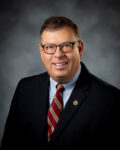
“Has our response in May been sufficient to the demand you’re experiencing?” state Senator Mike Oliverio, R-Monongalia, asked Tucker.
“Your response in May was incredible, and I don’t say that very often about anything. I mean, what you all did to try to make our student whole I appreciated it so much — and our students appreciated it so much. Not in many other states, really any other states, went to the length that you all went to make sure our students were whole.”
The steps taken by the state helped support students with financial needs for higher education, Tucker told lawmakers on Sunday afternoon. But frustration over the federal financial aid problems remains clear.
“We have closed that gap significantly, but we are still over 6,000 students behind in filling out the FAFSA for this year,” Tucker said.
Tucker said about 43,540 students have been awarded the higher education grant and the Promise Scholarship because of the state actions to try to help. The prior year’s number was 31,867 students. “So we have far more students who are receiving the award,” Tucker said, acknowledging that only a little more than 40 percent of students usually claim those financial awards for in-state college expenses.
Tucker said the state has a marketing program going on right now to try to encourage students to fill out federal financial aid applications.
But she is also worried about potential hiccups still to come at the federal level.
It’s not an encouraging sign, she said, that the U.S. Department of Education has committed to fully launching the FAFSA by Dec. 1 — a couple of months later than Tucker considers ideal.
“They are shooting for December 1st. And so my concern here is that any way you slice it we’re gonna have an administration change in D.C. That’s just what’s gonna happen,” she said.
“And one of the things that happened with this FAFSA rollout was that nobody was paying enough attention to the sender who was trying to build this form. So as people leave, are starting to leave now and may not get hired — the higher leadership — until January, February, what happens to the FAFSA? Who’s minding the shop to make sure it actually comes out December 1st. I have a lot of questions about that.”

Delegate Joe Statler, R-Monongalia, wanted to know about potential problems with federal financial aid in the coming months. “What’s the worst-case scenario for universities and students in West Virginia,” Statler asked.
Tucker responded that the worst possibility would be “that it rolls out the same way it rolled out this year.”