

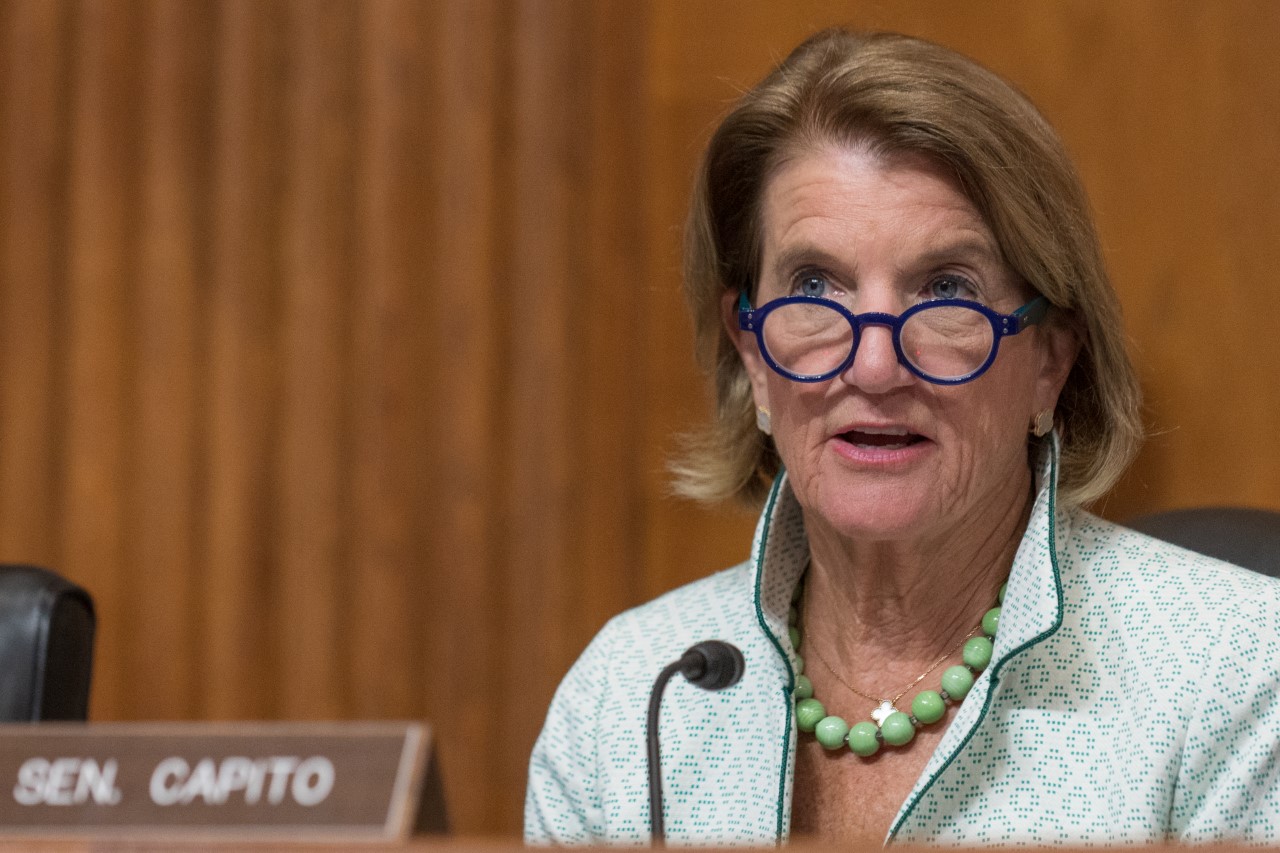
A Trump administration directive of a broad spending freeze has been halted, and Senator Shelley Moore Capito says the situation illustrates an emerging conflict between the executive and legislative branches over the constitutional power of appropriation.
“The Congress has the power of the purse to appropriate and to spend the money, and we need to retain that power,” Capito, R-W.Va., said during a briefing in response to a MetroNews question.
“And we need to work with the administration to make sure we’re moving in the same direction, or we’re going to end up in the Supreme Court debating the different constitutional spending or appropriating powers between the executive and the legislative, and we don’t need to be fighting we’re all on the same team.”
A directive issued this week by the White House Office of Management and Budget had widespread implications over hundreds of millions of dollars in grants flowing to states. It said federal agencies “must temporarily pause all activities related to obligation or disbursement of all Federal financial assistance.”
Federal judges halted the freeze, at least temporarily, and the White House said it was withdrawing the memorandum — but not the freeze itself or the review of agency spending.
The administration had said the order would not have affected federal dollars flowing to individuals — like Social Security or Medicare. But it could have affected all kinds of grants and loans. Even Meals on Wheels expressed concern about the freeze and its effects on food delivery for seniors.
Capito, a member of the U.S. Senate Committee on Appropriations, has played a major role in steering millions of dollars in grants to West Virginia.
In a briefing with West Virginia reporters, Capito volunteered that she has been concerned about the freeze and said her office has received a lot of questions from organizations and the public. Many of the questions from reporters focused on the freeze.
“We heard from a lot of people from West Virginia, very uncertain as to what this means, and in terms of nonprofits, educational institutions, the state, et cetera,” Capito said in her introductory remarks.
“Right now we are operating under the assumption that the OMB memo has been withdrawn and that money is still moving out.”
The U.S. Constitution assigns the power of the purse to Congress. The president’s job is to “take care” that these laws are “faithfully executed.”
“There is a big question here, I think even constitutionally, as to whether he can do this in certain instances,” Capito said in response to a question by Steven Allen Adams of the Ogden Newspapers.
“I think if you look at what the money that has been appropriated by the Congress — the Congress has the power of the purse and the appropriation power — is he usurping the power?”
The senator made reference to the Impoundment Act, which was put into law in 1974 to require the president to report promptly to the Congress all withholdings of budget authority and to abide by the outcome of the congressional impoundment review process.
“Is he impounding those funds? And is he permitted to do that as the executive? And I think that’s a well grounded debate, and personally, I think for the separation of powers that we need as a Congress to remain hold of the purse strings as we as we move forward,” Capito said.
“He can set the policies and have all that. We’re the ones who are the funders. And so we have to, I think, retain that power.”
The original directive said “Financial assistance should be dedicated to advancing Administration priorities, focusing taxpayer dollars to advance a stronger and safer America, eliminating the financial burden of inflation for citizens, unleashing American energy and manufacturing, ending ‘wokeness’ and the weaponization of government, promoting efficiency in government, and Making America Healthy Again.
“The use of Federal resources to advance Marxist equity, transgenderism, and green new deal social engineering policies is a waste of taxpayer dollars that does not improve the day-to-day lives of those we serve.”
Capito said entities that could be affected by the directive would benefit from more specific definition of many of those terms.
“Well, I do believe the administration does need to be much more definitive. That’s where you see the confusion and concern. I don’t blame people for being concerned. I mean, we have a list in my office now of all of the organizations that in all my offices have been we’ve been contacted by, and it’s extensive,” she said.
“And when you look through the list, whether it’s a Meals on Wheels, whether it’s a child advocate center, whether it’s a some of our heritage programs, you know, it’s all across the board.”
She expressed hope that additional time will allow more certainty.
“You can’t just throw this out there and throw everybody into a panic. We need to work together here. If there are certain areas that the administration doesn’t believe fulfill the missions that the President believes he was elected on, then you need to work with Congress, but we’re gonna have some disagreements there. There’s no doubt.”