

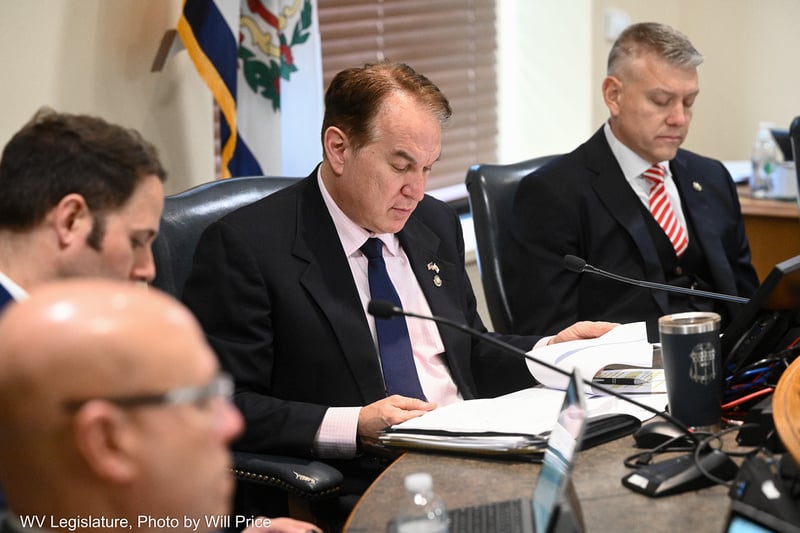
The state Senate will vote on a statewide ban on camping in public places. The ban is meant to address homeless populations, but some senators said it could also be used to deal with mass protests.
 “In fact, this is not a bill about the homeless population. This also would be applicable to some of those violent pro Hamas demonstrations in New York, where you see the camping outside,” said Senate Judiciary Chairman Mike Stuart, R-Kanawha.
“You see the applicability of something like this, right, to be able to say, ‘Listen, you’re just not allowed to go out there and camp and cause destruction and burn fires in a city and violently protest what had happened in Israel.'”

Senator Tom Willis, R-Berkeley, later agreed with that assessment.
“I think it’s a useful and necessary tool to address some of the situations that we’ve seen sweeping across our nation, and we can preemptively prepare for them here in the state of West Virginia, for instance, the Hamas hostile campus takeovers, the cell block Seattle situation a few years ago where they literally took over parts of the city and law enforcement was scared to go in,” Willis said.
“It’s a tool to protect small businesses. You’ve seen how businesses are shutting down across the board in cities like San Francisco, and this gives a tool to our government officials to counteract some of that.”
The Senate Judiciary Committee debated the bill for about two hours before advancing it to the full body. The bill has already passed the House of Delegates, but it has now been amended so the two chambers would have to agree on a final version.
House Bill 2382 seeks to establish guidelines and consequences for unauthorized camping and storage on public lands in West Virginia. It does not necessarily ban sleeping on public property.
The bill describes maintaining public spaces by restricting those activities in instances where they interfere with public use or create health and safety risks.
Penalties for violations range from warnings to fines of up to $500 and potential jail time of up to 30 days in jail, with considerations for offering alternative shelter.
Members of Senate Judiciary adopted an amendment proposed by Senator Eric Tarr, R-Putnam, to offer transportation options to areas with excess capacity for services to those experiencing homelessness, a need for addiction services or a need for mental health services as an alternative to punishment.
The homelessness issue has been a focal point for several local governments, including Morgantown, Clarksburg, Princeton and Bluefield.
Mark Phillips, president and chief executive of Catholic Charities West Virginia, said he appreciates an addition to the bill that gives municipalities additional control over providing exempt areas for homeless people.
But he said that in some areas, Morgantown for example, shelters are full. So people might wind up being referred from shelter to shelter, finding nothing available, “so individuals would then be forced to toward the fine or toward imprisonment. After they were let out of prison, they’d just be in the same situation they were previously.”
His concern, he said, is how the bill would work in practice.
“We do absolutely support police moving individuals toward shelter. We think police and social service agencies working together to counsel individuals toward housing can be really effective, but there are lots of places in West Virginia where it’s not possible,” Phillips told senators.
He added, “Individuals who are experiencing homelessness, who end up in the prison system, just are in worse shape when they come out.”

Senator Patricia Rucker, R-Jefferson, questioned the punitive aspects of the bill, noting that a second offense results in a possible $200 fine.
“We’re saying for second offense — you know you’ve been caught twice — there’ll be a fine. It could be $5, but we’re asking folks who do not have enough money for a home or car or basic needs to come up with money in order to be able to get away the second time.”
Rucker voted no on the bill.
“Although I understand the intent may be good and positive, I just I don’t agree with putting people in jail because they’re homeless,” she said.

Senator Scott Fuller, R-Wayne, said people who go downtown worry about their surroundings when they encounter homeless encampments.
“Allowing them just to sleep on the streets or on city blocks not only is is not a good look, it scares people,” Fuller said.
“You know, we have to not only take care of the people who are on the street, but we also have to think about those children and parents that are trying to — and the businesspeople, especially — that are trying to conduct a business or take their kids shopping.”