

First Energy Corp., one of West Virginia’s main power suppliers, has big qualms with a couple of bills flowing through the state Legislature.
First Energy’s Monongahela Power and Potomac Edison serve about 545,000 customers in 40 West Virginia counties.
One is a bill that passed out of the state Senate last week. Senate Bill 505, “Ensuring Reliable and Affordable Electricity Act,” includes guidelines for utilities seeking rate adjustments, particularly when they’re adding or removing generation and transmission assets. The focus is on their impact on grid reliability during peak demand.
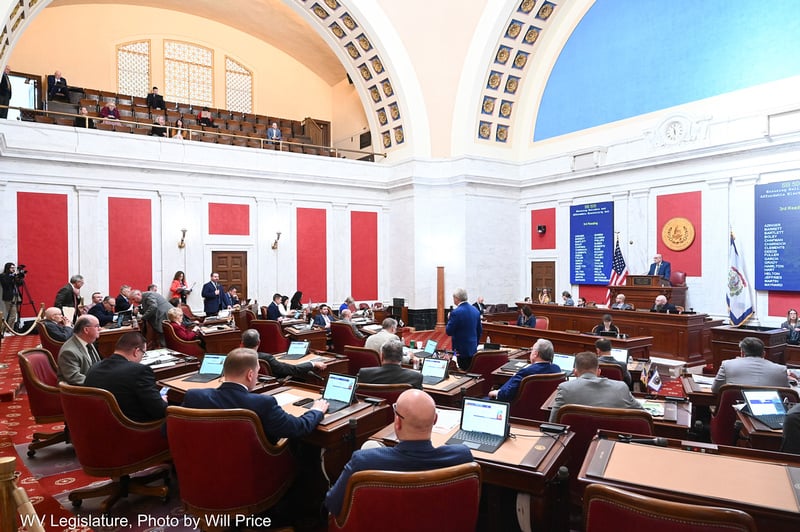
Another is HB 2014, a bill backed by the governor that introduces a Certified Microgrid Program and a High Impact Data Center Program for West Virginia, aiming to attract and support these industries. That bill was reviewed by the House Energy committee last week and this week will be considered by all of the delegates.
Potential effects on ‘Mamaw’s’ power bill
For the first of those bills, SB505, utilities would need to provide detailed evaluations of asset capabilities, and the PSC would be mandated to make explicit findings on whether the requirements are met, potentially disallowing cost recovery for assets considered unreliable.
Supporters have characterized the measure as ensuring power system reliability is a key factor when regulators determine if utility costs are fair and reasonable for ratepayers.
“This, by no means stops them from buying power off the grid, but what it does is — you hear the term a lot this session about Mamaw,” Senate Energy Chairman Chris Rose, R-Monongalia, said last week.
“This prevents Mamaw from paying for the cost of that plan, sitting there idle, or even only running at 30% due to the wear and tear and maintenance that occurs.”
Details with TJ: Senate Bill 505 Moves to House; Could Raise Mamaw’s Power Bill
First Energy Corp. sees it differently. The power company’s statement did not make reference to Mamaw, but suggested the bill would more likely cause her bills to rise.
“We strongly oppose Senate Bill 505, which represents a dramatic and unprecedented shift in utility regulation. If enacted, West Virginia would become the only state in the country to adopt such a burdensome and punitive framework,” Will Boye, senior communications representative, said on behalf of the company.
“This bill would significantly increase the complexity and cost of utility rate cases, ultimately driving up electric bills for hardworking West Virginians.”
In the power company’s view, the latest version of the bill would effectively block the development of new, utility-owned generation by imposing financial barriers that make future investments impossible.
“Without the ability to build new generation to meet growing customer demand — including from industries like manufacturing and data centers — West Virginia risks losing thousands of jobs tied to plant construction and long-term operations,” Boye said.
“Even worse, customers would bear the brunt of higher energy prices over time as utilities are forced to rely more heavily on purchased power and volatile PJM capacity and energy markets.”
West Virginia’s other big electric utility, American Electric Power, has also expressed concern about this bill.
“If this is the path the legislature chooses, we will align with the state’s policy, but this change could lead to higher electricity bills for our customers,” said Aaron Walker, president and chief operating officer for AEP’s Appalachian Power.
Data centers and microgrids
First Energy is also also deeply concerned about House Bill 2014, “which includes provisions that would add uncertainty and delay to long-term generation planning, threatening reliability and economic growth,” Boye said.
Power companies serving West Virginia have focused concern on the last few provisions of the 30-page bill, mandating the Public Service Commission to establish capacity addition schedules for utilities, prioritizing in-state coal and natural gas.
That part of the bill also emphasizes maintaining a minimum coal supply for grid resilience and restricts the use of automatic fuel adjustment clauses that cause net rate increases.
Appalachian Power vice present for regulatory and finance, John Scalzo, testified before the House Energy Committee last week.
“So couple different components, but I’d say there’s two components of this bill. There’s there’s a data center component, and then there’s a section in the back,” Scalzo told delegates.
“So on the data center component, we think we have the ability to serve these, bringing more customers on to our system has potential to actually lower customer rates.”
But on the other piece of the bill, Scalzo said, “that seems in our minds, is really not linked to the bill.”
He pointed to specific phrasing that “shall require the utilities to maintain their generating units and fuel inventories amount in a manner to allow them to be able to see us achieve a 69% capacity factor.”
That could result in unintended consequences, he said.
“Our concern with that is, it says you have to maintain your units. We already do that, and you have to maintain coal inventories to run at a 69% capacity factor. What that means for us, the way we’re interpreting it, to run on a 69% capacity factor on annual basis, we need about 15 million tons of coal.
“If we only run at a 40% capacity factor, because that’s what the market dictates, what the next section says, I’ve purchased 6 million tons of coal that I don’t need under that scenario. And so I only have a limited amount of space that I can store that, so I’m going to have to burn that off, even if it’s uneconomic, and that’s going to be borne by the ratepayers of West Virginia.”
First Energy will keep working with state representatives on concerns like these, Boye said.
“We’re proud to partner with the state of West Virginia to promote economic development, ensure reliability and keep energy costs as low as possible for families and businesses. That’s why we’ve voiced these concerns directly to lawmakers and will continue working with them to advance thoughtful, forward-looking policies that support long-term investment, protect customers and strengthen West Virginia’s energy future.”