

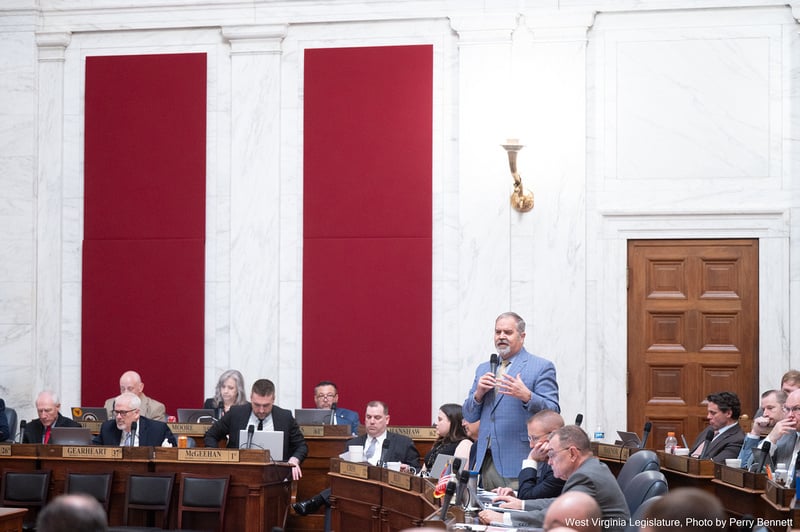
Delegates passed legislation intended to allow developers, particularly data centers, to harness localized, self-sufficient energy systems — with much of the discussion focused on opportunities for the state’s economy.

“You know, we’re looking for an opportunity to compete in West Virginia through an ever changing landscape of technological innovation, but we have to protect our ratepayers, and I think this bill really does that,” said Delegate Clay Riley, R-Harrison, who did most of the speaking in favor of the bill.
The “Power Generation and Consumption Act,” a bill supported by Gov. Patrick Morrisey’s administration, passed the House of Delegates by an 88-12 vote.
With about a week and a half remaining in the regular legislative session, HB 2014 now goes to the state Senate for consideration.
HB 2014 introduces a Certified Microgrid Program and a High Impact Data Center Program for West Virginia, aiming to attract and support these industries.
Much of the legislation is focused on data centers, the physical facilities that house computer structures like servers and storage.
“Data centers represent a significant and growing sector of the economy, generating substantial economic activity, including jobs, infrastructure investments, and technological innovation,” the bill states.
Data centers are enormous energy users, and that is only expected to grow as artificial intelligence and other computing innovations gain traction.
They are prolific in states like neighboring Virginia, but they are also controversial among residents because of their aesthetics and noise. They are not major employers but can contribute significantly to local property taxes.
The bill offers a possibility for data center developers who might want their own energy framework, the microgrids in the bill’s name.
In the microgrid piece of the legislation, the secretary of the Department of Commerce can identify and certify the districts following conclusions that there would be a significant and positive economic impact for the state.
An industrial plant or facility choosing to locate and operate within a certified district must represent a new electric generating load to take advantage of the program’s provisions.
Riley said West Virginia is positioned well to take advantage of the proliferation of data centers.
“We have the energy, the water, the workforce,” Riley said. “Between the resources we have in coal and natural gas, we have powered this country for generations, and we can continue to power it for generations ahead.
“The men and women that work in the coal industry, the 60,000 people who keep the lights on, and the 90,000 people who work in the natural gas industry, those 150,000 West Virginians want to continue to power this country.”
And lastly, he said, “We have grit. We’ll figure it out.”

Delegate Marty Gearheart, R-Mercer, questioned the wisdom of the bill. He said power rates in West Virginia are high because there are not enough users to spread the cost, and he questioned whether this bill offers too much opportunity for big energy users to pick a power option that would not share the cost with everybody else.
Gearheart was not arguing against the development of data centers, but he did question whether the microgrids portion of the bill represents good policy.
“These folks pay their taxes. They pay a lot of taxes. It’s a business that’s worthwhile having,” he said.
But pointing to the development of data centers in other areas of the country, he asked, “The question, I think, is, is, why are data centers able to locate in those areas without microgrids and when they come to West Virginia, it requires a microgrid?”

Delegate Bill Ridenour, R-Jefferson, spoke in favor of the bill and noted that he has observed the proliferation of data centers in neighboring Virginia.
“I think these are going to be a significant economic boon to West Virginia,” Ridenour said.
He continued, “I think this microgrid is a way for us to actually use the energy that we produce, the coal, the natural gas that we have available here, and that we can then use to power these data centers here give jobs to our people.”

Delegate Henry Corby Dillon, R-Wayne, also expressed support for the legislation.
“This is an attempt to innovate. This is an attempt to do and take a new approach to energy policy in the state, and it’s not going to harm our utility companies, it’s not going to harm ratepayers, it’s not going to harm oil and gas, it’s not going to harm coal. I believe that this is a net positive first state,” Dillon said.

Delegate Adam Vance, R-Wyoming, reached the same conclusion.
“I kind of look at this as a way of of helping the southern coalfields,” Vance said. “I think this will actually help our people out down there.”